Likkutei Sichos Vol. 9 – Ha'azinu 1
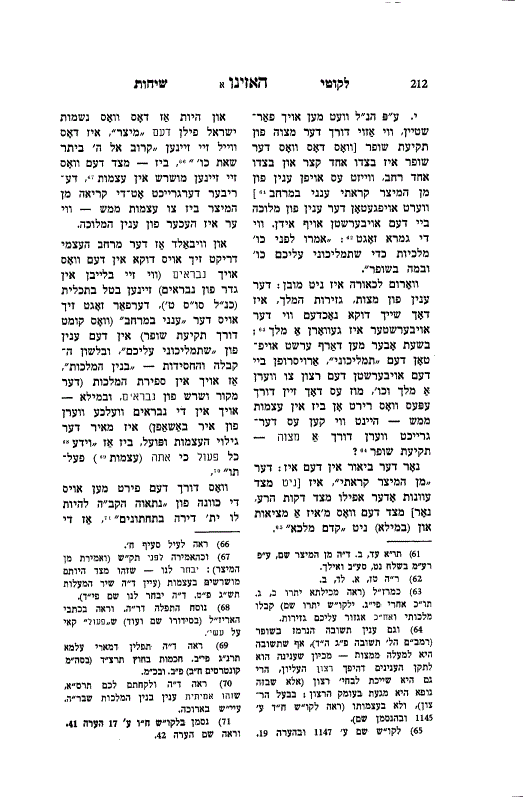
1. It is stated in the Sifrei that Moshe Rabbeinu was "close to the heavens" and "distant from the earth." Therefore, he said, "Give ear, O heavens, and I will speak; and let the earth hear the words of my mouth." For the heavens, he used the term "give ear" (האזנה), which indicates closeness, and for the earth, he used the term "hear" (שמיעה), which indicates distance.
According to the same reasoning, the Sifrei explains why Yeshayahu said it in the reverse order: "Hear, O heavens, and give ear, O earth." For the heavens, he used "hear" and for the earth, "give ear," because Yeshayahu was "distant from the heavens" and "close to the earth."
We need to understand: "Give ear, O heavens, and let the earth hear" is a verse in the Torah, which means that every aspect of it is a teaching for every recipient of the Torah, for every Jew. It implies that one must be "close to the heavens" and "distant from the earth." This is puzzling: if Yeshayahu, the "greatest of the prophets," was distant from the heavens and close to the earth, how is it possible that the level of being close to the heavens and distant from the earth (like Moshe) is demanded from every Jew?
2. On the other hand, if every Jew can reach the level of being "close to the heavens" (and this is due to the aspect of Moshe that is found within him), why did Yeshayahu not achieve this?
The question becomes even stronger: Yeshayahu's prophetic words, "Hear, O heavens, and give ear, O earth," were said as a continuation and in connection to "Give ear, O heavens," which Moshe had said, as the Sifrei explains.
We must therefore say that what Yeshayahu said, "Hear, O heavens," following "Give ear, O heavens," and in continuation to it, contains a higher quality than what Moshe said, "Give ear, O heavens." This is why the Sifrei emphasizes, "Yeshayahu came and supported it," because only after Yeshayahu, through the power of Moshe, approached and reached the level of being "close to the heavens and distant from the earth," could he then attain an even higher elevation — being "distant from the heavens and close to the earth."
Consequently, since "Hear, O heavens, and give ear, O earth" is also a part of the Torah — a teaching — it is understood that this matter is also an instruction for every Jew: that after reaching the level of being "close to the heavens," one should not stop there, but rather use this strength to elevate even higher — to become "close to the earth," etc.
2. It is known that every matter in the Torah has a unique connection to the time in which it is read in the Torah. Therefore, it is understandable that the fulfillment of the two directives in Parshas Ha'azinu (including the directive of "close to the earth, etc.," which is also mentioned in the Sifrei on Parshas Ha'azinu) is particularly suited to the Ten Days of Repentance (or to the four days between Yom Kippur and Sukkos) when this portion is read.
3. This can be understood by prefacing with what is stated in the writings of the Arizal, that "anyone who does not cry during the Ten Days of Repentance, his soul is not complete." The explanation of this in simple terms is: During the Ten Days of Repentance, our sages say, the Almighty is "found" and "close" to every Jew. In the language of Chassidus, this is described as "the closeness of the luminary to the spark." If even at such an elevated and opportune time, a Jew is not aroused to repentance (to the point of crying), it is evidence that "his soul is not complete"; his soul has "become completely distant, etc.," and therefore "it has no awakening to return to the house of its Father."
However, this requires explanation: From the expression "anyone who does not cry, etc., his soul is not complete," it implies that this refers to every Jew, even a completely righteous person. This is why it is also stated about the Arizal: "The Rabbi, of blessed memory, would customarily cry..."
4. On Rosh Hashanah and Yom Kippur. At first glance, it seems that repentance (especially when it involves crying) is for sins and transgressions, from which a completely righteous person is entirely pure. So how is it relevant to demand repentance from a completely righteous person, to the extent that if he does not cry during the Ten Days of Repentance, it is evidence that "his soul is not complete"?!
5. Regarding a beinoni (an intermediate person), one could still explain: It is true that a beinoni is someone who "has never committed a sin and will never commit one." However, since the evil in his left side remains "in its full strength as at birth" and "has not been displaced at all," [especially since he can still have a fleeting evil thought, which he immediately dismisses], it is therefore required of him to engage in repentance for this. If his current state (having evil within him) does not move him to tears during the Ten Days of Repentance, then "his soul is not complete."
Similarly, one could explain even regarding a tzaddik she'eino gamur (an incomplete righteous person) — since he too has not completely eradicated the evil within him (only that it is so minimal that it is "nullified in its minority and considered as nothing").
However, "anyone who does not cry, etc." is a phrase that includes even a completely righteous person (to the extent that it is stated even concerning the Arizal, as mentioned above), and therefore it is not understood: What is the necessity for him to cry during the Ten Days of Repentance?
The fact that even a completely righteous person can be moved to tears of repentance is understandable: Due to the trait of humility and the like, even a completely righteous person can be in a state of "I do not know, etc." regarding his own self-assessment and view himself much lower than he truly is. He might think that he has not fulfilled his role, and therefore — he cries tears of repentance.
However, the question remains: Why should we assume that he must cry? There can be completely righteous individuals who are not mistaken about their state (and on the contrary: "the true path (in service) is that one must know one's essence... and one's true virtues"), and they know their virtues as they truly are — so why should he cry?
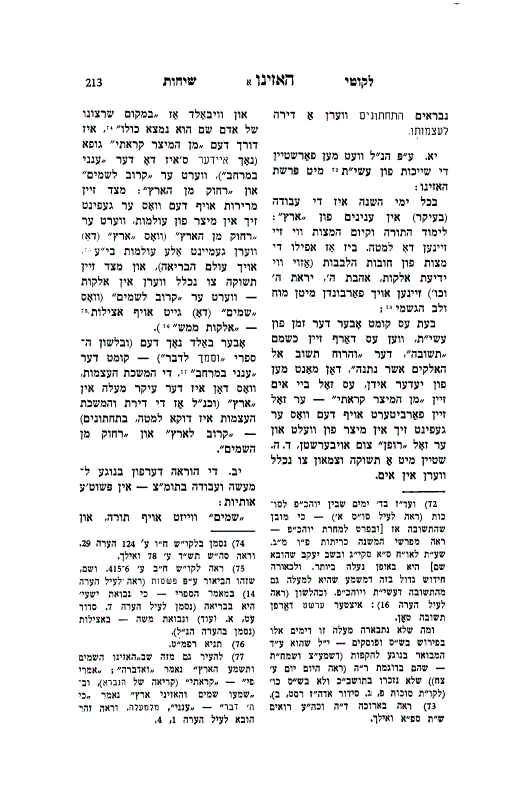
4. The Alter Rebbe, in Likkutei Torah, explains the concept of "one who does not cry on Rosh Hashanah and Yom Kippur, his soul is not complete," stating that this crying does not stem from melancholy, but rather, as it is written about Rabbi Akiva, when he comprehended the secrets of the Torah, "his eyes flowed with tears."
However, we cannot accept that the crying of a completely righteous person during the Ten Days of Repentance is solely of the type of crying that occurred with Rabbi Akiva. For if this were the case, it would imply that the saying "anyone who does not cry, etc." refers to two types of crying, which are completely opposite to each other: (for the righteous) a crying of utmost joy, which comes "due to the soul's attachment"; and (for the majority of the Jewish people, who are not connected to this "great level") a crying of utmost bitterness, which comes due to (sins and) distance from G‑dliness.
And since the language "anyone who does not cry, etc." includes all Jews together, it implies that it is speaking about one type of crying for all Jews.
5. Therefore, it is implied that even for completely righteous individuals, just as for all Jews, there must be crying (also) over their distance from G‑dliness.
The explanation of this is as follows: The essence of teshuvah (repentance) is to return the soul to its source and root — "and the spirit shall return to G‑d who gave it." And since even a completely righteous person, who serves G‑d with awe and great love in delight, does not reach through his service the level of attachment to G‑d with fear and love as it was before his descent into this material world, because "the body cannot endure it" — therefore, this should also evoke in a completely righteous person the concept of teshuvah, to return to the elevated level from before the descent. This distress over the distance, being far from the previous level of attachment, should affect him to the point of crying, meaning to the extent that he cannot bear it.
And with this, it becomes understandable what is stated, "Anyone who does not cry during the Ten Days of Repentance, his soul is not complete," because even the crying of completely righteous individuals, since it comes from the fact that the soul "descended from its place of honor and became physical," is of the same type of crying as that of ordinary Jews.
6. We must understand: This descent and materialization, which is connected to the fact that "the body cannot endure it," is seemingly not dependent on the person himself. For if it were dependent on the choice of the individual, surely the completely righteous person, in his perfection of service and refinement, would have corrected this as well. Thus, it remains difficult: Why should the completely righteous person cry (and do teshuvah) over a "distance" that he did not cause, and for which the rectification does not depend on him?
If the completely righteous person were to think about himself, about his own benefit, one could still explain this in some way: Since being here below, he is still lower than he was before, he is therefore embittered about his state — even though he is not at all guilty in this matter. However, the truth is that a completely righteous person is entirely devoted to fulfilling the higher intention, and the intention is that his soul should be found below in a state of descent and materialization. So why should he be embittered and cry over the descent when he knows this is the higher intention?
One can answer this: The intention in the soul's descent below is not the descent itself, but the ascent that comes through the descent; that is, that the soul should reach an even greater nullification and attachment to G‑dliness than it had before the descent. And since even a completely righteous person is here below a "separate entity," he is "something and not nothing," it turns out that he has not yet fulfilled the intention of his mission — and the fact that he is not fulfilling his role (and is not utterly nullified) should distress him so much that it brings about crying.
7. However, it still remains unexplained: If it were required of a Jew to reach a state of absolute self-nullification, surely he could achieve this; and since he cannot reach it, it seemingly means that this is not his task. This brings up the question again: Why the crying over this?
8. The explanation of this is as follows: Souls, in their essential nature, are G‑dliness. However, this is, so to speak, how G‑dliness "becomes" a creation (even later, a soul remains G‑dliness), and therefore they have the power to transcend the limitations of created beings and achieve a state of complete nullification. This transcendence from the boundaries of creation is accomplished precisely through their bitterness over their own "selfhood."
This is the meaning of "From the straits I called... G‑d answered me with expansiveness": When a Jew feels that despite all the elevations he has achieved through his service, he still finds himself in a "strait" [because he has not yet reached the level of "to be nullified and included in the light of G‑d truly, to be one and united with a complete unity, but rather he is an entity unto himself, fearing and loving G‑d"], from this feeling and experience of the "strait," he prepares for the "expansiveness," he emerges from the strait and the limitation of created beings and becomes nullified and united with the Almighty.
9. And this is the advantage that the Ten Days of Repentance — the time of "when He is found" and "when He is near" — have over all other days of the year ("although repentance and crying out are always beautiful"): During this time, repentance (in addition to being "immediately accepted") is much deeper. For the repentance then is not only for sins, but also for the general sense of self and existence that is felt in the descent of the soul below, which is felt most during the time of closeness to the source — because "the closer one is to G‑d, the more humble one must be." And since during these ten days, G‑d is "found" and "near" to every Jew, even to one who needs to do simple repentance, he can then also reach the deeper and more elevated bitterness over his overall distance.
This is why the statement "whoever does not cry..." includes all Jews together, because for everyone there can be (not only the same type of crying, but also) the very same crying. And through this — to the "expansiveness of G‑d."
9. When the soul reaches the level of complete self-nullification while it is here below, despite being in the form of a "created being" (especially when it also brings about self-nullification in relation to the body and the animal soul), it is thereby elevated even higher than the elevation it had before its descent into the form of a human being. This is because it reveals that its unity with the Almighty is an essential unity that has no limitations whatsoever, to the extent that even the form of a created being within it (while remaining in this form) is completely nullified and utterly united.
And this is the explanation of "From the straits I called G‑d; G‑d answered me with expansiveness": Through the service of repentance — "From the straits I called" — one not only emerges from the "limitations of a created being," but furthermore, one reaches the true expansiveness — to the Essence and Being of the Infinite One, blessed be He, which is not defined by any boundaries (not even by the definition of being boundless). It is precisely because of this that a created being can also be completely nullified.
10. Based on the above, we can also understand how through the mitzvah of sounding the shofar [which, by having one narrow end and one wide end, alludes to the concept of "From the straits I called G‑d; G‑d answered me with expansiveness"], the matter of kingship is accomplished for the Almighty over the Jewish people, as the Gemara states: "Say before Me... Kingship so that you will make Me king over you... and with what? With the shofar."
For at first glance, it is not understood: The concept of mitzvos, the decrees of the King, is relevant only after the Almighty has become a King; however, when one needs to first accomplish the "make Me king," to arouse in the Almighty the desire to become a King, etc., it must be through something that touches the very Essence itself — how can this be achieved through a mitzvah — the sounding of the shofar?
But the explanation is: The "From the straits I called" is [not due to sins or even due to the subtlety of evil, but] due to the fact that one is an existence and (therefore) not "before the King."
11. Since the reason that the souls of Israel feel the "strait" is because they are "closer to G‑d with greater intensity," to the extent that they are rooted in the Essence, this calling from the strait reaches the very Essence itself — as it is beyond the concept of kingship.
And since the essential expansiveness expresses itself specifically in the fact that even created beings (as they remain within the framework of created beings) are completely nullified (as explained at the end of section 9), therefore, the "He answered me with expansiveness" (which comes through the sounding of the shofar) is expressed in the matter of "that you will make Me king over you." In the language of Kabbalah and Chassidus, this is the "building of kingship," meaning that even in the Sefirah of Malchus (the source and root of created beings, and consequently — also in the created beings that are brought into existence from it), the revelation of the Essence shines and acts, until "every creature will know that You (the Essence) have made it."
Through this, the intention of "the Holy One, blessed be He, desired to have a dwelling place in the lower realms" is fulfilled, so that the lower creations become a dwelling place for His Essence.
12. Based on the above, we can understand the connection between the Ten Days of Repentance and the portion of Haazinu:
Throughout the year, the primary service is in matters of "earth": the study of Torah and the fulfillment of mitzvos as they are here below. Even the mitzvos of the duties of the heart (such as knowledge of G‑dliness, love of G‑d, fear of G‑d, etc.) are also connected with the physical mind and heart.
However, when the time of the Ten Days of Repentance arrives, when it must be, as its name suggests, "repentance," the "and the spirit will return to G‑d who gave it," it demands from every Jew that there be within him "from the strait I called" — he should be embittered by the fact that he finds himself in the strait of the world and should "call" to the Almighty, meaning to stand with a longing and thirst to be included in Him.
13. Since "where a person's will is, there he is entirely," through the act of "from the strait I called" itself (even before the "He answered me with expansiveness"), one becomes "close to the heavens" and "distant from the earth." Due to his bitterness over finding himself in the straits of the worlds, he becomes "distant from the earth" (where "earth" here refers to all the worlds of Beriah, Yetzirah, and Asiyah — including the world of Beriah). And due to his longing to be included in G‑dliness, he becomes "close to the heavens" (where "heavens" here refers to Atzilus — "actual G‑dliness").
However, immediately after this, comes the "He answered me with expansiveness," the drawing down of the Essence, where the primary advantage is in "earth" (as mentioned above, that the dwelling and drawing down of the Essence is specifically below, in the lower realms) — "close to the earth" and "distant from the heavens."
14. The lesson from this regarding the practical service in Torah and mitzvos — in simple terms:
"Heavens" indicates Torah, and "earth" indicates mitzvos. Since each of them has an advantage: the attachment and unity of the G‑dly soul with the Almighty comes (primarily) through the study of Torah, while making the world a dwelling place for Him comes (primarily) through the fulfillment of mitzvos — therefore, a Jew must have both aspects:
At the beginning of the service, he should be "close to the heavens and distant from the earth," meaning he should not rush to refine the world, but his main delight should be in the study of Torah;
However, after he has this movement, he must recognize that "the study is not the main thing, but the deed," for "the purpose of his creation and descent into this world" is to make the world a dwelling place for the Blessed One.
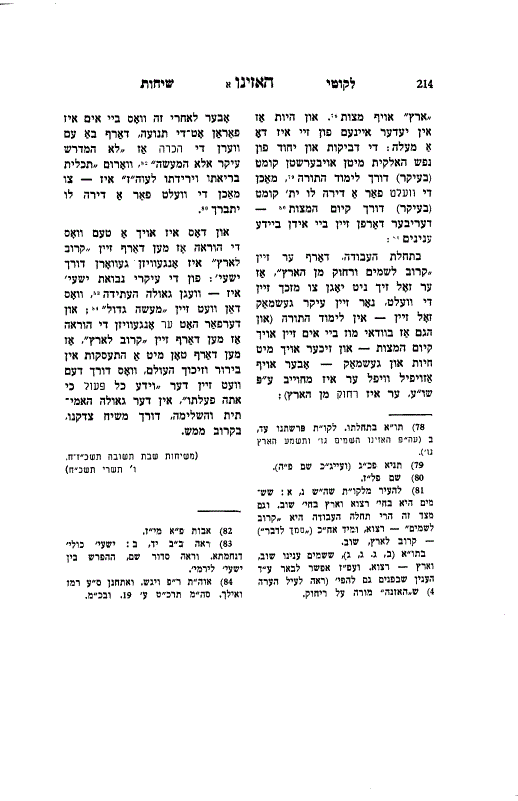
15. And this is also a reason why the instruction that one must be "close to the earth" is indicated by Isaiah. One of the main themes of Isaiah's prophecy is about the future redemption, when "action will be great." Therefore, he pointed out the instruction that one must be "close to the earth," meaning that one must engage in the refinement and purification of the world. Through this, "every creature will know that You are its Maker" in the true and complete redemption, through our righteous Mashiach, very soon.
(From the talks of Shabbos Shuvah 5724, 6 Tishrei 5728)