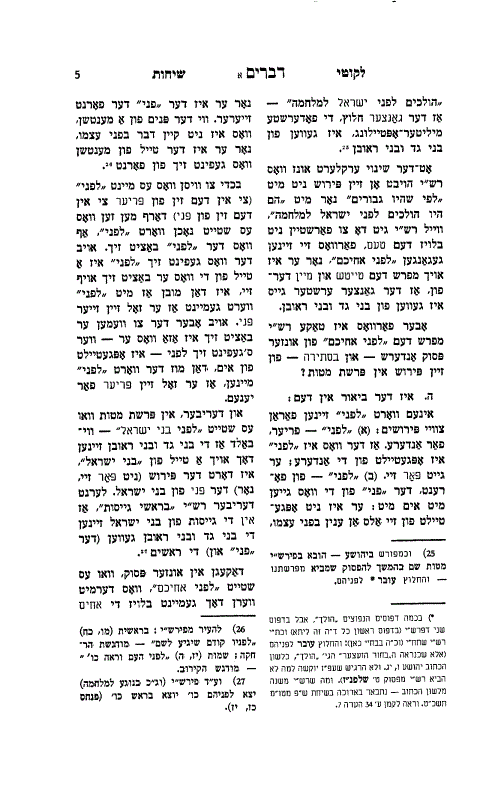
In Parshas Matos, Rashi explains the words “before the Children of Israel” to mean “at the heads of the military divisions.” This indicates that the members of the tribe of Gad were only at the front of the divisions, but did not constitute the entire advance force. The divisions also included members of the other tribes; the tribe of Gad merely stood at their head.
In our parshah, however, Rashi explains that they went before the Jewish people, implying that the entire advance force consisted of members of the tribe of Gad.
Rashi states on the verse, “Before your brothers”:
“They would go before Israel in battle, because they were mighty, and the enemies would fall before them, as it is stated, ‘He tears the arm together with the crown of the head.’”
This requires explanation. Rashi had already explained this matter in Parshas Matos, on the verse “before the Children of Israel”:
“‘Before the Children of Israel’—at the heads of the military divisions. Because they were mighty, as it is stated regarding Gad, ‘He tears the arm together with the crown of the head.’ Moshe also repeated and explained this to them in Sefer Devarim.”
Why, then, must Rashi explain it again?
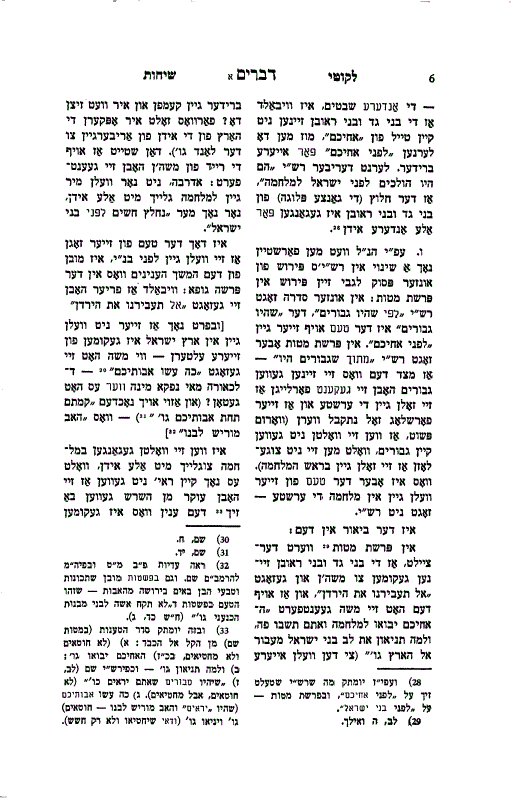
The explanation can be understood by first noting that in Parshas Matos, Rashi says “at the heads of the military divisions.” The tribe of Gad stood at the front of the divisions, but they did not make up the entire advance force. Members of the other tribes were also present in the divisions, while the tribe of Gad served as their leaders.
In our parshah, by contrast, Rashi explains that they went before the Jewish people, implying that the entire advance force consisted of members of the tribe of Gad.
The reason for this difference is that the meaning of the word “before” depends on the context.
In Parshas Matos, the verse states, “before the Children of Israel.” Since the members of Gad were themselves part of the Children of Israel, “before” must be understood in the sense of the face or front of the body: the face is part of the entire person, but it serves as the front of the whole. Accordingly, Rashi explains that the tribe of Gad stood only at the heads of the military divisions, but did not constitute the entire advance force.
In our parshah, however, the verse states, “before your brothers.” The members of Gad are not included within the phrase “your brothers,” which refers to the other tribes. Therefore, “before” must mean that they went ahead of all the other tribes. The entire advance force was thus composed of members of Gad.
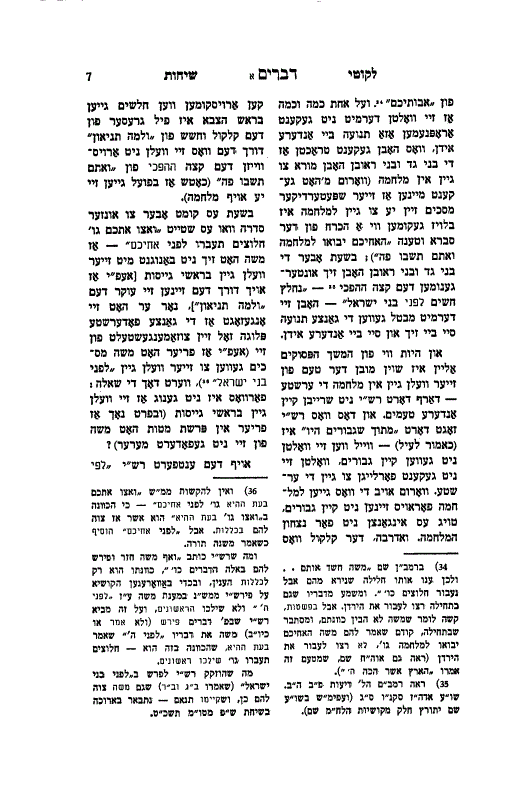
In Parshas Matos, the purpose was to demonstrate that the members of Gad were not afraid to enter Eretz Yisrael. For that purpose, it was sufficient that they go at the heads of the military divisions, together with the other tribes who formed the advance force. Rashi adds that they were mighty, because otherwise the Jewish people would not have allowed them to stand at the front.
All this applied when Moshe still believed that the vow concerning his entry into Eretz Yisrael might be annulled and that the decree could be canceled.
In our parshah, however, Moshe already knew that he would not enter the Land. He therefore wanted the tribe of Gad to constitute the entire advance force, because they possessed an additional quality beyond the general strength of the other tribes: “the enemies would fall before them.”
This represents an even greater degree of might than that of the tribe of Yehudah. Regarding Yehudah, it is stated, “Your hand will be at the neck of your enemies,” meaning that the enemies would turn and flee before them. Regarding Gad, however, the enemies themselves would fall before them.
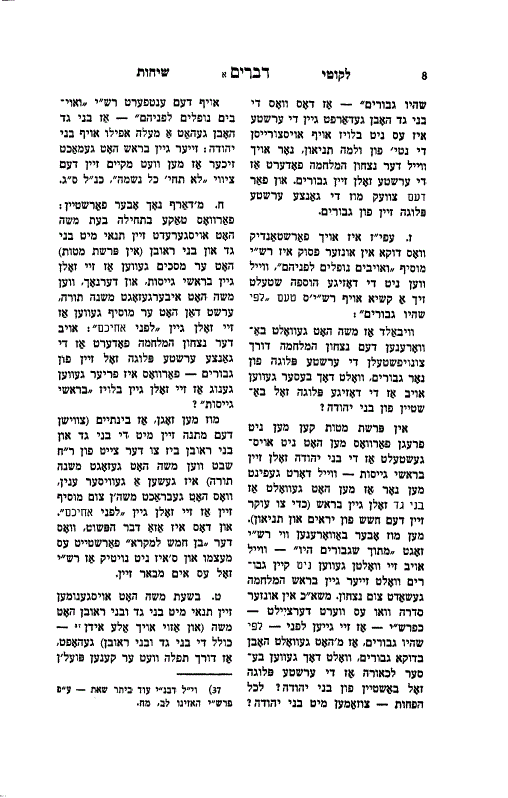
Since this war was against the seven Canaanite nations, concerning whom the Torah commands, “You shall not allow any soul to live,” the exceptional strength of Gad was required—the power through which “the enemies would fall before them.”
The Inner Dimension of Torah
The concept of the advance force represents mesirus nefesh, self-sacrifice that transcends reason and understanding. Within mesirus nefesh itself, there are two levels.
At the beginning of one’s avodah, corresponding to Parshas Matos, the purpose of remembering one’s readiness for mesirus nefesh is to strengthen the service performed by one’s revealed faculties. As explained in Tanya, the fulfillment of all the mitzvos depends upon remembering the principle of mesirus nefesh.
This is reflected in the fact that the tribe of Gad went together with the other tribes. Mesirus nefesh serves as the force that empowers and supports the revealed faculties.
Afterward, however, one reaches mesirus nefesh as an avodah in its own right, entirely above the revealed faculties. This resembles the avodah of the Ne’ilah prayer. This is represented by the tribe of Gad passing “before your brothers”—going ahead on their own.
When the avodah is one of mesirus nefesh as an independent level, the battle against the yetzer hara takes the form of “he tears the arm together with the crown of the head.”
There is then no need for a separate and particular avodah directed toward each individual faculty. The power of mesirus nefesh affects all the faculties equally, because it is a transcendent, encompassing power that stands above division.
There is also another distinction. In an avodah based upon reason and understanding, one begins with the “crown of the head”—the intellect—and only afterward influences the lower faculties.
In the avodah of mesirus nefesh, however, one begins with the power of action, represented by the “arm,” because the faculty of action is connected to the very essence of the person.