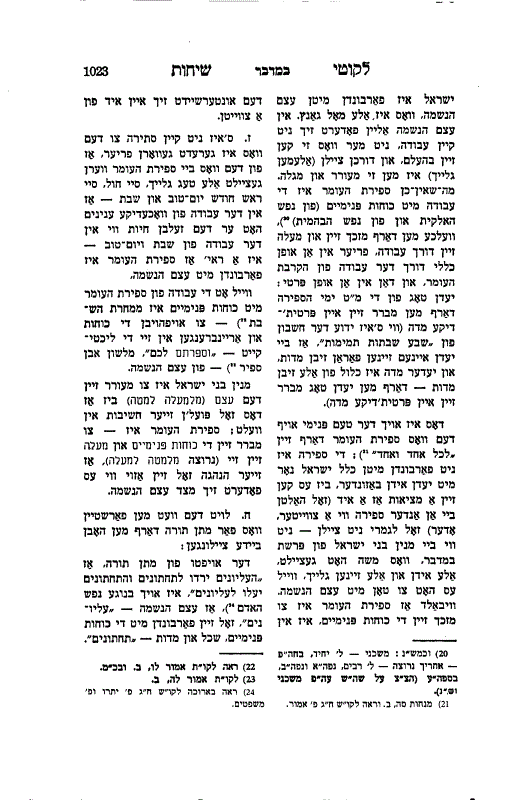
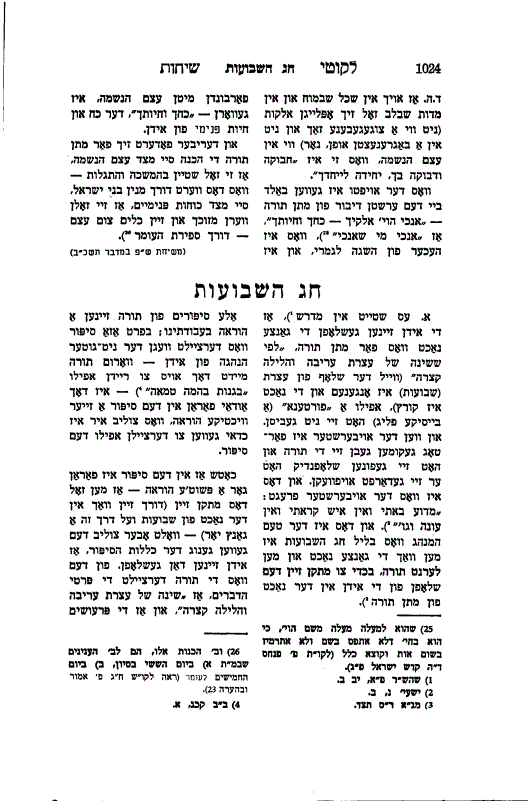
מבוא
In Likkutei Sichos, Chelek Daled, the Rebbe addresses Parshas Bamidbar.
In this sicha, the Rebbe explores how the act of counting serves as a preparation for Matan Torah—the giving of the Torah at Sinai.
First, we encounter the counting described in Parshas Bamidbar, where the Jewish people are counted in detail. Alongside this, there is also the counting of Sefiras HaOmer, which is itself a preparation for Matan Torah.
The fact that Parshas Bamidbar is always read before Shavuos is not incidental. This timing highlights that the central theme of Bamidbar—counting—is intimately connected to preparing for receiving the Torah. Indeed, the entire fourth book of the Chumash is called Chumash HaPekudim—the Book of Counting—emphasizing this motif.
The Rebbe will discuss how counting functions as a preparation for Matan Torah and will analyze the differences between the counting of Bnei Yisrael in Bamidbar and the counting of Sefiras HaOmer. Both forms of counting are necessary to achieve a complete and proper preparation for receiving the Torah.
We will learn inside, beginning with section one. In this first section, the Rebbe explains that it is no coincidence that Parshas Bamidbar is read before Shavuos. Rather, it is by precise design: the counting described in Parshas Bamidbar serves as a direct preparation for Matan Torah—a concept that will be explored in depth throughout this sicha.
סעיף א׳
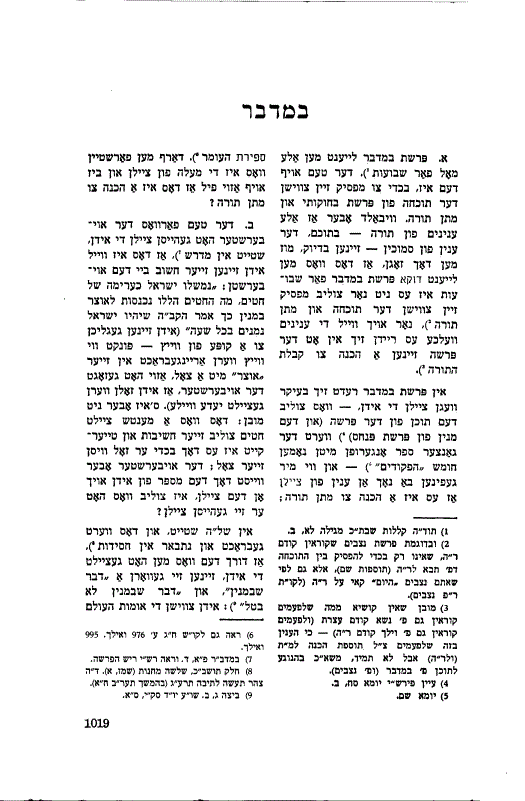
Parshas Bamidbar is always read before Shavuos. The reason for this is to create a separation between the Rebuke found in Parshas Bechukosai and the giving of the Torah at Matan Torah. In other words, after reading Bechukosai, which contains harsh rebuke, we do not go directly into Shavuos and Matan Torah; instead, we insert Parshas Bamidbar in between.
However, since all matters of Torah—including the placement of sections next to each other—are precise and intentional, it follows that there is a deeper reason for specifically reading Parshas Bamidbar before Shavuos. The interruption could have been achieved with any parsha, yet it is always Bamidbar that serves this role.
This indicates that it is not only about creating a break between the Rebuke and Matan Torah. Rather, the content of Parshas Bamidbar itself serves as a preparation for receiving the Torah. The themes discussed in this parsha are uniquely suited to readying us for Matan Torah.
The main topic in Parshas Bamidbar is the counting of the Jewish people. Because of this focus on counting—both here and later in Parshas Pinchas—the entire book is called Chumash HaPikudim, the Book of Numbers.
As noted by Rashi and referenced in Gemara Yoma 22b, both the census in Bamidbar and the one in Pinchas contribute to this name. The repeated act of counting is significant enough to define the character of the whole sefer.
We also find another example where counting serves as a preparation for receiving the Torah: Sefiras HaOmer, the counting of the Omer leading up to Shavuos. This parallel suggests that there is something special about counting itself that prepares us for Matan Torah.
This leads to a question: What is so significant about counting? What unique quality does it possess that makes it such an important preparation for receiving the Torah?
סעיף ב׳
In footnote 2, the Rebbe demonstrates with an example that when a parsha interrupts, it is not merely a break in the sequence, but actually serves as a meaningful interruption. For instance, the parsha of Atem Netzovim acts as an interruption between the rebuke in Parshas Ki Savo and Rosh Hashanah. Although Netzovim is read to separate Ki Savo from Rosh Hashanah, the content of Atem Netzovim Hayom also relates directly to Rosh Hashanah itself.
This shows that while there is an explicit reason for the interruption—to create a separation—there is also an intrinsic connection between these parshas and the upcoming holiday. The parshas we read before each festival serve as preparation for that festival, not just as arbitrary interruptions.
The Rebbe further notes in the footnote that in some years, we read not only Parshas Bamidbar before Shavuos but also Parshas Naso. Similarly, before Rosh Hashanah, sometimes both Netzovim and Vayelech are read. However, this does not detract from the fact that Bamidbar always precedes Shavuos and Netzovim always precedes Rosh Hashanah. The additional readings simply mean that in those years, extra preparation is needed from those additional portions.
Therefore, Bamidbar consistently serves as preparation for Shavuos, and Netzovim consistently prepares us for Rosh Hashanah. The Rebbe emphasizes that even when there are extra parshas read, these two—Bamidbar and Netzovim—are always positioned before their respective holidays.
As a result, the Rebbe seeks to uncover the connection between the counting described in Parshas Bamidbar and the festival of Shavuos—the time of Matan Torah (the giving of the Torah).
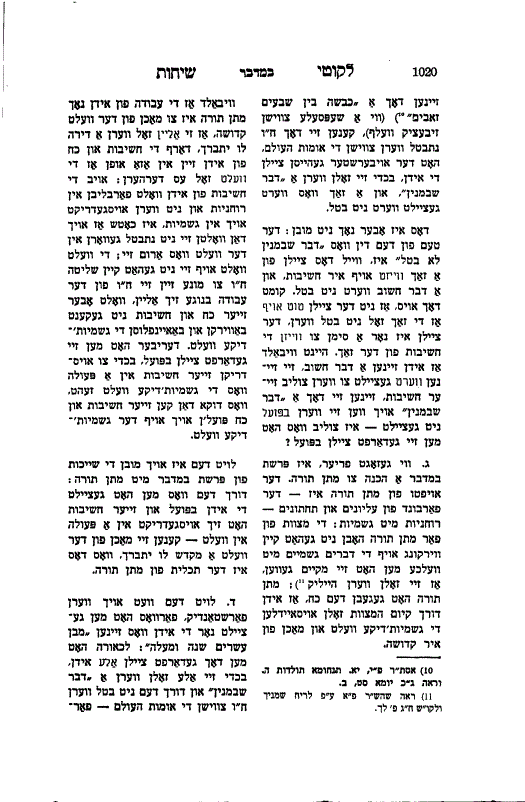
In this section (S’if Beis), the Rebbe continues by questioning the true purpose behind counting. Normally, Chazal explain—based on Midrash—that counting something indicates its importance: a person counts what matters to him because he does not know how much there is and wants to keep track. But Hashem already knows everything; He does not need to count to find out numbers.
The Rebbe also cites the explanation from the Shlah HaKadosh: by counting them, Bnei Yisrael become a defined number—and something with a defined number cannot be nullified (batel) among others. This gives strength and permanence to the Jewish people.
סעיף ג׳
The Rebbe raises a question regarding the idea that Bnei Yisrael are not nullified among the nations because they are counted. He points out that, according to halacha, the reason something is not nullified is due to its importance. The fact that it is counted is only an indication of its significance, not the cause of it. In other words, things are counted because they are important; the counting itself does not create their importance.
This leads to a deeper question: If counting is merely a sign of importance and not what makes something important, then what is the purpose of Hashem commanding to count the Jewish people? It would seem that their inherent value comes first, and only then are they counted as a result. So why does Hashem instruct Moshe to count them?
The Rebbe brings a Midrash to shed light on this issue. The Midrash explains that Hashem counts Bnei Yisrael because they are precious to Him. It offers a parable: Just as bundles of wheat are brought into storage and counted because of their value, so too Hashem counts the Jewish people at all times due to their dearness.
In Yiddish, as quoted by the Rebbe in parentheses, "Jews are equated to a bundle of wheat... just like wheat is brought into its storage place by number." This analogy emphasizes that counting reflects how cherished Bnei Yisrael are in Hashem’s eyes.
However, this explanation itself raises another question. When a person counts wheat or any valuable item, it is done in order to know how much there is—because one does not know the total otherwise. But Hashem already knows exactly how many Jews there are at all times; His knowledge is perfect and complete even without any act of counting.
If so, why does Hashem command Moshe to count them? What purpose does this serve if it cannot be for Hashem’s own knowledge?
Although the Rebbe does not state this explicitly in the sicha at this point, he notes an interesting detail: The number resulting from this census in Parshas Bamidbar turns out to be exactly the same as a previous count. This observation further highlights that the act of counting must have a deeper meaning beyond simply arriving at a total.
סעיף ד׳
We see that the Jews were already counted earlier, as mentioned in Parshas Ki Sisa, which took place several months before. The number of Jews then was exactly the same as now; there was no change in the count. Rashi explains that it was indeed the exact same number, so this counting was not for the purpose of discovering a new total.
This idea fits with what the Rebbe is discussing here, and is also brought down and explained in Chassidus. Through being counted, the Jewish people became a davar shebeminyan—an entity defined by its number. In halacha, something that is counted individually acquires a special status: a davar shebeminyan cannot be nullified (batel) even among many others.
Normally, when something is mixed into a large group, it can become nullified and lose its distinct identity. However, if it is something that is counted separately, like an item of significance or value, it retains its identity and cannot be nullified. The Jewish people among the nations are compared to one sheep among seventy wolves—they remain distinct and cannot be lost or absorbed among the nations.
This is why Hashem commanded to count the Jews: so they would become a davar shebeminyan, an entity that stands out and cannot be nullified among the nations of the world. Their being counted gives them this unique status.
However, the Rebbe points out that this explanation still leaves us with questions. The halachic reason why something that is counted does not become nullified is because counting highlights its importance; it shows that this item matters. Since it is important, it cannot simply disappear or lose its identity within a larger group.
The act of counting demonstrates significance, but we still need to understand more deeply why this makes it impossible for such an entity to become nullified. The Rebbe suggests there is more to explore about how counting relates to importance and identity.
סעיף ה׳
The fact that something is not nullified because it is counted does not mean that the act of counting itself prevents nullification. Rather, being counted is a sign of the item’s inherent importance. Since Jews are inherently important, they deserve to be counted; their significance makes them an “item which is counted” even without an actual count.
Given this, why was it necessary to physically count the Jews? If their importance alone qualifies them as countable, what does the act of counting add?
The Rebbe explains that the actual counting was required to bring out their importance in the physical world. The purpose of Matan Torah is to connect the spiritual and the physical—to unite heaven and earth. Remaining important in essence is a lofty quality, but unless that importance is expressed physically, it does not impact the material world.
This necessity ties directly into the connection between counting and Matan Torah. As mentioned earlier, Parshas Bamidbar serves as a preparation for Matan Torah.
Der Erfüllung von Maten Teure ist der Verbund von Elyonim und Takhtoinim—Matan Torah’s accomplishment is uniting the upper and lower realms, spirituality with physicality.
Before Matan Torah, mitzvos performed by our ancestors had no effect on the physical objects involved; those items did not become holy through their use in mitzvos. Matan Torah gave Jews the power to refine and sanctify physicality through mitzvah observance.
Since our mission after Matan Torah is to make holiness from within the world itself—to transform physicality into a dwelling place for Hashem—it follows that Jewish importance and power must be manifest in a way that is recognized by the world itself.
If Jewish significance remained only spiritual and was never expressed physically, then although Jews would not be nullified by their surroundings (the world would have no power to prevent them from serving Hashem), their influence would also not extend outward—they would not impact or transform the material world around them.
Therefore, it was necessary for Jews to be counted in actuality. This concrete act expresses their importance in a way visible to the physical world. Only then can their unique powers affect and transform material reality—enabling them to make even this world into a dwelling place for Hashem.
Accordingly, we understand more deeply why Parshas Bamidbar precedes Matan Torah. Through actually counting the Jewish people—expressing their significance through a tangible action—their spiritual greatness becomes manifest within creation itself.
סעיף ו׳
The Rebbe explains that the Jewish people have the ability to make this world a sanctuary for Hashem. This is, in fact, the ultimate purpose of Matan Torah—the giving of the Torah. The significance and power of each Jew can impact not only spiritual realms but also the physical world itself.
Based on this, we can also understand the connection between Parshas Bamidbar and Matan Torah. Through the actual counting of the Jewish people, their importance was expressed in a tangible action within the world. This act enables them to transform the world into a dwelling place for Hashem, which is precisely the goal of Matan Torah.
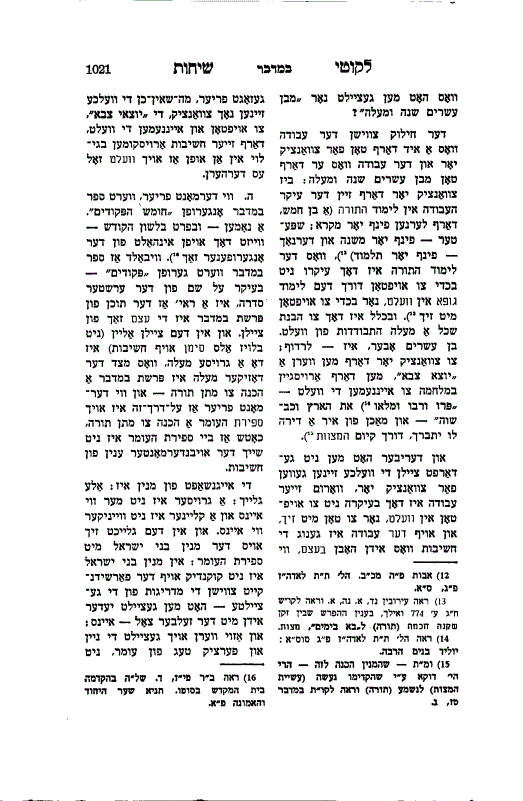
With this explanation, the Rebbe clarifies why only those from twenty years old and above were counted in this census, and not those younger. Since every Jew is inherently important, it would seem logical that all should be counted. However, the purpose of counting was not merely to acknowledge their value, but to draw that value down into practical effect within the world.
The main responsibility for bringing this importance into worldly action begins at age twenty. Before reaching twenty, a person’s primary focus should be on self-development—growing in learning and personal refinement—rather than engaging with or confronting the outside world.
Therefore, before age twenty, it is not yet necessary to be counted as part of those who go out to influence and elevate the world. The counting becomes relevant when one is ready to take on that mission—to go out and actively engage with worldly matters.
This is reflected in the Mishnah’s teaching about life stages: up until twenty years old, a Jew’s main occupation should be Torah study—five years dedicated to Chumash (Scripture), five years to Mishnah, and five years to Talmud. The focus during these formative years is internal growth and acquiring knowledge.
The study of Torah at this stage is not primarily about changing or affecting the world through one’s learning; rather, it is about transforming oneself—becoming knowledgeable and spiritually developed.
There is an advantage in being somewhat secluded from worldly distractions during these years so that one can fully devote oneself to learning and self-improvement.
However, upon reaching twenty years old—as indicated by the Mishnah—one must begin to “pursue” or engage with life’s broader responsibilities. At this point, a Jew becomes obligated to go out into the world and fulfill their mission: “be fruitful and multiply,” fill and conquer the earth, and make it a dwelling place for Hashem through mitzvah observance.
סעיף ז׳
The Rebbe explains that involvement with the world—actively engaging and accomplishing within it—truly begins when a person turns twenty years old. Therefore, it was unnecessary to count those under twenty, since their main focus is not yet on transforming the world, but rather on developing themselves. Their essential value is already recognized by Hashem, and they are blessed for their service even without being counted.
For these younger individuals, their importance is inherent; they do not require enumeration to establish their worth. In fact, as previously discussed, not being counted can itself be a sign of distinction—their value is so fundamental that it does not depend on being part of a tally. Counting, by contrast, brings a person into the realm of worldly action and responsibility.
However, once a Jew reaches the age of twenty and joins the ranks of those who serve in the army—those tasked with conquering and refining the world—their mission must be expressed openly. Their impact should be felt even by the world itself. This is why only those from the age of twenty and up were counted: their role is to engage directly with worldly matters in a way that is visible and transformative.
The Rebbe raises an additional point: perhaps this also explains why only men were counted and not women—a question that has been asked before. If conquering and transforming the world is primarily assigned to men, while women’s primary role centers on raising children and building the home, this distinction would clarify why only men are included in the census from age twenty onward.
This same reasoning could apply to both criteria: counting only males and only those from age twenty and up. The unique responsibilities associated with each group determine their inclusion in the census.
In Section 5 (Ayis Hei), the Rebbe will further clarify that beyond what we have learned about counting conferring importance, there must be something uniquely significant about counting itself. The very fact that an entire book of Torah—Bamidbar—is called “Numbers” (Chumash HaPikudim) because of its opening portion underscores this point.
When something receives a name in Lashon HaKodesh—the holy tongue—it reflects its inner essence. Thus, calling Sefer Bamidbar “the Book of Counting” indicates that counting itself is central to its theme—not just what or whom is being counted, but the act of counting as such.
This idea extends to Sefiras HaOmer, where each day is counted equally—regardless of whether it’s a weekday or Shabbos. Every day adds just one number; every individual counts as one, no matter their personal greatness or status. The act of counting places everyone on equal footing: each person or day is simply “one” among many.
This equality points to an essential quality within every Jew—a core identity that transcends individual distinctions. In Sefiras HaOmer, too, regardless of which day it falls on or its particular significance, each day contributes equally toward reaching Matan Torah (the Giving of the Torah).
This process prepares us for Matan Torah by emphasizing our shared essence—the fundamental unity among all Jews—which serves as a fitting preparation for receiving Hashem’s essence at Sinai.
As mentioned earlier:
בספר במדבר און גערופן חומש הפקודים
The Book of Bamidbar is called “the Book of Counting.” When something receives a name in Lashon HaKodesh—especially when used in Torah—it reflects its true content. Since Bamidbar receives its name primarily because of its opening parsha’s census, this demonstrates that counting itself—not just who or what is counted—is at the heart of this section’s message.
סעיף ח׳
The act of counting itself, not merely as a sign of importance or significance, carries a unique quality. This is why Parshas Bamidbar serves as a preparation for Matan Torah. Similarly, as mentioned earlier, the counting of the Omer—Sefiras HaOmer—is also a preparation for Matan Torah. Even though by Sefiras HaOmer the notion of conferring importance does not apply in the same way, there is still something inherently valuable about the act of counting.
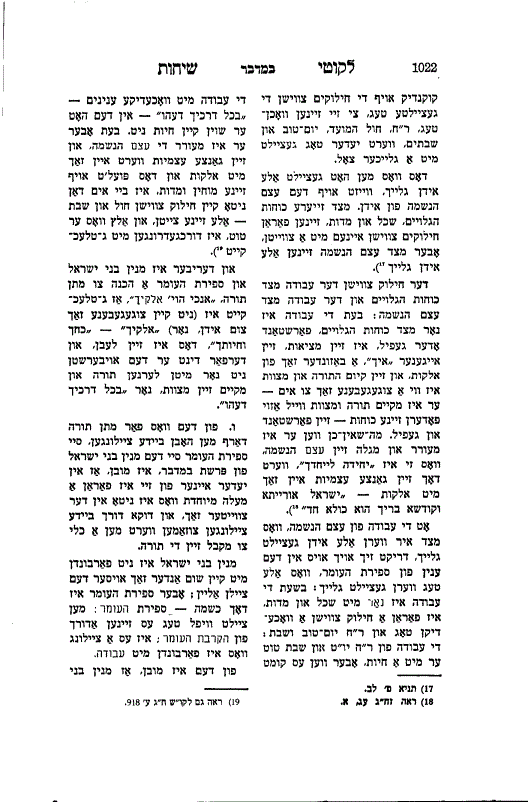
The Rebbe now explains what this quality is and how it prepares us for receiving the Torah—both through counting Bnei Yisroel in Parshas Bamidbar and through Sefiras HaOmer. The defining characteristic of counting is that it makes everyone equal: a greater person is not counted as more than one, and a lesser person is not counted as less than one. This equality is found both in the counting of Bnei Yisroel and in the counting of the Omer.
When we count Bnei Yisroel, despite their differences in spiritual level or status, each individual receives the same number—one. Similarly, each day of Sefiras HaOmer, whether it is a weekday, Rosh Chodesh, Chol HaMoed, Yom Tov, or Shabbos, is counted equally as one day. All together they make up forty-nine days; each day counts equally regardless of its unique qualities.
What does this equality represent? It reflects the essence of the Jewish soul—etzem haneshamah—where there are no distinctions; everyone is simply one. When we look at revealed powers such as intellect and emotion (seichel and middos), there are differences between individuals. But from the perspective of the soul’s essence, all are equal.
This means that when one's service to Hashem comes only from revealed faculties—understanding or feeling—it remains an expression of his own selfhood. He exists as an independent entity apart from G‑dliness; his observance of Torah and mitzvos becomes something added onto himself because that’s what his abilities demand.
However, when he arouses and reveals his soul’s essence—which seeks only to unite with Hashem—then there is no sense of “I.” His entire being becomes one with G‑dliness. As it says: ישראל ואורייתא וקודשא בריך הוא כולא חד—the Jew, Torah, and Hashem are all truly one (Zohar III 73a).
This service from the essence of the soul—which causes all Jews to be counted equally—is also expressed in Sefiras HaOmer: all days are counted equally. When service comes only from intellect or emotion, there’s a difference between serving on weekdays versus Rosh Chodesh or Yom Tov or Shabbos; on special days he serves with more vitality and enthusiasm. But when it comes to weekday matters—“בכל דרכיך דעהו,” knowing Hashem in all your ways—he may lack energy or inspiration.
If instead he arouses his soul’s essence—even on weekdays—his entire being becomes united with G‑dliness. This then influences his intellect and emotions so that there’s no distinction between weekday and Shabbos; everything he does at every time becomes permeated with G‑dliness.
This explains why both counting Bnei Yisroel and Sefiras HaOmer serve as preparations for Matan Torah. At Matan Torah Hashem declares: “אנכי ה' אלקיך”—I am Hashem your G‑d—not as something external or additional but as your very power and life-force (“אלקיך” from “כחך וחיותך”). This becomes your heart and life itself.
Therefore, serving Hashem isn’t limited to learning Torah or performing mitzvos but extends to knowing Him in all your ways (“בכל דרכיך דעהו”). The idea behind both countings is to reveal this essential connection so that you become ready to receive “אנכי ה' אלקיך”—that G‑dliness becomes truly yours.
The Rebbe goes on to explain why both types of counting are necessary before Matan Torah: both Sefiras HaOmer (counting days) and Minyan Bnei Yisroel (counting people). From this we understand that each has its own unique advantage which cannot be found in the other; only through both together do we become vessels fit to receive the Torah.
The counting of Bnei Yisroel stands alone—it isn’t connected to any other matter except for simply being counted. In contrast, Sefiras HaOmer—as its name implies—is tied to an act: we count how many days have passed since bringing the Omer offering. This means it’s a counting connected with an ongoing service.
Thus, Minyan Bnei Yisroel corresponds to etzem haneshamah, which is always whole and requires no work or refinement—only revelation through counting everyone equally. By contrast, Sefiras HaOmer involves working with our inner faculties (kochos penimim)—both godly soul and animal soul—to refine them through daily avodah: first generally by bringing the Omer offering, then specifically by refining a particular character trait each day during forty-nine days (as explained regarding chesed sheb’chesed etc.).
This also explains why Sefiras HaOmer must be performed by each individual Jew—not just by Beis Din on behalf of everyone (as with Yovel)—because it involves personal refinement unique to each person’s inner powers. It can even happen that two Jews will be at different counts if someone missed a day entirely; unlike Minyan Bnei Yisroel where Moshe counts everyone together equally.
The reason for this distinction: since Sefiras HaOmer aims at refining our inner faculties—which differ from person to person—the count reflects those differences; whereas Minyan Bnei Yisroel relates to our shared essence where all are equal.
This might seem contradictory since earlier we said that all days in Sefiras HaOmer are counted equally—a sign that it too relates to etzem haneshamah. The answer is that although Sefiras HaOmer works with inner faculties (kochos penimim), its purpose is to elevate them—to infuse them with light from the soul’s essence (“וספרתם לכם”—from sapphire, shining stone), tying essence into our revealed powers.
The difference between these two countings: Minyan Bnei Yisroel draws down revelation from above—the essence into our world; Sefiras HaOmer elevates our inner faculties upward toward their source so they too become conducted like etzem haneshamah.
This dual process prepares us for Matan Torah—a fusion where “the upper descends below” and “the lower ascends above.” In terms of our souls: our essence connects fully with our intellect and emotions so that even our understanding and feelings become permeated with G‑dliness—not as something added or limited but as an expression of our very core (“חבוק ודבוק חדל יאגדו”—hugged and bound together).
This was accomplished at Matan Torah when Hashem declared “אנכי ה' אלקיך”—the infinite I became your power and life-force—a connection higher than comprehension yet fully internalized within every Jew’s heart and mind.
Therefore both aspects are required in preparation: revealing etzem haneshamah through Minyan Bnei Yisroel (so it stands revealed), and refining kochos penimim through Sefiras HaOmer (so they become vessels for essence). Through this dual avodah we become truly ready for Kabbalas HaTorah—that G‑dliness should permeate every aspect of who we are.
Translation
1. In Likkutei Sichos, volume 4, the Rebbe addresses Parshas Bamidbar and explores how the act of counting serves as a preparation for Matan Torah—the giving of the Torah at Sinai. The detailed census in Bamidbar and the counting of Sefiras HaOmer both function as preparatory acts for receiving the Torah. The fact that Parshas Bamidbar is always read before Shavuos is deliberate, highlighting that its central theme—counting—is intimately connected to preparing for Matan Torah. The Rebbe will analyze how counting operates as a preparation for receiving the Torah and will compare the census in Bamidbar with Sefiras HaOmer, showing that both are necessary for a complete preparation.
2. Parshas Bamidbar is always read before Shavuos to separate the Rebuke in Bechukosai from Matan Torah. However, since every detail in Torah is precise, there must be a deeper reason why specifically Bamidbar is chosen for this role. The content of Parshas Bamidbar itself—its focus on counting—serves as a unique preparation for receiving the Torah. Both Rashi and Gemara Yoma note that the repeated census in Bamidbar and Pinchas gives Sefer Bamidbar its name, Chumash HaPikudim. Similarly, Sefiras HaOmer also prepares us for Matan Torah, suggesting that counting itself has special significance in this context. This raises the question: what unique quality does counting possess that makes it such an important preparation for receiving the Torah?
3. In footnote 2, the Rebbe demonstrates that when a parsha interrupts another, it is not merely a break but serves as meaningful preparation for what follows—such as Atem Netzovim between Ki Savo and Rosh Hashanah. Even when additional parshas are read before holidays (like Naso before Shavuos or Vayelech before Rosh Hashanah), Bamidbar and Netzovim consistently precede their respective festivals. Thus, Bamidbar always prepares us for Shavuos. The Rebbe questions why Hashem commands to count Bnei Yisrael if their importance is already inherent and known to Him; after all, Hashem does not need to count to know their number. The Shlah explains that being counted gives Bnei Yisrael permanence—they cannot be nullified among others—but this too requires further exploration.
4. The Rebbe questions whether being counted truly prevents nullification or if it merely indicates pre-existing importance. If so, why did Hashem command Moshe to count Bnei Yisrael? The Midrash likens Hashem’s counting of Israel to someone who counts bundles of wheat because they are precious; yet Hashem already knows their number perfectly. Moreover, the census in Bamidbar yields exactly the same total as an earlier count in Ki Sisa, emphasizing that the act of counting must have deeper meaning beyond simply arriving at a total.
5. The Jews had already been counted previously with no change in number; thus, this census was not about discovering a new total. Chassidus explains that through being counted, Bnei Yisrael become a davar shebeminyan—an entity defined by its number—which halachically cannot be nullified among others due to its significance. This status ensures they remain distinct among the nations. However, since halacha teaches that being counted only signals importance rather than creating it, we must further examine why actual counting is necessary and how it relates to expressing Jewish identity and significance within creation.
6. Being counted does not itself prevent nullification; rather, it reflects inherent importance. If so, why was physical counting required? The Rebbe explains that actual counting brings out Jewish importance within physical reality—a core purpose of Matan Torah is uniting spiritual and physical realms. Before Matan Torah, mitzvos did not sanctify physical objects; after Sinai, Jews can refine materiality through mitzvos. Therefore, Jewish significance must be manifest physically so it can impact and transform the world into a dwelling place for Hashem—hence the necessity of an actual census before Matan Torah.
7. Through actual counting, Jewish importance becomes tangible within creation itself—enabling Jews to fulfill their mission of making this world a sanctuary for Hashem, which is the ultimate purpose of Matan Torah. This also clarifies why only those aged twenty and above were counted: while every Jew is inherently important, only those who are ready to engage with worldly matters (from age twenty) need their value expressed through enumeration; those younger focus on self-development through learning until they reach maturity and responsibility.
8. Engagement with worldly matters begins at age twenty; thus only those twenty and above were counted since their mission involves transforming the world through action visible even externally. Those under twenty retain inherent value without needing enumeration; indeed, not being counted can itself indicate distinction rooted in essential worth rather than practical mission. Similarly, only men were counted because conquering and refining the world primarily pertains to them according to traditional roles; women’s primary role centers on home-building and child-rearing. Naming Sefer Bamidbar “the Book of Counting” underscores that counting itself—not just who or what is counted—is central to its message; this theme also appears in Sefiras HaOmer where each day or person counts equally regardless of individual greatness or status.
9. The act of counting itself possesses unique value beyond signaling importance—it establishes equality among all those counted: each person or day counts as one regardless of individual distinctions or spiritual level. This equality reflects etzem haneshamah—the essence of every Jewish soul—which transcends differences found in intellect or emotion (seichel or middos). When service derives from revealed faculties there are distinctions; but when one reveals his soul’s essence he becomes truly united with G‑dliness (“Yisrael v’Oraisa v’Kudsha Brich Hu kulah chad”). This essential unity is expressed both in Minyan Bnei Yisroel (census) and Sefiras HaOmer (counting days), preparing us for Matan Torah where G‑dliness becomes our very life-force (“Anochi Hashem Elokecha”).
10. Both types of counting are necessary before Matan Torah because each has unique advantages: Minyan Bnei Yisroel stands alone as an expression of etzem haneshamah requiring no refinement—everyone is simply one; Sefiras HaOmer involves personal avodah (service) refining inner faculties (kochos penimim) through daily effort culminating in readiness for Sinai. Unlike Minyan Bnei Yisroel which Moshe performs collectively on behalf of all Jews equally, Sefiras HaOmer requires individual participation reflecting personal refinement—even allowing different counts if someone misses a day entirely—because it works with aspects unique to each person’s inner powers.
11. Although Sefiras HaOmer works with inner faculties (kochos penimim), its purpose is to elevate them by infusing them with light from etzem haneshamah (“usfartem lachem”—from sapphire), thereby connecting essence into revealed powers. Minyan Bnei Yisroel draws down revelation from above—the soul’s essence into our world—while Sefiras HaOmer elevates our faculties upward toward their source so they too become conducted like etzem haneshamah. This dual process prepares us for Matan Torah—a fusion where “the upper descends below” and “the lower ascends above,” ensuring G‑dliness permeates every aspect of who we are through both collective essence and individual refinement.