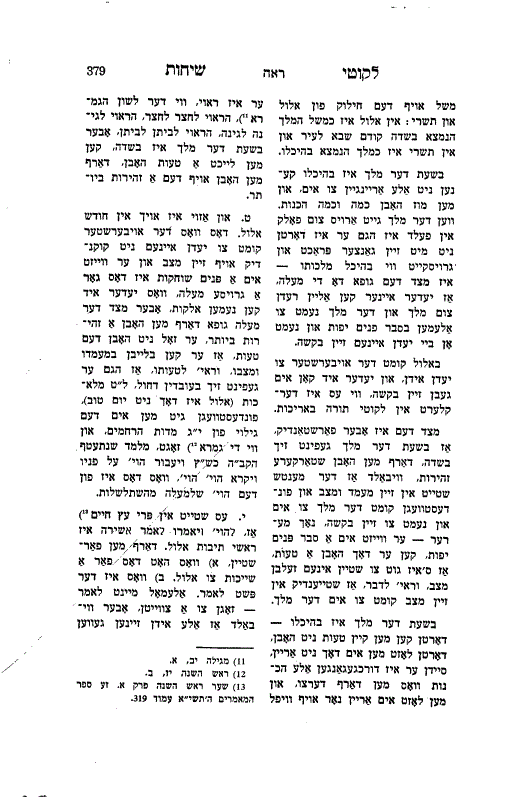
A split hoof indicates that a person performs every type of Divine service—both the right line and the left line. This demonstrates that his service is not merely the result of his natural disposition. He must then examine his conduct once again, consulting others to determine whether his service is truly as it should be. This is represented by chewing the cud.
There is a question regarding the signs of a kosher animal: Are they causative signs, meaning that they themselves bring about the animal’s kosher status, or are they merely identifying signs, indicating that the animal is kosher, although the signs themselves do not cause its purity?
It may be said that even according to the view that they are only identifying signs, there must nevertheless be an inner connection between these signs and the spiritual meaning of purity.
The explanation is as follows:
Eating represents the totality of man’s Divine service of elevating the inanimate, plant, and animal kingdoms to the level of the true “speaker”—the ultimate level of man, alluded to by the vision of “the likeness of a man upon the Throne.”
For this service to be performed properly—for the sake of serving Hashem rather than merely because it conforms to one’s natural temperament—there must be a split hoof.
The split hoof signifies that a person engages in every type of Divine service, both the right line and the left line. The right line represents kindness, closeness, and giving, while the left line represents restraint, discipline, and firmness. When a person is capable of serving Hashem through both approaches, this demonstrates that his conduct is not merely an expression of his natural character.
Moreover, the hoof must be completely divided. This means that one’s service through both lines must not remain merely external; it must penetrate one’s inner character as well.
Nevertheless, even after fulfilling all these conditions, a person cannot rely upon his own judgment. He must examine his conduct again and consult others to determine whether his service is truly as it should be. This is the spiritual significance of chewing the cud—reviewing and reconsidering one’s conduct rather than assuming that one’s original judgment was correct.
When the King comes into the field, a person must exercise additional caution not to think that he may remain in his present spiritual state.
The King in the Field
Likutei Torah presents the well-known analogy for the month of Elul of a king who comes into the field.
When the king comes into the field, however, a person must exercise additional caution. He must not imagine that he may remain in his present position and spiritual condition simply because the king has come close to him.
On the contrary, the King’s presence demands that the person leave his previous state and approach the King.
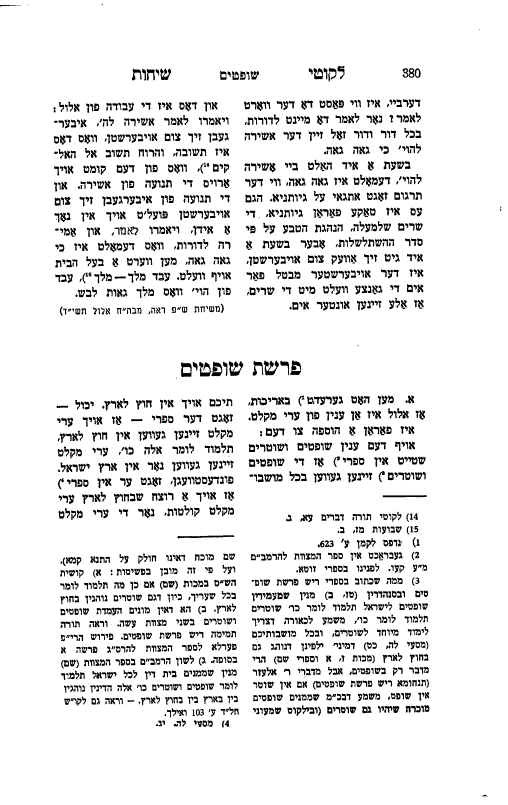
Pri Etz Chaim teaches that the name Elul forms an acronym for the words:
אָשִׁירָה לַה׳ וַיֹּאמְרוּ לֵאמֹר
“I will sing to Hashem, and they said, saying.”
The meaning of the word לֵאמֹר — “saying” is that this message applies in every generation.
Through one’s connection with the Divine Name Havayah, which transcends the entire ordered progression of creation, one reaches the state expressed by the words:
כִּי גָאֹה גָּאָה — “For He is exalted above the exalted.”
A person is thereby elevated above the spiritual forces and rulers through which the natural order is conducted, and above the limitations of nature itself.