
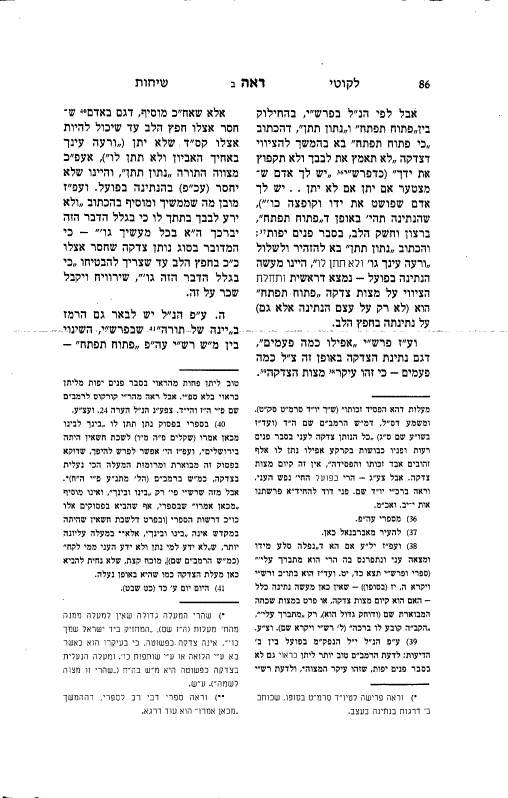
On the verse "You shall surely open your hand to him," Rashi explains "You shall surely open" as "even many times." Subsequently, on the verse "You shall surely give him," Rashi interprets it as "even a hundred times."
In the Sifrei on our verse, it is stated in both cases "a hundred times": "How do we know that if you opened your hand once, you should open it even a hundred times? The verse states, 'You shall surely open your hand to him.' And how do we know that if you gave him once, you should give him even a hundred times? The verse states, 'You shall surely give him.'
Simply, one could say that Rashi's reason, according to the plain meaning of the text, is that the first verse teaches us only "many times," while the second verse "You shall surely give" comes to add "even a hundred times."
However, it is difficult because, in the plain meaning of the text, one could interpret that the first verse ("You shall surely open") primarily speaks of the obligation of charity, while the second verse "You shall surely give" primarily refers to the mitzvah of gemilus chasadim (acts of kindness). This is because this verse follows the warning "Beware lest there be a base thought in your heart, saying, 'The seventh year, the year of release, is approaching,' and your eye be evil against your needy brother and you give him nothing," which, concerning the sabbatical year, the concern is related to gemilus chasadim, as it states earlier, "And this is the manner of the release: every creditor shall release what he has lent to his neighbor," and it continues "You shall surely give even many (a hundred) times" also in gemilus chasadim.
Similarly, we find in the commentaries that they wrote that both teachings in the Sifrei are necessary, "one for giving as charity and one for lending in his time of need, and it teaches us that even lending in his time of need is considered charity, even though he will repay him."
[There is another version in the Sifrei: "How do we know that if you opened your hand once, you will eventually open it many times? The verse states, 'You shall surely open your hand to him,' and in the verse 'You shall surely give,' I only know once; how do I know even a hundred times? The verse states 'You shall surely give,'" meaning that "You shall surely open" is not a command but a promise and blessing, "that if you opened once, you will eventually open many times," although it is obvious that this is not the plain meaning of the text.
And from Rashi's language in both verses, "even many times," "even a hundred times," it is understood that he interprets both as a command, according to the plain meaning of the text.]
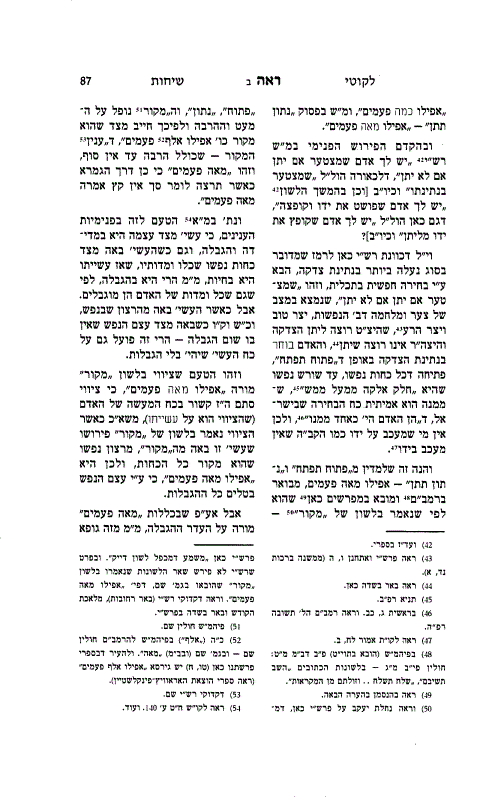
There is room to say, based on the distinction in the content of the verses: In the verse "You shall surely open," it states "sufficient for his need, which he lacks," that although "you are not commanded to make him wealthy," nevertheless, you must give him all "that he lacks," "even a horse to ride on and a servant to run before him" — and in this, one is obligated "even many times," whereas in the verse "You shall surely give," it refers only to giving alone — and in this, the obligation is "even a hundred times."
One can add a reason for this law — since in the verse "You shall surely open," it speaks of a large giving to fulfill all the needs of the poor, it does not command "a hundred times," for the Torah speaks of the majority, and the text speaks in the present, that such giving "a hundred times" is not common but only "many times," so that one should not say that since he has already given the poor sufficient for his need, he has fulfilled his obligation; whereas in the verse "You shall surely give," where there is no emphasis on "sufficient for his need, which he lacks," Rashi explains "even a hundred times," because in a simple giving, a small gift can indeed be "even a hundred times."
However, it still requires explanation, for ultimately, since the obligation to give to the poor is (as in the first verse) "sufficient for his need, which he lacks," it is understood that also what is stated "You shall surely give" (in the subsequent verse) includes the obligation of giving charity, which is discussed in the previous verse, in a manner of "sufficient for his need, which he lacks."
It seems simple to say, by first examining the precision in Rashi's heading, that in the first verse he quotes only the words "You shall surely open," whereas in the second verse he quotes "You shall surely give him" (even though the teaching "even a hundred times" is only from the words "You shall surely give").
It can be explained as follows: In the preceding verse, it is stated, "If there shall be a needy person among you... do not harden your heart or shut your hand against your needy brother," and it continues with "You shall surely open..." The verse "You shall surely give" follows (as mentioned above) in the context of the concern that "the seventh year, the year of release, is approaching, and your eye will be evil against your needy brother and you will not give him..."
From this, it is understood that the verse "You shall surely open" (which follows the warning against hardening the heart and shutting the hand) deals with the opening of the heart and hand of the giver, whereas the verse "You shall surely give" primarily addresses the giving to the poor and the borrower.
Therefore, specifically in the verse "You shall surely give," Rashi includes the word "to him" from the text, but not in the verse "You shall surely open," to inform us that here the main emphasis is on the action towards "him" — the recipient of the charity.
[Accordingly, it is simply understood why Rashi explains the word "to him" only in the second verse as "between you and him," and not in the verse "You shall surely open" (even though in the first verse the word "to him" is not necessary, as it could have said "You shall surely open your hand and lend him sufficient for his need which he lacks") — because only in the second verse is the main emphasis on the giving to the recipient, and therefore it specifies "to him" — "between you and him," indicating how the giving should be conducted in practice "to him," to the recipient; whereas in the verse "You shall surely open," the main point is (not the giving from the giver to the recipient, but) the opening of the heart and hand of the giver, thus there is no need to specify the word "to him" regarding the manner of giving (and perhaps one could say that the word "to him" here means "for him," that he opens his heart for the poor)].
Based on this, we can add: The fact that in the verse "You shall surely give to him," Rashi explains "even a hundred times," and in the verse "You shall surely open," he writes "even many times":
In the verse "You shall surely open," where the main emphasis of the command is not on the quantity of giving to the recipient but on the opening of the heart and hands of the giver, meaning the quality of the giving from the giver's perspective, there is no place to interpret "even a hundred times," because this is appropriate only when discussing giving to the recipient, where the text emphasizes that this act should be "even a hundred times," but not so much when discussing the content of opening the heart and hands of the giver.
Rather, it teaches us "even many times," that even though the text commands the giver of charity "You shall surely open," it is not enough for this to be only once, the first time he gives charity, but a person must strive that every act of charity should be in a manner of "You shall surely open your hand," the opposite of hardening the heart and shutting the hands.
And we can add regarding the halacha:
There is room to investigate: Whether giving charity with a willing heart and a pleasant demeanor is part of the essence of the mitzvah of charity, whereas anything less than this, although fulfilling the mitzvah, is only a partial fulfillment of the mitzvah; or whether the main mitzvah of charity is the giving itself, and a pleasant demeanor is an additional "virtue" in the giving.
The Rambam, in the Laws of Gifts to the Poor, in explaining the mitzvah of charity, writes, "It is a positive commandment to give charity to the poor according to what is fitting for the poor if the hand of the giver can reach, as it is stated..." and he goes on to explain the details of the laws of giving charity and supporting the poor and their manner. After several chapters, he elaborates on the greatness of the virtue of charity, that it is a sign of a righteous person, a descendant of our forefather Abraham, and no person becomes poor from charity, and that it should be given with a pleasant demeanor and joy, and one should empathize with the recipient's distress, and he enumerates eight levels of charity. And in these levels themselves — in the last two (the lesser ones) he writes, "Less than this is to give him less than what is fitting with a pleasant demeanor. Less than this is to give him with sadness." It is thus explicit that even this (giving with sadness) is a mitzvah of charity —
Especially since the Rambam divides them into two chapters (with several chapters in between), and in the first chapter, when he explains the essence of the positive commandment, he does not mention the virtues regarding the manner of giving, but writes them in a separate chapter. This indicates that according to the Rambam, the "positive commandment" is the giving of charity to the poor according to what is fitting for the poor, meaning that the act of giving in practice according to the need of the poor is the entire definition of the mitzvah. However, the manner of giving and giving with a pleasant demeanor are additional virtues in the mitzvah of charity. Therefore, even when one gives with sadness, one fulfills the mitzvah of charity.
But according to the above in Rashi's commentary, in the distinction between "you shall surely open" and "you shall surely give," the verse "you shall surely open" follows the commandment of charity "do not harden your heart nor shut your hand", that the giving should be in a manner of "you shall surely open," with willingness and desire of the heart, with a pleasant demeanor. And the verse "you shall surely give" comes to warn and negate "and your eye be evil against your poor brother and you give him not," meaning the actual act of giving. Thus, the beginning and primary commandment of the mitzvah of charity "you shall surely open" is (not only about the act of giving itself but also) about giving with a willing heart.
And on this Rashi comments, "even several times," that even giving charity in this manner should be done several times — because this is the essence of the mitzvah of charity.
However, he later adds that even in a person who lacks a willing heart to the extent that he might think not to give ("and your eye be evil against your poor brother and you give him not"), nevertheless, the Torah commands "you shall surely give," meaning that there should not be a lack (at least) in the actual giving. Based on this, it is understood why the verse continues and adds "and your heart shall not be grieved when you give to him, because for this thing the L‑rd your G‑d will bless you in all your work, etc." — because it speaks of a type of charity giver who lacks so much in the willing heart that he needs to be assured "because for this thing, etc.," that he will profit and receive reward for it.
Based on the above, we can also explain the hint in the "wine of Torah" in Rashi's commentary, the difference between what Rashi writes on the verse "you shall surely open" — "even several times," and what he writes on the verse "you shall surely give" — "even a hundred times."
First, the inner explanation of Rashi's words "there is a person who is troubled whether to give or not to give," which seemingly should have said "who is troubled in his giving" or similar [and similarly in the continuation of the phrase "there is a person who stretches out his hand and then withdraws it," here too it should have said "there is a person who withdraws his hand from giving" or similar]?
It can be said that Rashi's intention here is to hint that it refers to a very high level in the giving of charity, which comes through absolute free choice. This is "who is troubled whether to give or not to give," being in a state of distress and battle between the two souls, the good inclination and the evil inclination, where the good inclination wants to give charity and the evil inclination does not want him to give. The person chooses to give charity in the manner of "you shall surely open," an opening of all the powers of his soul, up to the root of his soul, which is "a part of G‑d above, truly," from which derives the true power of choice in Israel, "behold, man has become like one of us," and therefore there is nothing that can prevent him, just as nothing prevents the Holy One, blessed be He.
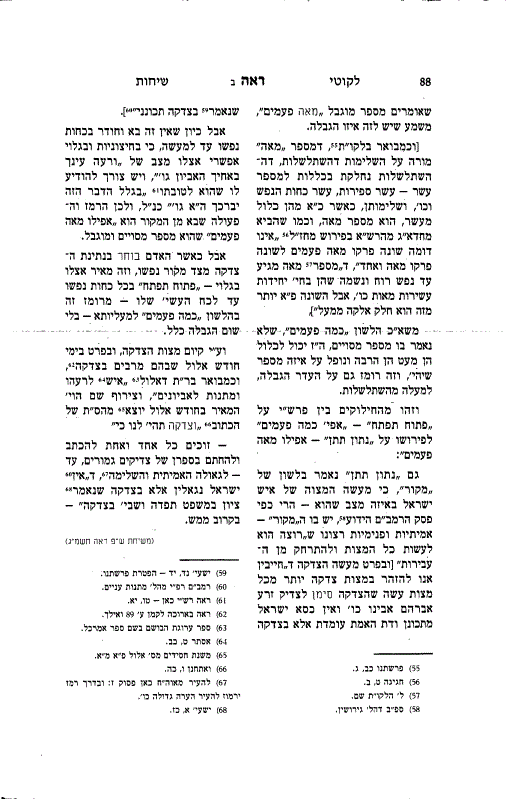
And this, that we learn from "you shall surely open" and "you shall surely give" — even a hundred times, is explained in the Rambam and brought in the commentaries here that it is because it is stated in the form of "source" — "open," "give," and the "source applies to both the small and the great, and therefore one is obligated because it is a source, etc., even a thousand times," that "the concept of the source — includes much until infinity, and this is 'a hundred times' because this is the way of the Gemara when it wants to express an infinite amount, it says a hundred times."
It is explained elsewhere the reason for this in the inner dimensions: Action, in and of itself, is measured and limited. Even when action stems from the faculties of one's soul, intellect, and emotions, which then infuse the action with vitality, it is still limited, because human intellect and emotions are inherently limited. However, when action comes from the will of the soul, and certainly when it comes from the essence of the soul, which has no limitations, it affects the power of action to also be without limitations.
This is the reason why a command in the form of a "source" indicates "even a hundred times," because a general command is connected to the power of action of a person (since the command is about his action). In contrast, when the command is stated in the form of a "source," it means that this action comes from the "source," from the will of the soul, which is the source of all powers, and therefore it is "even a hundred times," because through the essence of the soul, all limitations are nullified.
However, although in general "a hundred times" indicates the absence of limitation, nevertheless, from the very fact that a specific number "a hundred times" is mentioned, it implies some limitation.
[As explained in Likutei Torah, the number "one hundred" indicates the completeness of the chain of creation, which is generally divided into the number ten — ten Sefiros, ten faculties of the soul, etc., and their completeness, when each is included in ten, is the number one hundred, as brought from the Maharsha in explanation of the saying of our Sages, "There is no comparison between one who reviews his lesson a hundred times and one who reviews it a hundred and one times," for "the number one hundred reaches up to the levels of Nefesh, Ruach, and Neshamah, which are singular units of hundreds, etc., but one who reviews one more time is a part of G‑d above"],
whereas the expression "several times," which does not specify a particular number, can include both few and many and applies to any number, and this also hints at the absence of limitation, beyond the chain of creation.
This is one of the differences between Rashi's commentary on "you shall surely open" — "even several times" and his commentary on "you shall surely give" — "even a hundred times":
Even "you shall surely give" is stated in the form of a "source," because the act of the mitzvah of a Jewish person, in whatever state he is, as per the well-known ruling of the Rambam, contains the "source" — the truth and inner will that "he wants to perform all the mitzvos and distance himself from transgressions" [especially the act of charity, for "we are obligated to be more careful with the mitzvah of charity than with any other positive commandment, for charity is a sign of the righteous, the seed of our forefather Abraham, etc., and the throne of Israel is not established, nor does the true religion stand, except through charity, as it is said, 'You shall be established through charity'"].
But since this does not penetrate and illuminate his soul's faculties until it reaches action, because externally and openly he may be in a state of "and your eye is evil against your poor brother, etc.," there is a need to inform him that it is for his benefit "because of this thing, the L‑rd your G‑d will bless you, etc.," as mentioned above. Therefore, the hint and effect that comes from the source is "even a hundred times," which is a specific and limited number.
However, when a person chooses to give charity from the source of his soul, and this illuminates within him openly — "you shall surely open" with all the powers of his soul, even to his power of action — this is hinted at in the expression "several times" for the better — without any limitation at all.
And through the fulfillment of the mitzvah of charity, especially during the days of the month of Elul when charity is increased, as explained in the acronym of Elul "a man to his friend and gifts to the poor," and the combination of the Name of Havayah that shines in the month of Elul is derived from the final letters of the verse "and charity shall be for us because"
— each and every one merits to be inscribed and sealed in the book of completely righteous, until — the true and complete redemption, for "Israel is redeemed only through charity, as it is said, 'Zion shall be redeemed with justice, and her captives with charity'" — very soon.