Likkutei Sichos Vol. 29 – Ki Savo 1
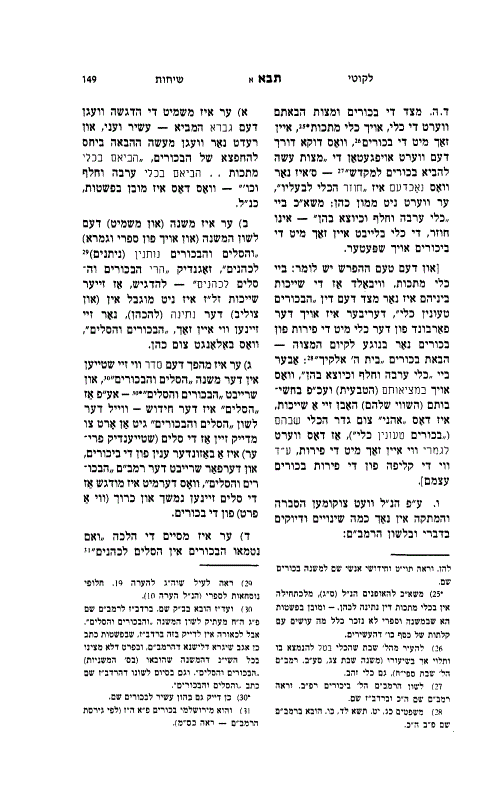
1. Regarding the mitzvah of Bikkurim, which requires that "the first fruits need a vessel," the Rambam states: If one brings them in metal vessels, the kohen takes the Bikkurim and the vessel is returned to its owner. However, if they are brought in willow or palm baskets and the like, both the Bikkurim and the baskets belong to the kohanim.
We need to understand: The source of this law, as commentators point out, is the Mishnah in Bikkurim, which states: "The wealthy bring their Bikkurim in baskets of silver and gold, while the poor bring them in wicker baskets of peeled willow, and both the baskets and the Bikkurim are given to the kohanim." From this Mishnah, the Gemara learns the principle: "From where do people say that poverty follows the poor? As it is taught, the wealthy... and the poor... the baskets and the Bikkurim are given to the kohanim."
From this, it is understood simply that the difference between "baskets of gold" and "wicker baskets" depends on the intention of the giver. Since it was customary for the wealthy to bring the Bikkurim in expensive vessels "of silver and gold," they did not intend to give away these costly vessels, as Rashi explicitly states: "The wealthy did not give their baskets to the kohen," presumably because of their value, and therefore they remain with the owners. In contrast, the poor, who bring the Bikkurim in "wicker baskets" (as they cannot afford expensive vessels), intend to give away the vessels as well, and therefore the "baskets" also belong to the kohanim. This supports the Gemara's proof for the principle "poverty follows the poor," as because he is poor, he brings the Bikkurim in "wicker baskets" — thus "poverty follows him" — and the "baskets" remain with the kohen.
However, the Rambam emphasizes the distinction between "metal vessels" and "willow vessels," without mentioning the difference between wealthy and poor. This implies that, according to the Rambam, it does not depend on the intention of the giver [which is related to the value or cheapness of the vessels, especially since "metal vessels" can also be of little value], but rather the distinction is connected to the type of vessel itself — whether it is a "metal vessel" or a "willow or palm basket."
1. According to the Rambam's approach, when the Gemara cites the source for the principle "poverty follows the poor" from the Mishnah in Bikkurim, which states "the wealthy bring...," it means not because the intention of the giver with a poor man's vessel is to give it to the kohen, but rather due to the consequence of the law: a poor person typically brings in a "wicker basket," and such a type of vessel must remain with the kohen.
— The Rambam's perspective requires further explanation.
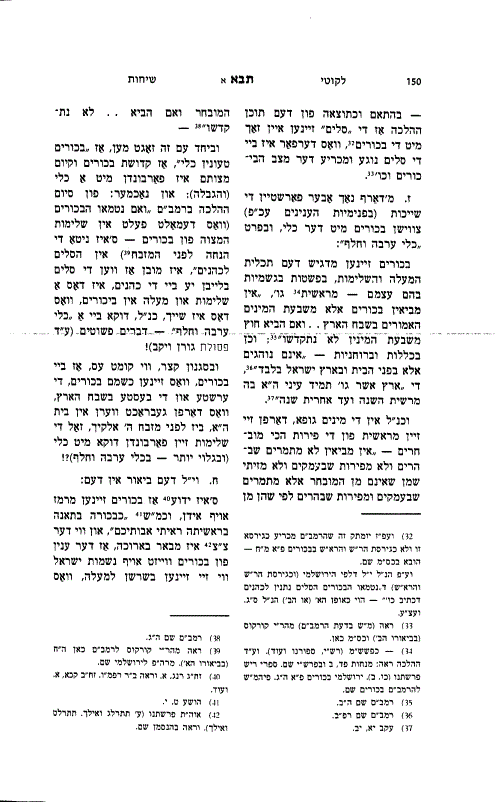
2. On the verse "And the kohen shall take the basket from your hand," the Sifrei states: From here they said that the wealthy bring Bikkurim in baskets of silver and gold, while the poor bring them in wicker baskets of peeled willow, and the baskets are given to the kohanim as a gift.
Commentators explain the interpretation of the Sifrei: from the word "the basket," which seems superfluous, we learn that the law "and the kohen shall take" (and it becomes his) applies specifically "when it is a basket, a simple basket," unlike if it is a "metal vessel" or similar.
The reason for this is "to provide a gift to the kohanim," as the Tosefos Yom Tov explains: Since the Bikkurim fruits of the poor are "few," it was instituted that a poor person should also give away the basket, so that "with the basket it will be considered a gift."
However, it is understood that this cannot be the Rambam's view, because according to this, it depends primarily not on the vessel in which the Bikkurim are brought, but on the quantity of fruits brought for Bikkurim — which again depends on the distinction between wealthy and poor — whereas the Rambam only distinguishes, as mentioned, between the types of vessels themselves and not the difference between the wealthy and poor in the quantity of fruits found in the vessels.
3. The explanation can be as follows: The obligation to give the basket to the kohanim along with the Bikkurim can be understood in several ways. Among them:
a) The connection of the baskets with the Bikkurim is only in their bringing, but the obligation to give the baskets to the kohanim is a separate obligation of giving, which has no connection to the obligation of giving the Bikkurim themselves.
b) The giving of the baskets has a connection to the giving of the Bikkurim, but the connection is only regarding the obligation of giving, that the obligation to give the Bikkurim to the kohen also drags along the giving of the baskets — but not that the act of giving the baskets is in the same category as the giving of the Bikkurim.
c) Or even more — that the connection is not only in the obligation of giving but also in the act of giving: the Bikkurim and the baskets must be given together in one act of giving.
Since there is a practical halachic difference between these approaches:
4. According to the first approach, where the connection of the baskets with the Bikkurim is only in their bringing to the "House of the L‑rd," the giving of the baskets has no connection with the giving of the Bikkurim. Consequently, the baskets can be given to any kohen, and perhaps it can be said that it does not necessarily have to be from the members of the watch.
According to the second approach, where the obligation to give the baskets is a result of the obligation to give the Bikkurim, it is reasonable that they should be given to the kohanim of the same watch, just like the Bikkurim themselves; however, not necessarily to the same kohen (or kohanim) who receives the Bikkurim.
According to the third approach, however, where the connection is also in that there must be one act of giving, it is clear that they are given to the same kohen (or kohanim) and in one act with the Bikkurim.
5. Based on this, it can be said that this is the difference between the interpretation of the Sifri according to its simple meaning, the interpretation of the Gemara in Bava Kama according to Rashi, and the explanation of the Tosefta, etc., in the Sifri:
a) From the fact that the law, that the baskets are given to the kohanim, is derived in the Sifri from the verse "And the kohen shall take the basket from your hand" as a specific law regarding the "basket," and also from the conclusion of the matter in the Sifri where it states "and baskets are given to the kohanim" — it implies that the obligation to give the baskets to the kohanim is a separate matter in the giving, not the giving of the Bikkurim. And this is the intention of the Sifri in its conclusion — "to grant a gift to the kohanim," that it is a separate "gift to the kohanim" that the poor person has, by giving the "basket" to the kohen.
b) In the Gemara Bava Kama, where the Mishnah is brought as a source for the saying "people say, humility follows the poor," it is proven from Rashi's commentary there, "and the wealthy did not give their baskets to the kohen," that the giving of the baskets by the poor to the kohen has a connection with their humble giving of the Bikkurim; and from this, that they give away the baskets in addition to the giving of the Bikkurim. However, on the other hand, there is no proof to say that the baskets have a connection to the Bikkurim themselves to the extent that their givings should be one act (and on the contrary: the expression "humility follows" would not be as fitting if the baskets were part of the giving of the Bikkurim).
3. According to the explanation of the Tosefos Yom Tov, etc., in the Sifri, "that the poor bring a small amount and with the basket it will be considered a gift" — meaning, the basket completes the Bikkurim so that they are considered a "gift" — it is reasonable to say that the giving of the baskets should be in one act of giving ("gift") with the Bikkurim, so that the Bikkurim will be a "sufficient gift."
5. Since the Rambam learns this in a fourth manner — with an additional novelty over the aforementioned approaches:
Not only is the basket connected with the Bikkurim in the act of giving, but it becomes like one entity with the Bikkurim (and the bringing of the Bikkurim): When is the completion of the Bikkurim and the fulfillment of their mitzvah — the bringing of Bikkurim — when the fruits are brought in a vessel and the vessel becomes like a part of the Bikkurim. In other words, the connection is not only in the action and the act (as in the second and third approaches), but also in the result, becoming one entity.
And the Rambam clarifies this by placing the law "if he brought them in metal vessels, etc." in continuation to the previous law "the Bikkurim require a vessel", meaning that the vessel (is connected and) becomes one entity with the Bikkurim; and in this law, there is no distinction between one type of vessel and another.
And the reason the Rambam distinguishes between "metal vessels" and "willow and palm baskets" is only because with "metal vessels" there is a special law, as indicated by the Rambam's wording "the vessel returns to its owner" — meaning, from the perspective of the Bikkurim and their mitzvah of bringing, the vessel, even a metal vessel, becomes one entity with the Bikkurim, which only through this is the "positive commandment to bring Bikkurim to the Temple" fulfilled — it is just that afterwards "the vessel returns to its owner," it does not become the property of the kohen. Whereas with "willow and palm baskets and the like" — it does not return, the vessel remains one entity with the Bikkurim even later.
5. The reason for the distinction can be explained as follows: With metal vessels, since their connection is only due to the law "the Bikkurim require a vessel," the connection between the vessel and the Bikkurim fruits is only relevant to the fulfillment of the mitzvah of bringing the Bikkurim to "the house of the L‑rd, your G‑d." However, with "willow and palm baskets and the like," which have a natural connection (at least in their importance or value), this connection affects the nature of the vessel itself ("the Bikkurim require a vessel"), so that it becomes completely like one entity with the fruits, similar to the peel of the Bikkurim fruits themselves.
6. Based on the above, we can further explain and clarify several changes and nuances in the words and language of the Rambam:
a) He omits the emphasis on the person bringing the Bikkurim — whether wealthy or poor — and speaks only about the act of bringing in relation to the object of the Bikkurim, "he brought them in metal vessels... he brought them in willow and palm baskets, etc." — which is understood simply, as explained above.
b) He changes (and omits) the language of the Mishnah "and the baskets and the Bikkurim are given to the kohanim," saying instead "the Bikkurim and the baskets are for the kohanim" — to emphasize that their connection to each other is not limited to (and because of) the giving (to the kohen), but rather they are like one entity, "the Bikkurim and the baskets," which belong to the kohen.
c) He reverses the order as it appears in the Mishnah "the baskets and the Bikkurim," and writes "the Bikkurim and the baskets" — even though "the baskets" is the novelty — because the phrase "the baskets and the Bikkurim" gives room to deduce that the baskets (standing first) are a separate matter from the Bikkurim. Therefore, the Rambam writes "the Bikkurim and the baskets," which emphasizes that the baskets are drawn and connected (as a detail) to the Bikkurim.
d) He concludes the law with "and if the Bikkurim become impure, the baskets are not for the kohanim" — in accordance with and as a result of the content of the law that the "baskets" are one entity with the Bikkurim, and therefore, the state of the Bikkurim is decisive and influential regarding the baskets, etc.
7. However, we still need to understand the connection (at least in the inner dimensions of the matters) between the Bikkurim and the vessel, especially "willow and palm baskets":
8. Bikkurim emphasize the ultimate elevation and perfection, both in their simple, physical form — as they are from the "first of" the seven species mentioned in the praise of the land, "Bikkurim are only brought from the seven species mentioned in the praise of the land... and if one brings from outside the seven species, they are not sanctified"; and also in a general and spiritual sense — "they are only practiced in the presence of the Temple and only in the Land of Israel," the "land which... the eyes of the L‑rd your G‑d are always upon it, from the beginning of the year to the end of the year."
As mentioned above, it is not enough that they are from the species themselves; they must be from the first and choicest fruits — "one does not bring from mountain dates or valley fruits or oil olives that are not of the best, but from valley dates and mountain fruits because they are of the best, and if one brings... they are not sanctified."
Along with this, it is said that "Bikkurim require a vessel," that the sanctity of Bikkurim and the fulfillment of their mitzvah is connected with a vessel (and a limitation); furthermore, from the conclusion of the law in the Rambam, "and if the Bikkurim become impure (which then lacks the completion of the mitzvah of Bikkurim — there is no placement before the altar), the baskets are not for the kohanim," it is understood that when the baskets remain with the kohanim, it is a completion and an advantage in Bikkurim, which, as mentioned, is specifically related to a "willow and palm basket" — simple things (like the waste of the threshing floor and winepress)!
In brief, how is it that with Bikkurim, which are, as their name implies, the first and the best in the praise of the land, which must be brought to the House of the L‑rd, up to "before the altar of the L‑rd your G‑d," their completion is specifically connected with a vessel (and more explicitly — with a willow and palm basket)?!
9. It can be explained as follows:
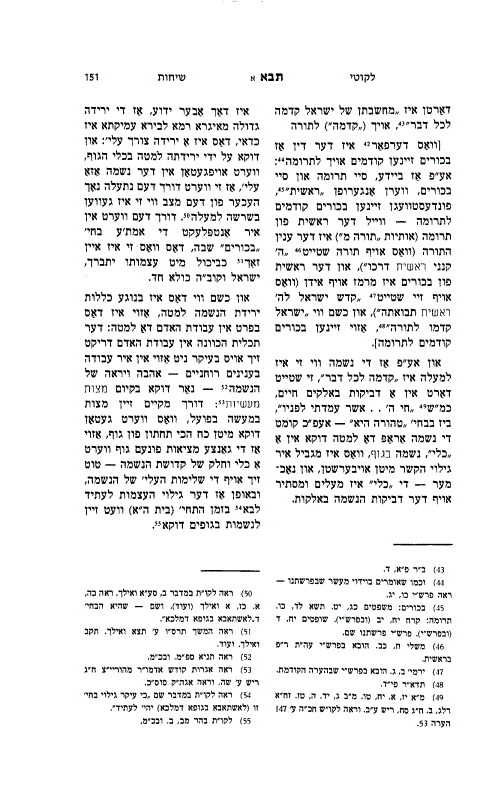
It is known that Bikkurim allude to the Jewish people, as it is written, "like the first fruit of the fig tree in its beginning, I saw your fathers," and as the Tzemach Tzedek explains at length, the concept of Bikkurim points to the souls of Israel as they are in their root above, where "the thought of Israel preceded everything," even ("preceded") the Torah.
[Therefore, the law is that Bikkurim precede even Terumah: although both Terumah and Bikkurim are called "first," nevertheless, Bikkurim precede Terumah — because the "first" of Terumah (the letters "Torah M") is the concept of the Torah (about which it is stated, "The L‑rd acquired me at the beginning of His way"), and the "first" of Bikkurim alludes to the Jewish people (about whom it is stated, "Israel is holy to the L‑rd, the first of His produce"), and just as "Israel preceded the Torah," so too Bikkurim precede Terumah].
10. And although the soul, as it is above, "preceded everything," standing there in a cleaving to the living G‑d, as it is written, "As the L‑rd lives, before whom I stand," reaching the level of "pure it is" — nevertheless, the soul descends here below specifically into a "vessel," a soul in a body, which limits its revelation and connection with the Creator. Moreover, the "vessel" conceals and obscures the soul's cleaving to G‑dliness.
However, it is known that this great descent from a high peak to a deep pit is worthwhile, as it is a descent for the sake of an ascent. Specifically through its descent below into the vessel of the body, the soul achieves such an ascent that it becomes elevated even higher than its state in its root above. Through this, the true aspect of "Bikkurim" within it is revealed, that it is, so to speak, one with the Essence of the Blessed One, as "Israel and the Holy One, blessed be He, are entirely one."
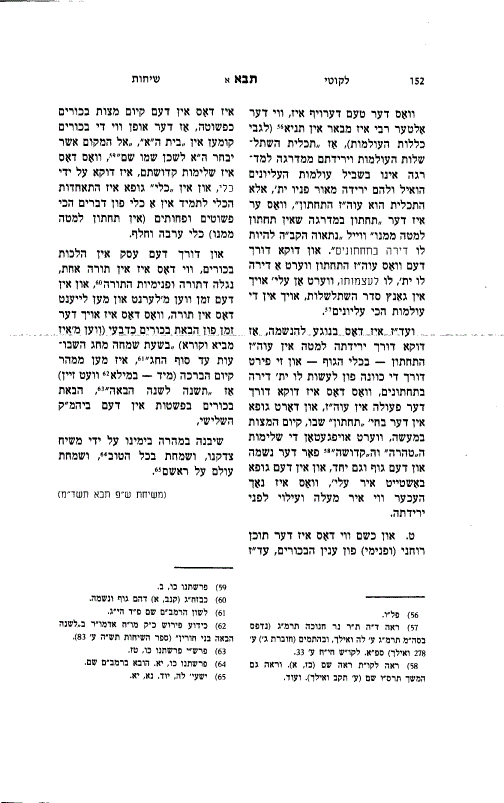
Just as this is true regarding the general descent of the soul below, so too it is in particular concerning the service of man here below: the ultimate purpose in the service of man is expressed not primarily in spiritual matters — the love and awe of the soul — but specifically in the fulfillment of practical mitzvos. By fulfilling mitzvos in actual deed, which is done specifically with the lowest power of the body, so that the entire existence of the body becomes a vessel and part of the holiness of the soul, the perfection of the soul's ascent is achieved. This is in such a manner that the revelation of the Essence in the future, at the time of the resurrection, will be specifically for souls in bodies.
The reason for this, as the Alter Rebbe explains in Tanya (regarding the general worlds), is that "the purpose of the chain of worlds and their descent from level to level is not for the higher worlds, since for them it is a descent from the light of His Countenance, but the purpose is this lowest world," which is the "lowest in degree, with none lower beneath it," because "the Holy One, blessed be He, desired to have a dwelling in the lower realms." And specifically through this, that this lowest world becomes a dwelling for Him, for His Essence, there is an ascent in the entire order of the chain of worlds, even in the highest worlds.
9. Based on this, regarding the soul, it is specifically through its descent into this lowest world — within the vessel of the body — and by fulfilling the intention of making for Him, blessed be He, a dwelling in the lower realms, which is achieved specifically through action in this world, and particularly in the aspect of the "lowest" within it, the fulfillment of mitzvos in deed, that the perfection of "purity" and "holiness" is accomplished for the soul and the body together. And in this itself lies its ascent, which is even greater than its level and elevation before its descent.
10. Just as this is the spiritual (and inner) content of the concept of the first fruits, so too is it in the fulfillment of the mitzvah of the first fruits in its simple sense. The manner in which the first fruits come into the "House of the L‑rd," "to the place which the L‑rd your G‑d will choose to place His Name there," which is the perfection of their holiness, is specifically through a vessel. And within the "vessel" itself, it is the unification of the vessel permanently in a vessel made of the simplest and most insignificant materials (in the lowest of the low), a basket of willow and palm.
And through engaging in the laws of the first fruits, as it is in one Torah, both the revealed Torah and the inner Torah, and at the time when one learns and reads this in the Torah, which is also the time of bringing the first fruits properly (when one brings and recites) "at the time of joy from the festival of Shavuos until the end of the festival," one hastens the fulfillment of the blessing (immediately — automatically it will be) that "next year you shall repeat," the bringing of the first fruits in its simple sense in the Third Beis HaMikdash,
which will be built speedily in our days by our righteous Moshiach, and you shall rejoice in all the good, and everlasting joy shall be upon their heads.
(From the talk of Shabbos Parshas Ki Savo, 5744)