

Parshas Yisro
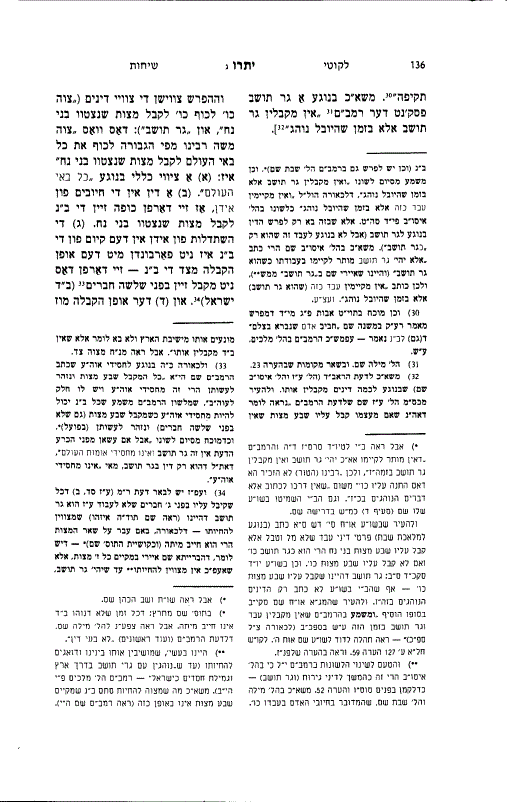
1. The Rambam states in Sefer "HaYad"1: "משה רבינו לא הנחיל התורה והמצות אלא לישראל שנאמר2 מורשה קהלת יעקב3 ולכל הרוצה להתגייר משאר האומות שנאמר4 ככם כגר, אבל מי שלא רצה אין כופין אותו לקבל תורה ומצות, וכן צוה משה רבינו מפי הגבורה לכוף את כל באי העולם לקבל מצות שנצטוו בני נח וכל מי שלא יקבל יהרג" ("Moshe Rabbeinu bequeathed the Torah and the mitzvos only to Israel, as it says, 'An inheritance of the congregation of Yaakov,' and to anyone from the other nations who wishes to convert, as it says, 'As you, so shall the convert be.' But one who does not wish to is not compelled to accept Torah and mitzvos. And so too Moshe Rabbeinu commanded, from the mouth of the Almighty, to compel all the inhabitants of the world to accept the commandments that the Bnei Noach were commanded; and whoever does not accept is put to death").
From the plain meaning of the Rambam's words it is understood that the obligation "לכוף את כל באי העולם לקבל מצות שנצטוו בני נח" ("to compel all the inhabitants of the world to accept the commandments that the Bnei Noach were commanded") is connected with the Giving of the Torah. This is emphasized even more in the following halachah in the Rambam5: "כל המקבל שבע מצות ונזהר לעשותן הרי זה מחסידי אומות העולם כו' והוא שיקבל אותן ויעשה אותן מפני שצוה בהן הקב"ה בתורה והודיענו על ידי משה רבינו שבני נח מקודם נצטוו בהן" ("Whoever accepts the seven commandments and is careful to observe them is one of the pious of the nations of the world… provided that he accepts them and observes them because the Holy One, blessed be He, commanded them in the Torah and made known to us through Moshe Rabbeinu that the Bnei Noach had previously been commanded in them").
This needs to be understood: What connection does the observance by the Bnei Noach of their commandments have with Jews — to the point that upon Jews there rests an obligation "to compel all the inhabitants of the world" to fulfill the seven commandments? And we must also understand the connection to the Giving of the Torah and to Moshe Rabbeinu — that their observance must be because "the Holy One, blessed be He, commanded them in the Torah and made it known to us through Moshe Rabbeinu"6?
2. Seemingly, one could explain the reason why their observance must be "because the Holy One, blessed be He, commanded them in the Torah…"7 according to the way the Rishonim8 define the distinction between the titles one finds regarding a non-Jew: ger toshav (resident alien), ben Noach (and an idolater (akum*8, Kuti9)) — that a ger toshav is one who accepted upon himself, before a Jewish court, to fulfill the seven Noahide commandments, "וכיון שקבלן בב"ד הוא נקרא בשבע מצות אלו מצווה ועושה וכי הא אנו מצווין להחיותו .. וב"נ הוא שלא קבלם בב"ד אלא דקים לן שמקיים אותם מעצמו והוא נדון בהם כמו שאינו מצווה ועושה" ("and since he accepted them in court, he is called, with regard to these seven commandments, one who is commanded and performs, and we are commanded to sustain him… whereas a ben Noach is one who did not accept them in court, but we know that he observes them on his own, and he is judged regarding them as one who is not commanded and performs")10 (and a plain gentile is one who is not careful regarding the seven commandments11).
Accordingly, it seemingly emerges that at the Giving of the Torah the obligation and command to the Bnei Noach regarding the observance of their commandments was annulled; and as the Gemara12 says on the verse13 "עמד וימודד ארץ ראה ויתר גוים" ("He stood and measured the earth; He saw and released the nations"): "ראה ז' מצות שקבלו עליהם בני נח ולא קיימום עמד והתירן להן" ("He saw the seven commandments that the Bnei Noach accepted upon themselves and did not keep; He rose and released them from them"); and the Gemara there concludes, "לומר שאפילו מקיימין אותן אין מקבלים עליהם שכר .. כמצווה ועושה אלא כמי שאינו מצווה ועושה" ("to say that even if they keep them, they do not receive reward for them… as one who is commanded and performs, but as one who is not commanded and performs"); "אין מצווין לקיימן" ("they are not commanded to keep them")14.
And at the Giving of the Torah there came a new obligation regarding the seven commandments: G‑d declared in the Torah that the Bnei Noach are obligated in the seven commandments — a new law was introduced, that when a ben Noach accepts the seven commandments before a Jewish court he is called "one who is commanded and performs"15 in the seven commandments16.
Therefore the Rambam says that their acceptance and observance must be "because the Holy One, blessed be He, commanded them in the Torah and made it known to us through Moshe Rabbeinu"17 — because the earlier obligation was annulled18.
However, the Rambam cannot be explained this way, because:
a) From the continuation of the Rambam's wording, "and made known to us through Moshe Rabbeinu that the Bnei Noach had previously been commanded in them"19 (that the command to the Bnei Noach began "previously"), it is seemingly implied that the command to the Bnei Noach was not annulled20.
b) This only explains what the Rambam says in the second halachah (cited above): that a ben Noach is called a "ger toshav" and one of the "pious of the nations of the world" specifically when he accepts and performs the seven commandments "because the Holy One, blessed be He, commanded them…"
But the earlier law (cited above) in the Rambam remains unexplained — "Moshe Rabbeinu commanded…" (which comes in continuation of the beginning of the halachah: "Moshe bequeathed the Torah and mitzvos only to Israel…") "to compel all the inhabitants of the world to accept the commandments that the Bnei Noach were commanded" — which is (not a law concerning the acceptance of the commandments by the ben Noach, but rather) a command upon Jews, that they must compel the Bnei Noach to accept their commandments. What connection does the observance of the Noahide commandments have with Jews — to the point of compelling?
3. The source of this command to Jews stems from the very fact that "the Holy One, blessed be He, commanded them in the Torah and made it known to us through Moshe Rabbeinu that the Bnei Noach had previously been commanded in them." For seemingly: Why did G‑d make it known to us through Moshe Rabbeinu, and "commanded them in the Torah" — "which He bequeathed to Israel" — regarding the seven Noahide commandments? From this it is seemingly understood that this is an obligation upon Jews (and the word (— the concept of) "previously" is a parenthetical statement, [indicating] that the command to the Bnei Noach had begun previously).
Accordingly, one can say even more — that the reason why there is an obligation upon Jews "to compel…" stems from the very fact that the Bnei Noach must accept (and perform) the seven commandments "because the Holy One, blessed be He, commanded them in the Torah…" — for the connection of a ben Noach to Torah is only through the Jewish people (to whom the Torah was given).
But — what is the explanation of the connection (that a Jew should need to occupy himself with "compelling all the inhabitants of the world…")?
4. Furthermore: From the words of the Rambam it is understood that the obligation upon Jews "to compel all the inhabitants of the world…" is not connected with the law "provided that he accepts them… because the Holy One, blessed be He, commanded them in the Torah…":
The Rogatchover21 says that according to the Rambam's view there are two categories: a) a ger toshav, which is specifically when he accepted in court (before three chaverim); b) a ben Noach who does not accept the seven commandments in court, or22 [who lives] nowadays when the Jubilee is not in effect (and consequently "אין מקבלין גר תושב" ("a ger toshav is not accepted")23), and who observes the seven commandments — regarding whom too "מצווין עליו להחיותו" ("we are commanded to sustain him")*23.
And since even regarding a ben Noach who is not a ger toshav "we are commanded to sustain him," it must necessarily be said that when the Rambam says "Moshe Rabbeinu commanded… to compel… to accept the commandments that the Bnei Noach were commanded, and whoever does not accept is put to death," he means by this (not (specifically) an acceptance "before three chaverim" (in court) in order to become a ger toshav, but even) a (plain) acceptance to fulfill the seven commandments (the law of a plain ben Noach); that is, the law "to compel all the inhabitants of the world to accept…" is not connected with the law of a ger toshav.
Accordingly, the precise order of the Rambam's wording in the aforementioned halachah is better understood. These are his words: "Moshe Rabbeinu commanded from the mouth of the Almighty to compel all the inhabitants of the world to accept the commandments that the Bnei Noach were commanded, and whoever does not accept is put to death. "והמקבל אותם הוא הנקרא גר תושב בכל מקום וצריך לקבל עליו בפני שלשה חברים" ("And one who accepts them is the one called a ger toshav everywhere, and he must accept [them] upon himself before three chaverim")."
From the fact that the Rambam says "to compel… to accept the commandments that were commanded," and does not immediately conclude "(to accept the commandments that were commanded) and they shall be like gerei toshav" or the like (similar to his wording elsewhere24), it is implied that the matter of "and one who accepts them is the one called a ger toshav" is a separate matter, and not an explanation (and condition) of "to compel all the inhabitants of the world to accept the commandments that the Bnei Noach were commanded." And it is obvious that the command "to compel all the inhabitants of the world to accept the commandments that the Bnei Noach were commanded" is for the very purpose that they accept the commandments with which they were commanded, and not in order that they become a "ger toshav"25,
[and as is also implied from the Kesef Mishneh26: regarding a slave who has not been circumcised, the Rambam26 says "מותר לקיימו ובלבד שיקבל עליו שבע מצות שנצטוו בני נח . . אבל אם לא קיבל עליו שבע מצות יהרג מיד" ("it is permitted to keep him, provided he accepts upon himself the seven commandments that the Bnei Noach were commanded… but if he did not accept upon himself the seven commandments, he is put to death immediately") (the reason for which is27 because "Moshe commanded… to compel all the inhabitants of the world… and whoever does not accept is put to death"). The Raavad objects to this: "אין לנו עתה להרוג איש" ("we may not now put anyone to death"); to which the Kesef Mishneh says: "אין כאן השגה על דברי רבינו . . ואם אין ידינו תקיפה בעונותינו לא מפני זה ה"ל להניח מלכתוב הדין" ("There is no objection here to the words of our master… and if, because of our sins, our hand is not strong, he should not on that account have refrained from writing the law").
From this it is understood that the law "Moshe commanded… to compel… to accept the commandments… and whoever does not accept is put to death" is an obligation that is in force also28 nowadays*28, when the Jubilee is not in effect29, and also when "our hand is not strong"30. Whereas regarding a ger toshav, the Rambam31 rules: "אין מקבלין גר תושב אלא בזמן שהיובל נוהג" ("a ger toshav is accepted only when the Jubilee is in effect")32.]
The difference between the two laws ("commanded… to compel… to accept the commandments that the Bnei Noach were commanded," and "ger toshav"): "Moshe Rabbeinu commanded from the mouth of the Almighty to compel all the inhabitants of the world to accept the commandments that the Bnei Noach were commanded" is: (a) a general command concerning "all the inhabitants of the world"; (b) a law among the obligations of Jews, that they must compel the Bnei Noach to accept the commandments that the Bnei Noach were commanded; (c) the effort of Jews in the observance of the Bnei Noach is not connected with the manner of acceptance on the part of the Bnei Noach — they need not accept it "before three chaverim"33 (a Jewish court)34; and (d) the manner of acceptance need not specifically be "because the Holy One, blessed be He, commanded them in the Torah"35.
Whereas the definition of a ger toshav is: (a) a law only for the court that wishes to accept [him]; (b) only when the acceptance by the court is "before three chaverim"35*; (c) and in a manner that it is "because the Holy One, blessed be He, commanded them in the Torah" ("אבל אם עשאן מפני הכרע הדעת אין זה גר תושב" ("but if he performed them because of an intellectual conclusion, he is not a ger toshav")).
That is, the law "to compel all the inhabitants of the world to accept…" is not connected with the law of acceptance (in a Jewish court) that was introduced at the Giving of the Torah, through which the ben Noach becomes a ger toshav (one who is commanded and performs35).
5. This will be understood by first considering the Rambam's wording, "Moshe Rabbeinu commanded from the mouth of the Almighty to compel all the inhabitants of the world" — not [merely] to make an effort that all the inhabitants of the world accept36 the commandments that the Bnei Noach were commanded, or the like; the command extends to the point of "compelling."
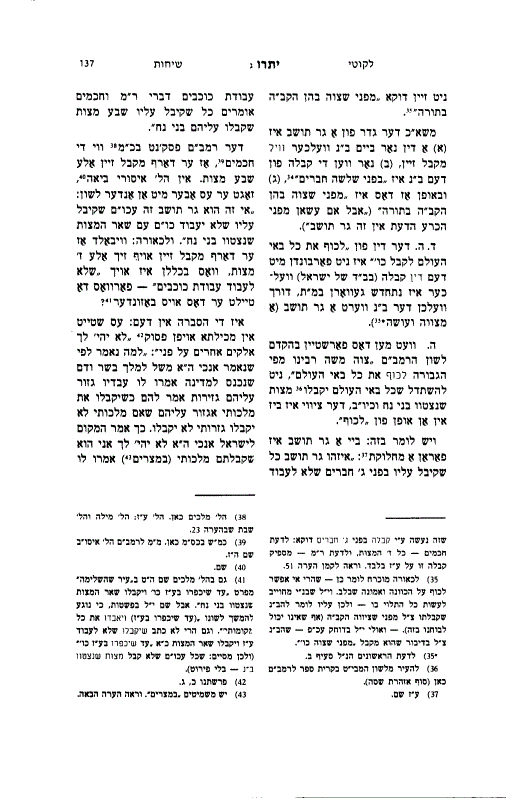
It may be said about this: Regarding a ger toshav there is a dispute37: "איזהו גר תושב כל שקיבל עליו בפני ג' חברים שלא לעבוד עבודת כוכבים דברי ר"מ וחכמים אומרים כל שקיבל עליו שבע מצות שקבלו עליהם בני נח" ("Who is a ger toshav? Anyone who accepted upon himself before three chaverim not to worship idols — these are the words of Rabbi Meir; and the Sages say: anyone who accepted upon himself the seven commandments that the Bnei Noach accepted upon themselves").
The Rambam rules in several places38 like the Sages39, that he must accept all seven commandments. In the Laws of Forbidden Relations40, however, he states it with different wording: "אי זה הוא גר תושב זה עכו"ם שקיבל עליו שלא יעבוד כו"ם עם שאר המצות שנצטוו בני נח" ("Who is a ger toshav? This is an idolater who accepted upon himself not to worship idols, together with the other commandments that the Bnei Noach were commanded"). Seemingly: since he must accept upon himself all seven commandments, among which is also "not to worship idols" — why does he single it out separately here41?
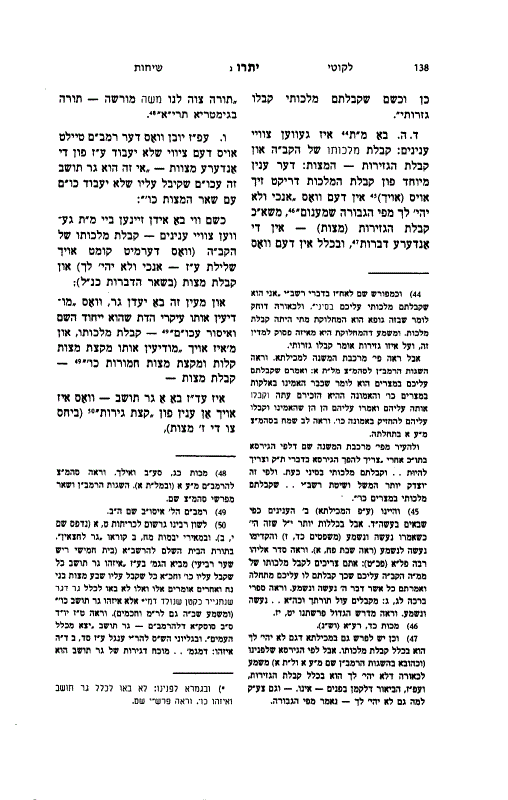
The explanation of this is: The Mechilta states on the verse42 "לא יהי' לך אלקים אחרים על פני" ("You shall have no other gods before Me"): "למה נאמר לפי שנאמר אנכי ה"א משל למלך בשר ודם שנכנס למדינה אמרו לו עבדיו גזור עליהם גזירות אמר להם כשיקבלו את מלכותי אגזור עליהם שאם מלכותי לא יקבלו גזירותי לא יקבלו. כך אמר המקום לישראל אנכי ה"א לא יהי' לך אני הוא שקבלתם מלכותי (במצרים43) אמרו לו כן וכשם שקבלתם מלכותי קבלו גזירותי" ("Why is this said? Because it says, 'I am the L‑rd your G‑d.' A parable to a king of flesh and blood who entered a province. His servants said to him, 'Issue decrees upon them.' He said to them, 'When they accept my sovereignty, I will issue decrees upon them; for if they do not accept my sovereignty, they will not accept my decrees.' So too G‑d said to Israel: 'I am the L‑rd your G‑d; you shall have no… I am He Whose sovereignty you accepted (in Egypt).' They said to Him, 'Yes.' 'And just as you accepted My sovereignty, accept My decrees'").
That is, at the Giving of the Torah44 there were two matters: acceptance of the sovereignty of the Holy One, blessed be He, and acceptance of the decrees — the commandments. The distinct matter of accepting the sovereignty is expressed (also)45 in the fact that "אנכי ולא יהי' לך מפי הגבורה שמענום" ("'I am' and 'You shall have no' we heard from the mouth of the Almighty")46, whereas acceptance of the decrees (commandments) [is expressed] in the other commandments47, and in general in "תורה צוה לנו משה מורשה — תורה בגימטריא תרי"א" ("'Moshe commanded us the Torah, an inheritance' — 'Torah' has the numerical value of 611")48.
6. Accordingly, it will be understood why the Rambam singles out the command not to worship idols from the other commandments — "Who is a ger toshav? This is an idolater who accepted upon himself not to worship idols, together with the other commandments…":
Just as with the Jewish people there were two matters at the Giving of the Torah — acceptance of the sovereignty of the Holy One, blessed be He (which also brings with it the negation of idolatry — "I am" and "You shall have no"), and acceptance of the commandments (in the other commandments, as mentioned above);
and similarly with every convert, whom "מודיעין אותו עיקרי הדת שהוא ייחוד השם ואיסור עכו"ם" ("we inform of the fundamentals of the faith, which are the Oneness of G‑d and the prohibition of idolatry")49 — acceptance of His sovereignty — and whom one also "מודיעין אותו מקצת מצות קלות ומקצת מצות חמורות כו'" ("informs of some of the lighter commandments and some of the weightier commandments…")49 — acceptance of the commandments —
so too with a ger toshav — which is also a matter of "קצת גירות" ("partial conversion")50 (with respect to the seven commandments) — since his acceptance does not come about through coercion but of his own good will, both matters must be present in it: the acceptance "not to worship…" — acceptance of His sovereignty; and the acceptance to fulfill "the other commandments that the Bnei Noach were commanded" — acceptance of His commandments51.
[Accordingly, it is also understood why the Rambam details this specifically in the Laws of Forbidden Relations — because only there does the law of a ger toshav come in continuation of the laws of conversion52.]
7. Accordingly, it may be said that it is similar regarding "all the inhabitants of the world" — also those who do not wish to accept upon themselves the seven commandments before a Jewish court (to become a ger toshav) — that acceptance of His sovereignty is a fundamental element in their observance of the seven commandments53.
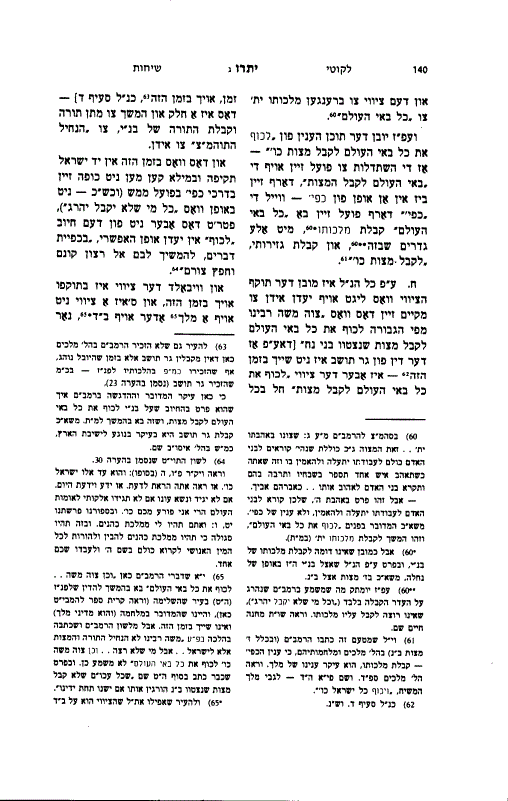
And this is the connection of "Moshe Rabbeinu commanded… to compel… to accept…" to the Giving of the Torah and to the Jewish people54: The purpose of the Giving of the Torah is not only that Jews accept upon themselves the yoke of the Kingdom of Heaven and the yoke of the commandments, but that there be accomplished (also) "והי' ה' למלך על כל הארץ" ("And G‑d shall be King over all the earth")55 — that His sovereignty be heard throughout the entire world56. However, since His sovereignty and His commandments are possessed by the Jewish people in the manner of an "inheritance" (as the Rambam says at the beginning of the halachah: "Moshe Rabbeinu… bequeathed the Torah and the mitzvos… to Israel"), meaning that it has become entirely their own possession57 (to the point that it has, as it were, become such that they have ownership over it: it is called by his name58, he can forgo his honor, etc., since "תורה דילי' היא" ("it is his Torah")59) — they therefore have the power, and the command, to bring His sovereignty to "all the inhabitants of the world"60.
Accordingly, the content of "to compel all the inhabitants of the world to accept the commandments…" will be understood — that the effort to influence "the inhabitants of the world to accept the commandments" must extend to the point of "coercion" — because the "coercion" must bring about, among "all the inhabitants of the world," the acceptance of His sovereignty*60, with all the conditions it involves**60, and the acceptance of His decrees — "to accept the commandments…"61.
8. According to all the above, the force of the command upon every Jew is understood — to fulfill what "Moshe Rabbeinu commanded from the mouth of the Almighty to compel all the inhabitants of the world to accept the commandments that the Bnei Noach were commanded" [for although the law of a ger toshav does not apply nowadays62, the command "to compel all the inhabitants of the world to accept the commandments" applies at all times, also nowadays63, as mentioned in section 4] — this is a part and continuation of the Giving of the Torah and the acceptance of the Torah by the Jewish people, of [Moshe's] "bequeathing the Torah and mitzvos" to the Jewish people.
And the fact that nowadays the hand of Israel is not strong, and consequently one cannot compel through actual physical means of coercion (and all the more so not in the manner that "whoever does not accept is put to death"), does not, however, exempt one from the obligation "to compel" in every possible way — "בכפיית דברים, להמשיך לבם אל רצון קונם וחפץ צורם" ("by compulsion of words, to draw their hearts to the will of their Maker and the desire of their Creator")64.
And since the command is in force also nowadays, and it is a command not upon a king65 or upon a court*65, but upon everyone who has it in his power66 to compel [as is evident from the aforementioned law (section 4) regarding a slave, where the Kesef Mishneh gives the reason for the coercion: "שכיון שזה ברשות ישראל שהרי עבד הוא חייב לכופו לקבל שבע מצות" ("that since this one is under the authority of a Jew, for he is a slave, he is obligated to compel him to accept the seven commandments"), because "Moshe commanded… to compel all the inhabitants of the world…"],
it is understood that everyone who has an opportunity for this — and all the more so one who has contact (through business and the like) with Bnei Noach — must make an effort and exert influence67 upon them to accept their seven commandments68.
9. A further explanation is needed: Since the command "to compel" applies also nowadays — why is the law not stated explicitly in the Shulchan Aruch and its commentators?
Moreover: The command obligates every Jew who has the ability "to compel" — and it is well known that in earlier generations there were many Jews who had the power and the suitable conditions for this; surely, then, they fulfilled the command and acted upon it. Furthermore — certainly various questions arose in connection with it (what the obligation of coercion is, in what manner, etc.) — so why do we not find in the books of responsa that anyone discusses this matter?
The explanation of this may be: It is known from Jewish history that in past times, even in countries where conversion was not forbidden by the government's law, Jews were very careful to avoid anything that could be interpreted as an act of helping someone convert (even in cases where the convert came of his own accord to convert — and certainly not to do anything that could be regarded as an effort and propaganda to convert people) — because even in such countries this was a danger, owing to the turmoil and libels it could provoke, and especially because of the great concern that it would be used against the Jews, as in other countries — as is seen also in the disputations of the Middle Ages and elsewhere, and even in recent generations —
and it is understood that the effort of a Jew to influence a ben Noach (and all the more so in a manner of "coercion") to observe the seven commandments was likewise bound up with such danger — it could be taken as interference in their faith, etc., etc.
And especially since one must tell him69 that he should observe [them] "because the Holy One, blessed be He, commanded them in the Torah and made it known to us through Moshe Rabbeinu":
It is therefore understood that as a rule Jews had to refrain from this because of danger to life; and in exceptional cases when it was done, it was with appropriate caution and without publicity.
It is therefore understood why no responsa on this were published either. And it may be said that for the same reason the law ("to compel") is also not mentioned in the Shulchan Aruch and its commentators — in those times it was a matter of danger to life*69.
And it is understood that where the concern is entirely absent — as in these countries — the command to compel applies.
10. Seemingly, one could ask about this from the law in the Shulchan Aruch70: "ויזהר מלהשתתף עם עכו"ם שמא יתחייב לו שבועה ועובר משום לא ישמע על פיך" ("One should be careful not to enter into a partnership with an idolater, lest he become obligated to take an oath to him, and he would transgress 'it shall not be heard on your mouth'71"), from which it is evident that the reason one may not bring about that the gentile swear by his idol is because of the prohibition of "it shall not be heard on your mouth" — whereas according to the above there is an explicit prohibition in this, and on the contrary, a Jew is obligated to bring about (to compel) that the gentile not transgress the prohibition of idolatry?
Furthermore: the Shulchan Aruch72 rules that "דברים שהם מיוחדים למין ממיני אלילים כו' אסור למכור לעובדי אותם אלילים כו' (משום לפני עור73) ואם קונה כך לסחורה מותר" ("items designated for a particular type of idol… may not be sold to the worshipers of those idols… (because of 'before the blind'), but if he buys it for merchandise, it is permitted") — that is, one may sell to someone who does not "worship those idols," even though the latter will sell it to "the worshipers of those idols," because "אלפני עור מפקדינן אבל אלפני דלפני לא מפקדינן" ("we are commanded regarding 'before the blind,' but we are not commanded regarding 'before [one who is] before the blind'")74. And there is also an opinion75 that the prohibition of selling "to the worshipers of those idols" applies specifically when "אין להם אחרים כיוצא בו או שלא יוכלו לקנות במקום אחר, אבל אם יכולים לקנות במקום אחר מותר למכור להם כו'" ("they have no others like it, or they cannot buy it elsewhere; but if they can buy it elsewhere, it is permitted to sell to them…"), because in such cases the prohibition of "before the blind" falls away.
This is puzzling: Since there is the obligation to compel the Bnei Noach to accept the seven commandments, it is seemingly all the more so that one may not perform an act that would enable them to transgress the seven commandments (even in a case where the prohibition of "before the blind" is not present)!
[And although the command to Moshe Rabbeinu (to compel…) is mainly to make an effort that the people of the world accept [them] upon themselves, as mentioned above — it is nevertheless understood and obvious that there is no place to perform an act that assists [one] to transgress the seven commandments, contrary to the acceptance that one brought about in him!]
11. The explanation of this may be:
The command "to compel all the inhabitants of the world…" applies when fulfilling the command does not cause the Jew a loss (a loss, a withholding of profit, etc.)76. Since the Shulchan Aruch there speaks of commerce and sale, and likewise regarding "lending [objects] to them… and lending [money] to them"77, which speaks of a case where one profits from the loan of the object or of money, immediately or in the future, or because of the ways of peace and the like (to negate the prohibition of "לא תחנם" ("do not show them favor")78) — one may sell to them;
whereas because of "it shall not be heard" and "before the blind," which are negative prohibitions, one may not sell even where there is a loss, and (all the more so) where there is a withholding of profit.
Therefore, in our case — in a time and place (as in this country) where the effort of Jews to influence the nations of the world to accept upon themselves the seven commandments is not connected at all with any danger, G‑d forbid, nor with any loss or withholding of monetary profit (on the contrary, the effort will bring assistance to Jews, as will be explained below), the obligation "to compel all the inhabitants of the world to accept the commandments that the Bnei Noach were commanded" applies in its full force.
12. In addition to the main point — that the effort to bring about that the nations of the world accept upon themselves the seven commandments is a command that was given to "Moshe Rabbeinu from the mouth of the Almighty" (as the ruling is stated explicitly in the Rambam) —
there is a further matter here: the effort will bring benefit and assistance to the Jewish people:
All Jews are still under the terrible impression of the horrific events, may the Merciful One save us, that took place some forty years ago. It was seen clearly then that wherever there were pious ones of the nations of the world who to a certain extent observed the seven commandments — they refrained from murder and robbery, may the Merciful One save us — through this (in a natural manner) tens upon tens of Jews were saved.
Certainly "לא תקום פעמים צרה" ("trouble shall not arise a second time")79, may the Merciful One save us and G‑d forbid; and only good, in visible and revealed good — shall there be for each and every one, may they live long and well — for Israel.
And now, given the situation and the times — when one often meets non-Jews in matters of business and the like, in pleasant ways and closeness, etc. — one has a living example of the above, and all the more so from their conduct then, even though at that time it was a danger for the pious of the nations — and all the more so now, especially when it brings them benefit.
This shows how the observance of the commandments by the Bnei Noach brings benefit (also) to the Jewish people, and in various ways.
— Also quite simply: When a non-Jew has the choice — whether to harm the Jew, G‑d forbid (in his livelihood and the like), or, on the contrary, to help him — if the non-Jew is permeated with the awareness of "an Eye that sees and an Ear that hears," etc., the knowledge that he must observe the seven commandments, this will have a very good effect (also) on his attitude toward Jews.
Another point in this: In addition to the fact that through such efforts thousands upon thousands of non-Jews will be added who will observe the seven commandments — the fulfillment of G‑d's command thousands upon thousands of times, and in addition also benefit for Jews, as mentioned above — the effort itself is also something that evokes an attitude of respect and esteem toward Jews: seeing how Jews endeavor that righteousness and justice should reign in the world, and how they exert themselves for the benefit of the entire neighborhood, country, and humanity, there comes about among the nations of the world — "וראו כל עמי הארץ" ("and all the peoples of the earth shall see") that the Jewish people are "נתתיך לאור גוים" ("I have made you a light to the nations")80 — the pride of Yaakov is exalted.
May it be G‑d's will that Jews exert themselves to influence the Bnei Noach to take upon themselves to observe the seven commandments with which they were commanded by the Holy One, blessed be He. Fortunate is the portion and great is the merit of those who will act in this, for in addition to bringing about benefit and assistance for Jews and non-Jews and similar matters (as mentioned above), there comes the most essential of essentials: they fulfill a command that "Moshe Rabbeinu commanded from the mouth of the Almighty."
And the fulfillment of this command is also a close preparation for the fulfillment of the prophecy "כי אז אהפוך אל עמים שפה ברורה לקרוא כולם בשם ה' ולעבדו81 שכם אחד" ("For then I will transform the peoples to a pure language, that they all call upon the name of G‑d and serve Him with one accord")82,
in the true and complete Redemption through our righteous Moshiach, speedily in our days, literally.
(From the sichos of Acharon shel Pesach and the farbrengens following it, 5743)
Notes
1) Laws of Kings 8:10.
2) Berachah 33:4.
3) See Kesef Mishneh there, that its source is Sanhedrin 59a, beginning of the page (and it is cited in the Rambam there, 10:9).
4) Shelach 15:15.
5) Ibid., halachah 11.
6) But this requires study, for from the plain wording of the Rambam it is implied that "and made known to us…" refers only to what follows it: that the Holy One, blessed be He, made known to us, the Jewish people, through Moshe Rabbeinu, that the Bnei Noach had previously been commanded in them — although according to this it requires study what practical difference this notification makes — and it is very forced to say that it is only to reconcile the verses, and that he therefore emphasizes "and made known to us" (and not "and made known") — for seemingly there is no practical difference in this. — And see below, notes 17 and 18. — Perhaps it can be said that the word "previously" is a parenthetical statement; see below in the text. Note also the citations of Maharan on the Rambam, Laws of Kings here, who brought a source for the Rambam's words from the Midrash: "R. [OCR unclear] said: [Regarding] the pious of the nations of the world, we have heard that they have a share in the World to Come… Who is a pious one of the nations of the world? One who accepts upon himself the seven commandments because they are written in the Torah." And see the commentary Yad Yehudah on Asarah Maamaros, Maamar Chakor Din, part 3, ch. 21.
7) And see Likkutei Sichos vol. 16, p. 59ff.; vol. 20, p. 140ff.; and elsewhere.
8) Novellae of the Ramban and the Ritva on Makkos 9a.
*8) And see Rambam there, 10:6 and 12 — the differences between a ben Noach idolater and a ger toshav. And see below, beginning of section 4 [OCR unclear]. Lechem Mishneh, beginning of ch. 10 there.
9) In the Ritva: "Three terms were said regarding gentiles: ger toshav, ben Noach, and Kuti." And in the Ramban, in place of Kuti: "and the goy mentioned everywhere." It needs clarification in each place individually (and especially regarding the third title) whether it was altered by the censor.
*) And see Likkutei Sichos vol. 20, p. 140, note 27.
10) Wording of the Ritva there.
11) So it is in the Ritva there. And in the Ramban: "And the goy mentioned everywhere is a ben Noach regarding whom it has not been established whether he keeps their commandments or not, and presumably most of them do not keep them; therefore…" And see Sifrei, beginning of Parshas Berachah, on the verse "G‑d came from Sinai": "Rather, even the seven commandments that the Bnei Noach accepted upon themselves they were unable to uphold, until they cast them off and they were given to Israel."
12) Bava Kamma 38a; and Avodah Zarah 2b, end of the page, ff. — cited in the Ramban and Ritva there.
13) Chavakuk 3:6.
14) Rashi on Avodah Zarah there — 3a, beginning of the page.
15) See Ramban there: "Why did they say, 'He saw the seven commandments… and He rose and released them'? [It means] that they would not receive reward for them except as one who is not commanded and performs; but this one who accepted them upon himself in a Jewish court is one who is commanded and performs."
16) On all of the above, see Responsa Veshav HaKohen, siman 38, s.v. "Ve'al pi dinim eilu" (though he connects it with the reason that he is called one of the pious of the nations of the world), and in his book Daas Kedoshim (37c ff.).
17) In the Ramban and Ritva it is not mentioned that a ger toshav must accept [them] because the Holy One, blessed be He, commanded them in the Torah and made it known to us through Moshe Rabbeinu. Perhaps this is automatically included when one accepts the commandments in a Jewish court, for this itself indicates that he accepts them in the aforementioned manner, since in a Jewish court the force of all the commands (including those said before Moshe) is solely because the Holy One, blessed be He, so commanded (afterwards) in the Torah and made it known to us through Moshe Rabbeinu — see the Rambam's Commentary on the Mishnah, Chullin, end of ch. 7. Note also the commentary Mayim Chaim (by the Pri Chadash) on the Rambam, Laws of Kings here, who explains that this is the source for the Rambam's words here (regarding a ben Noach), "provided that he accepts them…"
18) Note Sanhedrin (59a): "Every commandment that was said to the Bnei Noach and repeated at Sinai was said to both these and those." And see Rashi on Sanhedrin there, s.v. "Lazeh velazeh," and the sources cited in the next note.
19) And see the Rambam's wording there, beginning of ch. 9. And see Chemdas Yisrael, in Kuntres Ner Mitzvah, Laws of Kings there.
20) For seemingly the Rambam does not hold that "He rose and released them" is halachah. And see note 15 for the view of the Ramban; and see the commentary of R. Yerucham Fishel Perla on the Sefer HaMitzvos of Rav Saadia Gaon, vol. 3, Miluim, section 8 (246d ff.).
21) Tzafnas Paneach on the Rambam, Laws of Forbidden Relations 14:8; Tzafnas Paneach, Mahadura Tinyana, Laws of Idolatry 10:6 (32a; ibid., end of col. 3).
22) In Tzafnas Paneach, Mahadura Tinyana there, he mentions only: "And a ben Noach, that is, at a time when the Jubilee is not in effect… at least to sustain him nowadays, when it is impossible to accept a ger toshav, our master holds that one must sustain him." But in Laws of Forbidden Relations there he wrote: "But without this (without acceptance in court), or at a time when the Jubilee is not in effect, he is then in the category of a ben Noach explained in ch. 10 there, halachah 6."
23) Rambam, Laws of Idolatry, end of 10:6; Laws of Circumcision 1:6; Laws of Shabbos, end of ch. 20; Laws of Forbidden Relations there, halachah 8.
*23) And so it seemingly is in Responsa Tzemach Tzedek, Yoreh De'ah, [OCR unclear].
24) In Laws of Circumcision there, regarding a slave. For although he wrote in Laws of Forbidden Relations there, halachah 7, "And why is he called toshav? Because it is permitted for us to settle him among us in the Land of Israel," nevertheless his name was fixed as ger toshav, as the Rambam calls him everywhere, and as he writes here: "and one who accepts them is the one called a ger toshav everywhere." And see the Raavad and Kesef Mishneh, Laws of Idolatry there.
25) As is also evident from the fact that in the command to compel, the Rambam says "to accept the commandments that were commanded" — "to accept" plainly, and not "to accept before three chaverim" (and see below in the text and in note 34).
26) Laws of Circumcision there.
27) As stated in the Kesef Mishneh there.
28) Even the Raavad disputes only the law that "he is put to death immediately" [for the Raavad holds that nowadays, when we have no Sanhedrin, capital cases cannot be judged, as explained in Tzafnas Paneach, Laws of Circumcision there], but he does not dispute the law "provided he accepts upon himself the seven commandments." Moreover, the Kesef Mishneh there adds that it can be said that the Raavad disputes only the law of "he continues to defer with him… or if he stipulated…," since "nowadays… we cannot put him to death… it is forbidden to keep him… he is sold immediately." And see the Alter Rebbe's Shulchan Aruch, Mahadura Basra on the laws of Shabbos, pertaining to sections 252 and 304 (411a). And see the next note.
*28) Note the Alter Rebbe's Shulchan Aruch, Mahadura Basra there: "And that the Rambam mentioned (in the Laws of Shabbos there) the Noahide commandments regarding a slave and maidservant is because otherwise it is forbidden to keep them at all, even outside the Land and nowadays, according to his view in ch. 1 of the Laws of Circumcision and in ch. [OCR unclear] of the Laws of Forbidden Relations." Note also Tzafnas Paneach, Laws of Circumcision there, at the beginning: "And it can be said that they disagree whether now, nowadays…"; and in Laws of Forbidden Relations there: "But it seems that a resident slave… is always accepted… but from our master's wording at the end of ch. 20 of the Laws of Shabbos it does not seem so, and here too he wrote the opposite."
29) Seemingly, it can be said that what the Rambam writes in Laws of Circumcision, "provided he accepts upon himself the seven commandments and is like a ger toshav," does not mean that he becomes an actual ger toshav (for a ger toshav is accepted only when the Jubilee is in effect), but that he is "like a ger toshav" in this particular detail, that he accepted upon himself the seven Noahide commandments (and so too it can be explained in the Rambam, Laws of Shabbos [OCR unclear]). This is also implied by the conclusion of his wording, "and a ger toshav is accepted only when the Jubilee is in effect," for seemingly he should have said, "and such a slave is kept only when the Jubilee is in effect," as he words it in Laws of Forbidden Relations, end of 14:9. Rather, this comes only to explain the law regarding a ger toshav (but not regarding this slave, who is only "like a ger toshav"), whereas in Laws of Forbidden Relations there he wrote, "rather he shall be a ger toshav; it is permitted to keep him in his service when he is a ger toshav" (meaning that it speaks there of an actual "ger toshav"**), and he therefore writes, "such a slave (who is a ger toshav) is kept only when the Jubilee is in effect." This requires further study.
*) But see Beis Yosef on the Tur, Yoreh De'ah, beginning of siman 267, s.v. "VehaRambam": "that it is not permitted to keep him unless he is a ger toshav, and a ger toshav is not accepted nowadays"; and therefore "our master (the Tur) did not mention the case of 'if he stipulated with him…'," because "his way is to write only matters that apply at all times." The Beis Yosef also omitted it in his Shulchan Aruch there (paragraph 4), as stated in the Derishah there. Note that in Shulchan Aruch, Orach Chaim 304:1, he wrote (regarding labor on Shabbos) the details of the laws of a slave who was not circumcised and did not immerse, but accepted upon himself the seven Noahide commandments, who is like a ger toshav…, and if he did not accept upon himself the seven commandments…; and likewise in Shulchan Aruch, Yoreh De'ah 124:2: "a ger toshav, that is, one who accepted upon himself the seven commandments…" — even though the Beis Yosef in the Shulchan Aruch wrote only the laws that apply nowadays. Note that the Magen Avraham, Orach Chaim there, subsection 2, at its end, added: "And it is implied in the Rambam that a slave and a ger toshav are not accepted nowadays; see there [OCR unclear] (apparently it should read: end of ch. 19)" — see Tehillah LeDavid on the Shulchan Aruch there, section 5; Likkutei Sichos vol. 1, p. 127, note 59. And see the preceding note.
**) The reason for the different wordings in the Rambam may be that in the Laws of Forbidden Relations it comes in continuation of the laws of conversion (and of a ger toshav) — as below in the text, end of section 6, and note 52 — whereas in the Laws of Circumcision and the Laws of Shabbos there, the discussion concerns a person's obligation regarding his slave, etc.
30) And this is also evident in the Tosfos Yom Tov, Avos 3:14, who explains Rabbi Akiva's statement in the Mishnah there, "חביב אדם שנברא בצלם" ("Beloved is man, for he was created in the image [of G‑d]"), as said (also) regarding the Bnei Noach — based on what the Rambam writes in the Laws of Kings. See there.
31) Laws of Circumcision there, and in the other places cited in note 23.
32) This is unlike the view of the Raavad (Laws of Idolatry and Laws of Forbidden Relations there) that with regard to several laws he is accepted. Note the Kesef Mishneh, Laws of Idolatry there, that according to the Rambam "it seems one should say that indeed, if he accepted upon himself the seven commandments on his own, we do not prevent him from settling in the land; he comes only to say that the court does not accept him." But see Minchas Chinuch, mitzvah 94.
33) Seemingly, so it is also regarding the pious of the nations of the world, of whom the Rambam writes there in halachah 11, "Whoever accepts the seven commandments and is careful to observe them is one of the pious of the nations of the world and has a share in the World to Come": from the Rambam's wording it is implied that any ben Noach can be one of the pious of the nations of the world when he accepts the seven commandments (even not before three chaverim) and is careful to observe them (in practice). Similarly, he concludes his wording, "but if he performed them because of an intellectual conclusion, he is not a ger toshav and is not one of the pious of the nations of the world" — for if you say it is only a law regarding a ger toshav, why [say] "he is not one of the pious of the nations of the world"?
34) Accordingly, one can explain the view of Rabbi Meir (Avodah Zarah 64b), that anyone who accepted upon himself before three chaverim not to worship idols is a ger toshav, meaning (see Tosafos there, s.v. "Eizehu") that we are commanded to sustain him — for seemingly, if he transgresses the other commandments he is liable to death (as in the question of Tosafos there)* — it can be said that the Baraisa there speaks of one who keeps all seven commandments, yet nevertheless we are not commanded to sustain him** until he becomes a ger toshav, and this is accomplished through acceptance before three chaverim specifically: according to the Sages — all seven commandments; and according to Rabbi Meir — this acceptance regarding idolatry alone suffices. And see below, note 51.
*) But see Responsa Veshav HaKohen there.
*) Tosafos there answers: As long as a court has not judged him, he is not liable to death. But see Tzafnas Paneach on the Laws of Circumcision there, that according to the Rambam (and other Rishonim) "a judgment is not required."
**) That is, in practice: that we settle him among us and take care to sustain him (to the point that "we conduct ourselves toward a ger toshav with courtesy and kindness as toward a Jew" — Rambam, Laws of Kings 10:2). Whereas the commandment to sustain a plain ben Noach who keeps the seven commandments is not in such a manner (see Rambam there, halachah 12).
35) It seems necessary to say this — for it is impossible to compel intention and faith in the heart. And it can be said that a Jew is obligated to do everything that depends on him — and therefore he must tell the ben Noach that his acceptance must be because the Holy One, blessed be He, commanded (although he cannot test him in this). — And perhaps it can be said, at least in a forced manner, that the ben Noach must state verbally that he accepts "because He commanded…"
35*) According to the Rishonim mentioned above in section 2.
36) Note the wording of the Mabit in Kiryas Sefer on the Rambam here (end of azharah 365).
37) Avodah Zarah 65a.
38) Laws of Kings here; Laws of Idolatry; Laws of Circumcision and Laws of Shabbos, cited in note 23.
39) As stated in the Kesef Mishneh here; Maggid Mishneh on the Rambam, Laws of Forbidden Relations there, halachah 6.
40) There.
41) In the Laws of Kings there too, halachah 9, regarding "a city that made peace," he specifies "until they renounce idolatry and accept the other commandments that the Bnei Noach were commanded." But there it can simply be said [that this is] because it bears on the continuation of his wording, "(until they renounce idolatry) and destroy all its places." Moreover, he did not write that they accept not to worship idols and accept the other commandments, but rather "until they renounce idolatry…" (and therefore he concludes: "for any idolater who did not accept the commandments that the Bnei Noach were commanded" — without specifying).
42) Our Parshah, 20:3.
43) Some omit "in Egypt." And see the next note.
44) As stated explicitly there afterwards in the words of Rabbi Shimon bar Yochai: "I am He Whose sovereignty you accepted upon yourselves at Sinai." Seemingly it is forced to say that this itself is the dispute — when the acceptance of sovereignty took place. It is implied that the dispute is from which verse this is derived, and regarding which decrees He says "accept My decrees." But see the commentary Mirkeves HaMishneh on the Mechilta. And see the Ramban's glosses on Sefer HaMitzvos, negative commandment 1: "And their saying 'you accepted upon yourselves in Egypt' is to say that they had already believed in G‑dliness in Egypt, and that belief He reminded them of now, and they accepted it upon themselves and said 'yes, yes,' that they believed and accepted upon themselves to hold fast to the belief…" And see Lev Same'ach on Sefer HaMitzvos, positive commandment 1, at its beginning. Note also the commentary Mirkeves HaMishneh there, that according to the version in Toras Kohanim, Acharei, "the version in the words of the Tanna Kamma must be reversed, and it should read… 'and you accepted My sovereignty at Sinai now.' According to this the parable and the view of Rabbi Shimon bar Yochai are more correct… 'that you accepted My sovereignty in Egypt…'"
45) That is (according to the Mechilta), the two matters as they come in the Ten Commandments. But more generally it can be said that this was when they said "נעשה ונשמע" ("We will do and we will hear") (Mishpatim 24:7) and put "we will do" before "we will hear" (see Shabbos 88a). And see Tanna Devei Eliyahu Rabbah, ch. 31 (29): "You must accept upon yourselves the sovereignty of the Supreme King of kings, the Holy One, blessed be He, for so you accepted Him upon yourselves at the outset and said, 'All that G‑d has spoken we will do and we will hear.'" And see Sifrei, Berachah 33:3: "We accept the yoke of Your Torah, and so it says… 'we will do and we will hear.'" And see Midrash HaGadol on our Parshah, 19:17.
46) Makkos 24a, beginning of the page (and the sources cited there).
47) So too it can be explained in the Mechilta that "You shall have no" is also included in the acceptance of His sovereignty. But according to our version (and as cited in the Ramban's glosses there, positive commandment 1 and negative commandment 1), it is seemingly implied that "You shall have no" is included in the acceptance of the decrees, and according to this, the explanation below in the text does not hold. — It also requires some further study why "You shall have no" was also said from the mouth of the Almighty.
48) Makkos 23b, end of the page, ff. And see the Rambam's Sefer HaMitzvos, positive commandment 1 (and negative commandment 1); the Ramban's glosses and the other commentators on Sefer HaMitzvos there.
49) Rambam, Laws of Forbidden Relations there, halachah 2.
50) Wording of Rabbeinu Gershom on Kerisos 9a (printed there, 10b). And the Meiri on Yevamos 48b calls him "a half-convert." In Toras HaBayis HaShalem of the Rashba (House 5, beginning of Gate 4), he cites the Gemara in Avodah Zarah: "Who is a ger toshav? Anyone who accepted upon himself… and the Sages say: anyone who accepted upon himself the seven Noahide commandments; and others say: these and those did not enter the category of a convert*, for a convert who converted is like a newborn child; rather, who is a ger toshav…" (which implies [OCR unclear] also according to Rabbi Meir and the Sages). And see Taz, Yoreh De'ah 2, end of subsection 1, that according to the Rambam a ger toshav "has left the category of the nations." And in Gilyonei HaShas of R. Yosef Engel on Avodah Zarah 64b, s.v. "Eizehu": "From the Gemara… it is evident that the conversion of a ger toshav is that he accepts upon himself the commandments of a ger toshav in the manner of Jewishness, and becomes Jewish with regard to these commandments; for if he were still a ben Noach and kept them as a ben Noach, the expression 'entering under the wings of the Shechinah' would not apply to it, for this expression indicates Jewishness…" And see also Otzros Yosef (by the same author), novellae on Yoreh De'ah (vol. 1), section 10, explaining the words of the Taz.
*) In our version of the Gemara: "they did not enter the category of a ger toshav; rather, who is…" And see Rashi there.
51) Accordingly, it can be said that the dispute of Rabbi Meir and the Sages in Avodah Zarah there regarding a ger toshav — whether he must accept upon himself not to worship idols, or the other commandments as well — is [this]: whether for the status of ger toshav to take effect the acceptance of His sovereignty, which is the negation of idolatry, suffices (for even according to Rabbi Meir it speaks of one who keeps all seven commandments, as above, note 34), or whether there must also be acceptance of His commandments.
52) Therefore he details there the particulars of the conversion of a ger toshav, since this resembles a complete conversion — unlike the other places in the Rambam. So too here in the Laws of Kings, where the discussion is mainly about the seven Noahide commandments and not about the laws of conversion. Accordingly, it is better understood why he continues there, "and he is one of the pious of the nations of the world," and does not specify "provided that he accepts and is careful to observe them because the Holy One, blessed be He, commanded in the Torah…," as he writes here in the Laws of Kings — for by this he emphasizes there that he did not become an actual (Jewish) convert, but remains one of the pious of the nations of the world.
*) It requires some further study why he did not also write in the Laws of Forbidden Relations there that a ger toshav must accept before three chaverim, as he writes here in the Laws of Kings. Perhaps it can be said that this is self-understood, for the beginning of halachah 7 there, "Who is a ger toshav," is a continuation of halachah 6, "and three stand over him…," as is also emphasized in the continuation of his wording in halachah 7 there, "and he was not circumcised and did not immerse," for one might [otherwise] have thought [OCR unclear].
53) See also Responsa Machaneh Chaim, vol. 3, Yoreh De'ah, siman 46.
54) Note that the Giving of the Torah to the Jewish people also came about through "the Holy One, blessed be He, held the mountain over them like a barrel and said to them: If you accept the Torah, good; and if not, there will be your burial" (Shabbos 88a) — similar to "Moshe commanded… to compel… to accept the commandments… and whoever does not accept is put to death." And see Midrash HaGadol there.
55) Zechariah 14:9.
56) And see Shemos Rabbah, end of ch. 29: "When the Holy One, blessed be He, gave the Torah, no bird chirped, no fowl flew, no ox lowed, the Ofanim did not fly, the Serafim did not say 'Holy, holy,' the sea did not stir, the creatures did not speak; rather, the world was silent and still, and the voice went forth: 'I am…'"
57) As our Sages said, that a gentile who studies Torah transgresses [the verse] "morashah" (an inheritance), [read as] "me'orasah" (betrothed) (Sanhedrin 59a, beginning of the page). — Cited in the Kesef Mishneh on the Rambam here (as above, note 3).
58) Avodah Zarah 19a.
59) Kiddushin 32a, end of the page, ff., and in Rashi there, beginning of 32b.
60) In the Rambam's Sefer HaMitzvos, positive commandment 3: "That He commanded us to love Him, may He be exalted… and this commandment also includes that we call all people to His service, may He be exalted, and to believe in Him; for when you love a person, you speak his praises and multiply them and call upon people to love him… like Avraham your father." — But this is a detail of the love of G‑d, which is why one calls people to His service, may He be exalted, and to believe, and it is not a matter of coercion. Whereas the text discusses "to compel all the inhabitants of the world," and this is a continuation of the acceptance of His sovereignty, may He be exalted (at the Giving of the Torah).
*60) But obviously it is not comparable to the acceptance of His sovereignty by the Jewish people, especially according to the above, that among the Jewish people it was in the manner of an inheritance, unlike the seven commandments among the Bnei Noach.
**60) Accordingly, it is better understood what is implied in the Rambam, that he is put to death for the lack of acceptance alone ("and whoever does not accept is put to death") — since he does not want to accept His sovereignty upon himself. And see Responsa Machaneh Chaim there.
61) It can be said that for this reason the Rambam wrote it (and the seven Noahide commandments in general) in the Laws of Kings and Their Wars, because the matter of coercion — the acceptance of His sovereignty — is the essence of a king's role. And see Laws of Kings, end of ch. 4; and there 11:4 — regarding King Moshiach, "and he will compel all Israel…"
62) As above, section 4, and the sources cited there.
63) Note also that the Rambam did not mention here in the Laws of Kings that a ger toshav is accepted only when the Jubilee is in effect, although he mentioned it several times in his earlier laws — in several places where he mentioned a ger toshav (cited in note 23). For here the main discussion and emphasis in the Rambam is how it is a detail of the obligation upon the Jewish people to compel all the inhabitants of the world to accept the commandments, and that this comes in continuation of the Giving of the Torah; whereas the acceptance of a ger toshav relates mainly to settling in the land, as stated in the Laws of Forbidden Relations there.
64) Wording of the Tosfos Yom Tov cited in note 30. And see Vayikra Rabbah 6:5 (at its end): "'And he is a witness' — these are Israel… 'or has seen' — 'You have been shown to know'; 'or known' — 'And you shall know this day.' 'If he does not tell, he shall bear his iniquity' — if you do not declare My G‑dliness to the nations of the world, I will exact punishment from you…" And in Seforno on our Parshah, 19:6: "'And you shall be to Me a kingdom of priests' — and by this you will be a treasure, for you will be a kingdom of priests, to give understanding and to teach the entire human race to call all of them in the name of G‑d and to serve Him with one accord."
65) Some say that the Rambam's words here, "And so Moshe commanded… to compel all the inhabitants of the world," come in continuation of the preceding law (halachah 9) regarding a city that made peace (and see Kiryas Sefer of the Mabit here), meaning that it speaks of war (which is among the laws of a king) and does not apply nowadays. But from the Rambam's wording, and from the fact that he wrote it in a separate halachah — "Moshe Rabbeinu bequeathed the Torah and the mitzvos only to Israel… but one who does not wish to… And so Moshe commanded… to compel all the inhabitants of the world" — this is not implied. And especially since he already wrote at the end of halachah 9 there, "that any idolater who did not accept the commandments that the Bnei Noach were commanded is put to death if he is under our authority."
*65) Note that even if one were to say that the command is upon a court — for the Bnei Noach a single judge suffices (Rambam, Laws of Kings, end of ch. 9). And see the sources cited at the end of note 68.
66) See Sefer Chassidim §1124: "If a person sees a gentile committing a sin, if he can protest, he should protest, for the Holy One, blessed be He, sent Yonah to Nineveh…" And in the notes Mekor Chesed (Margulies) he cites a gloss of R. Meir Arik: "See Rambam ch. 8 of the Laws of Kings, that it is a mitzvah to compel all the inhabitants of the world regarding the seven commandments that the Bnei Noach were commanded, and this accords with the words of our master." And see Responsa Chasam Sofer, Choshen Mishpat, siman 185: "And granted that their money was permitted… but to cause them to stumble in the service of G‑d — who permitted that? On the contrary, it is a mitzvah to instruct them."
67) See the account [in] Maaseh Rav of the Chida, as he writes in his book Ma'agal Tov (Piotrkow edition — 14a; and in the complete edition (Jerusalem, 5594) — p. 162): "And I told the gentile living [there] that he should tell me in what he believes, and he said: in G‑d, the G‑d of Israel. I investigated this, and it seemed to me that it is so. And I said to him: if so*, morning and evening say the verse 'Shema Yisrael,' and keep the seven commandments, and beware of associating [anything with G‑d] in any way, but only complete unity of G‑d, the G‑d of Israel. And he accepted, and said that he would pray only to G‑d, the G‑d of Israel."
*) Seemingly, the explanation of the Chida's conduct is understood according to the above (section 6), that the Jewish people must bring about among the Bnei Noach the acceptance of His sovereignty and afterwards the acceptance of the commandments; but this is not the place [to elaborate].
68) Note also what the Tashbetz writes (vol. 3, siman 103), that it is forbidden to assist the Bnei Noach (even) to add to their seven commandments, even where there is no [prohibition of] "before the blind," for "one is obligated to prevent them… obligated to separate them." Simply, the obligation to separate them stems from the command to compel — meaning that it exists now too. So too did the book Kol Tzofayich (Rabbi Gershuni, Jerusalem 5740), p. 233, explain the words of the Tashbetz.
69) See above, note 35.
*69) And this is not comparable to the laws of converts and the laws of slaves, and likewise many laws in the Shulchan Aruch (such as Yoreh De'ah 153–156 and others) concerning the nations of the world, etc. — for it is plain that laws relating to an individual non-Jew are not comparable to the obligation that the Jewish people compel all the inhabitants of the world (and in a matter of faith, etc.).
70) Orach Chaim, end of siman 156.
71) Mishpatim 23:13.
72) Yoreh De'ah, beginning of siman 151.
73) See the commentators on Yoreh De'ah there.
74) Shach there (and so too in the other commentators on the Shulchan Aruch).
75) Rema there.
76) See Likkutei Sichos vol. 16, p. 150; vol. 20, p. 140; and elsewhere.
77) Tur and Shulchan Aruch, Yoreh De'ah 148 (paragraph 1).
78) Ibid., [OCR unclear], paragraphs 1 and 6 there.
79) Wording of the verse — Nachum 1:9. And see Likkutei Sichos vol. 23, p. 306, note 55, and in the gloss there.
80) Yeshayahu 49:6. And there, 42:6: "And I will make you a covenant of the people, a light to the nations." And see Radak there: "The second: that because of Israel, the nations will observe the seven commandments and go in a good way." And see the letter of Rosh Chodesh Nissan 5732 (printed in the Haggadah shel Pesach with Likkutei Taamim, Minhagim uBiurim (Kehot, 5746), p. 637ff.).
81) So it reads — "ule'ovdo" (with a vav) — in the Rambam cited in the next note. And see Likkutei Sichos vol. 23, p. 103, in the note.
82) Tzefaniah 3:9. Rambam, Laws of Kings, end of ch. 11. And see the Haggadah there, in the note.
Key Lesson
The Rambam's ruling that Moshe was commanded to bring all mankind to accept the seven Noahide commandments is a continuation of the Giving of the Torah: because the Torah is the Jewish people's inheritance, they have both the power and the duty to bring G‑d's sovereignty to the whole world. Where this involves no danger or loss, as in our time and place, every Jew who has contact with non-Jews should influence them, pleasantly and with words, to observe the seven commandments because G‑d commanded them in the Torah — which also brings benefit to the Jewish people and prepares the world for the Redemption.