Likkutei Sichos Vol. 24 – Chag HaSukkos
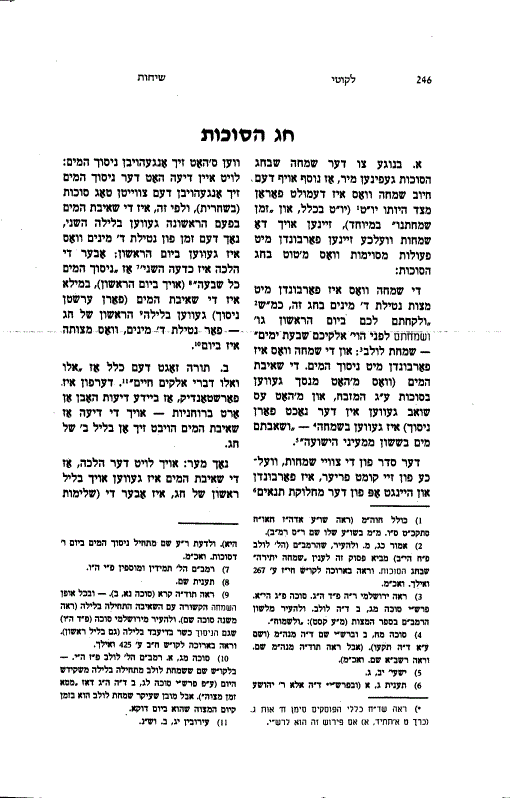
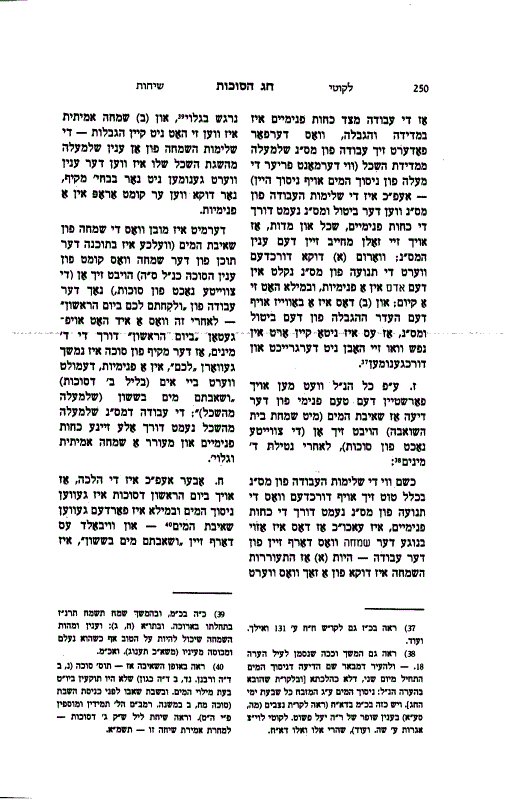
1. Regarding the joy of the festival of Sukkos, we find that in addition to the obligation of joy that exists because it is a Yom Tov (a festival in general, and specifically "the time of our rejoicing"), there are also specific joys associated with particular actions performed during the festival of Sukkos:
The joy associated with the mitzvah of taking the four species during this festival, as it is written, "And you shall take for yourselves on the first day... and you shall rejoice before the L‑rd your G‑d for seven days" — this is the joy of the lulav. Additionally, there is the joy connected with the water libation. The drawing of the water (which was poured on the altar during Sukkos, and was drawn at night before the libation) was done with joy — "And you shall draw water with joy from the wells of salvation."
The order of these two joys, which are connected to...
When the water libation began: According to one opinion, the water libation began on the second day of Sukkos (in the morning), and according to this, the first drawing of the water was on the second night, after the time of taking the four species, which was on the first day. However, the halacha follows the second opinion that the water libation was performed all seven days (including the first day), so the drawing of the water (for the first libation) was on the first night of the festival — before the taking of the four species, whose mitzvah is during the day.
2. The Torah states the principle that "These and those are the words of the living G‑d." From this, it is understood that both opinions have a place in spirituality — even the opinion that the drawing of the water begins on the second night of the festival.
Furthermore: Even according to the halacha, that the drawing of the water was also on the first night of the festival, the (completion of the joy of the Simchas Beis HaSho'eivah, the "extra joy," which was expressed through the "flute" (and musical instruments), only began on the night after the first Yom Tov.
And although this is seemingly due to another reason, "the lion crouches upon it," for "the flute... does not override Shabbos or Yom Tov" — therefore, in our times, when the joy of the Simchas Beis HaSho'eivah is not connected with the "flute," it can be said (as discussed several times) "our downfall is our benefit" — the joy of the Simchas Beis HaSho'eivah begins with several matters with great enthusiasm already from the first night of Sukkos —
Nevertheless, since every matter in Torah is precise, it is understood that the fact that the "extra joy" (in the Temple) actually began "on the night after the first Yom Tov" is because this is more fitting to the content of the joy — that the "extra joy" (as it was in the Temple) can only truly be "on the night after the first Yom Tov" and thereafter.
3. This can be understood by first explaining the connection (in the inner dimensions of the matters) of the water libation specifically to the festival of Sukkos:
One of the differences between the joy of the wine libation (as it is said, "One does not sing except over wine") and the joy of the water libation is:
The joy of the wine libation is also connected with the nature of man, similar to the joy that comes from wine in general, because wine naturally brings joy. That is, even though the joy of the wine libation is a holy joy, connected with the service of the Temple, it still has a connection with human nature.
[Similar to the mitzvah of the joy of Yom Tov, which must be connected with wine in its literal sense — "there is no joy except with wine" — the drinking of wine by a Jew is not for the sake of desire, G‑d forbid, but for the fulfillment of the mitzvah; therefore, the joy that comes through this is not from the wine itself (as it is for a non-Jew), but from the mitzvah within it, a joy of a mitzvah, and even more so — the drinking of wine is the mitzvah itself.
Jews are "one nation on earth," meaning that even in their physical body (earth), they are a "holy nation," from which it is understood that even the joy that the Jewish body feels truly derives from the holiness and mitzvah within the wine.
Nevertheless, since the joy is specifically connected with wine ("there is no joy except with wine"), and the simple reason in the Torah is because it naturally arouses joy, it is understood that the joy from the mitzvah has a connection to the nature and reality of the world.
In contrast, the joy associated with the water libation on the altar — since water is not naturally a source of joy — demonstrates that the joy at the drawing of the water has no connection to natural matters; it comes entirely from the command of the Holy One, blessed be He, "and you shall draw water with joy."
And this is the advantage of the water libation over the wine libation: In the case of the wine libation, since the joy has a hold in the nature of creation, it is measured and limited by the constraints of the nature of creation. However, in the case of the water libation, where the joy comes entirely from the command of the Holy One, blessed be He, which is infinite, the joy is also beyond measure and limitation.
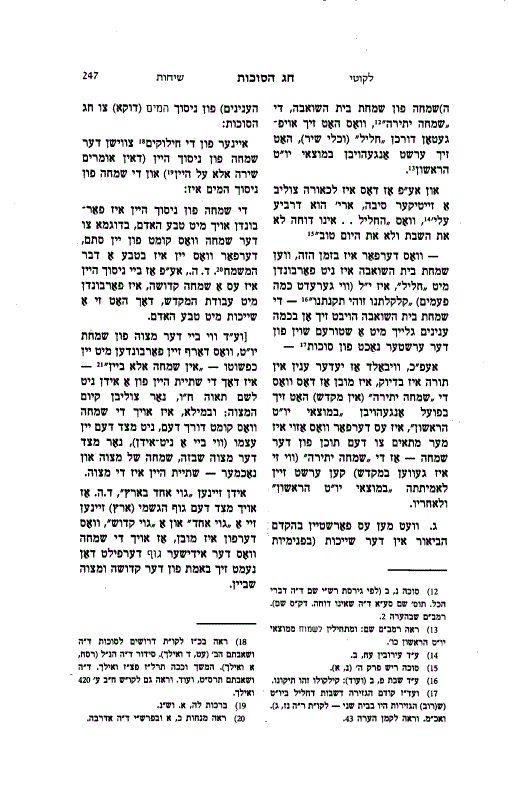
4. It is explained and known that within every Jew there is a "spiritual altar" — it is understood that the two types of joy from the wine libation and the water libation on the altar also exist in the spiritual service of every Jew:
The joy of the wine libation in the service of man means a joy of a mitzvah that comes through intellectual contemplation:
5. When a Jew contemplates the great privilege that the Almighty has given him the opportunity to fulfill a mitzvah, and the great elevation that occurs through his fulfillment of the mitzvos (that through the mitzvah he becomes connected and united with the Almighty) — this evokes within him a great joy.
However, since this joy is connected with intellect and contemplation, it is in a manner where, in addition to the mitzvah, the existence of the person fulfilling the mitzvah is also felt (similar to the joy that comes through wine, as mentioned above).
And since this joy is "composed of understanding," it is a joy "limited according to the manner of understanding."
In contrast, the joy of the water libation is an example of a joy of a mitzvah that is beyond intellect and contemplation: When a Jew stands in a state of self-sacrifice, giving himself entirely to the Almighty — he does not need to resort to intellectual explanation (of the great elevation of the mitzvah); as soon as he perceives that this is a command from the Almighty ("and He commanded us"), it evokes within him a great joy.
And this joy is a "true joy," which has no limitation (because it "reaches the essence of the soul, beyond the revealed powers"); and therefore, specifically regarding the joy (of the water libation), our Sages say, "Whoever has not seen the joy of the House of the Water Drawing has never seen joy in his life."
6. And this is also the general connection of the joy of the House of the Water Drawing to the festival of Sukkos:
The joy of Sukkos, the time of our rejoicing, comes from the service and matters that were accomplished on Rosh Hashanah and the Ten Days of Repentance, and especially on Yom Kippur. As is known, the concept of the sukkah's covering (which comes from the Clouds of Glory) is drawn from the repentance and the cloud of incense of Yom Kippur.
The service of Yom Kippur — "once a year" — is from the aspect of the yechidah of the soul, the connection of the essence of the soul with the Essence of the Almighty, "yechidah to unite You"; and the accomplishment of Sukkos is that this connection to the Almighty should be drawn into revelation, encompassing the Jew entirely with all his matters.
This is also expressed in the mitzvah of the sukkah in its simple sense — "You shall dwell in booths for seven days" — dwell as you live: all matters that one does in his home (eating, drinking, etc.) are encompassed by the mitzvah of the sukkah [which is the addition and advantage of the sukkah over the tallis: a tallis encompasses the Jew's head and majority; a sukkah encompasses all matters of the Jew, without any limitations].
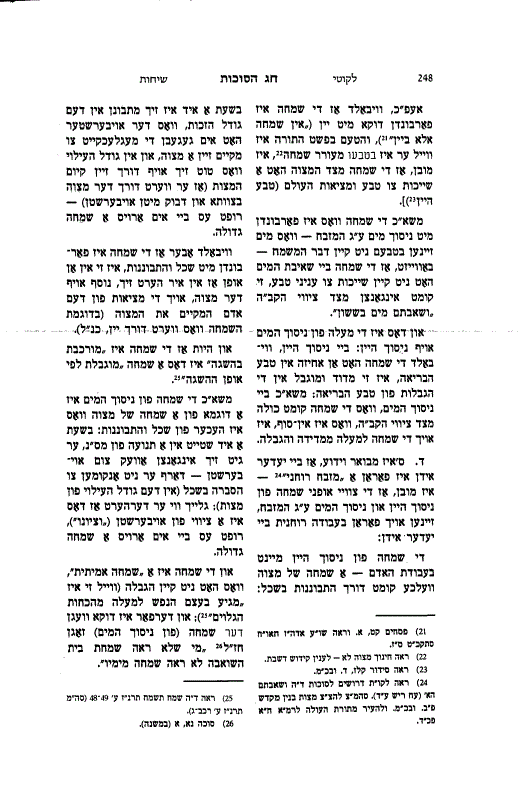
5. Therefore, the festival of Sukkos is the time of the water libation and the joy of the House of the Water Drawing, which is a joy that transcends reason and understanding, as mentioned earlier, because Sukkos evokes a joy that is beyond measure and limitation.
6. It is known that the mitzvah of the lulav is not an independent mitzvah that needs to be performed during the seven days of Sukkos, but rather it is connected and comes as a continuation of the mitzvah of the sukkah. This is also understood from the law that "the optimal way to fulfill the mitzvah of taking the lulav is in the sukkah."
The sukkah encompasses the Jew with all his matters in a way that it surrounds them from the outside, and in the language of Chassidus — it is a makif. The purpose of the mitzvah of taking the four species is "And you shall take for yourselves": the encompassing nature of the sukkah is taken "for yourselves," it becomes yours, it is drawn into an internal aspect.
[This is the reason why when taking the four species, one must bring them close to the heart, so that their matters should also be drawn into the (feeling of the) heart, and "the heart rules over all the limbs" — including the intellect in the head.]
And specifically through this, the concept of Sukkos (the revelation of the makif) is complete: although the service from the internal faculties is with measure and limitation, which is why it requires a service of mesiras nefesh that is beyond the measure of intellect (as mentioned earlier, the advantage of the water libation over the wine libation) — nevertheless, the perfection of the service of mesiras nefesh is when the nullification and mesiras nefesh permeate the internal faculties, intellect, and emotions, so that they too obligate the concept of mesiras nefesh; because (a) only through this does the movement of mesiras nefesh become absorbed in the person internally, and therefore it has permanence; and (b) this is evidence of the absence of limitation in the nullification and mesiras nefesh, that there is no place in the soul where they have not reached and permeated.
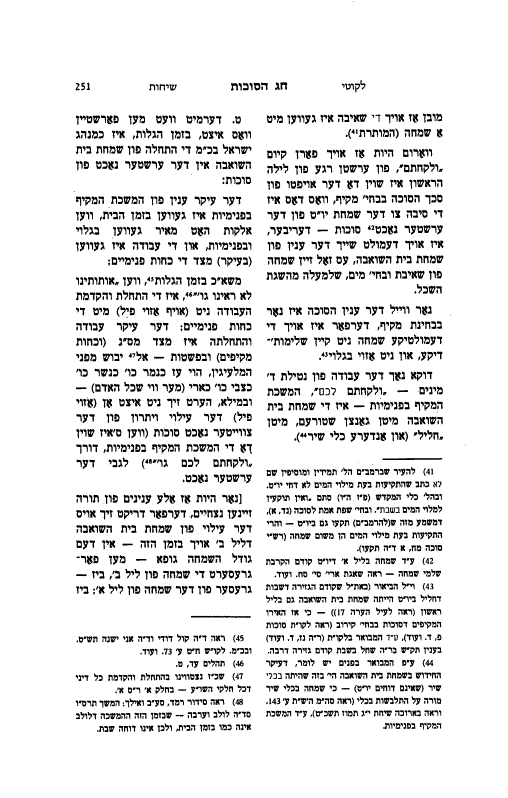
7. Based on all the above, we can also understand the inner reason for the opinion that the drawing of the water (with the joy of the House of the Water Drawing) begins (on the second night of Sukkos), after the taking of the four species:
Just as the perfection of the service of mesiras nefesh in general is achieved through the movement of mesiras nefesh permeating the internal faculties, so too, all the more so, this is true regarding the joy that should result from the service — because (a) the awakening of joy is specifically from something that becomes
8. The joy is felt openly, and (b) true joy is when it has no limitations. The perfection of joy from something beyond the grasp of intellect is when the matter is absorbed not only in a surrounding manner but specifically when it descends into an internalized state.
With this, we understand why the joy of the water drawing (which in essence is the content of the joy that comes from the concept of the sukkah, as mentioned above in section 5) begins (on the second night of Sukkos), after the service of "And you shall take for yourselves on the first day" — after a Jew has accomplished "on the first day" through the four species, that the encompassing aspect of the sukkah has been drawn "for you," internally. Then, on the second night of Sukkos, "And you shall draw water with joy (beyond intellect)"; the service of mesiras nefesh beyond intellect permeates all his internal faculties and arouses a true and revealed joy.
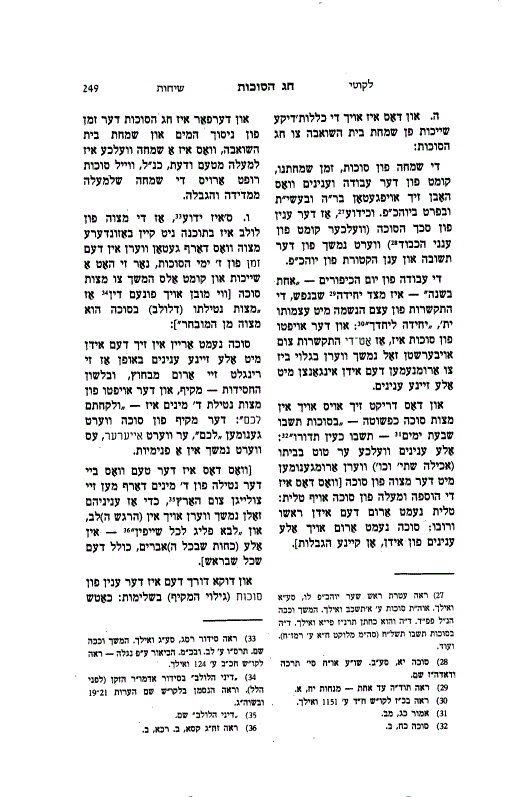
8. However, nevertheless, the halacha is that also on the first day of Sukkos there was the water libation, and consequently, there was the water drawing — and since it must be "And you shall draw water with joy," it is understood that also the drawing was with a permissible joy.
Because even before the fulfillment of "And you shall take," from the very first moment of the first night, there is already the effect of the sukkah's covering in the aspect of makif, which is the reason for the Yom Tov joy of the first night of Sukkos — therefore, even then, the concept of the joy of the House of the Water Drawing is relevant, that there should be joy from the drawing and the aspect of water, beyond the grasp of intellect.
But since the concept of the sukkah is only in the aspect of makif, therefore, the joy at that time is not complete and not as revealed.
Only after the service of taking the four species — "And you shall take for yourselves," drawing the makif internally — is the joy of the House of the Water Drawing with the full excitement, with the "flute" (and other musical instruments).
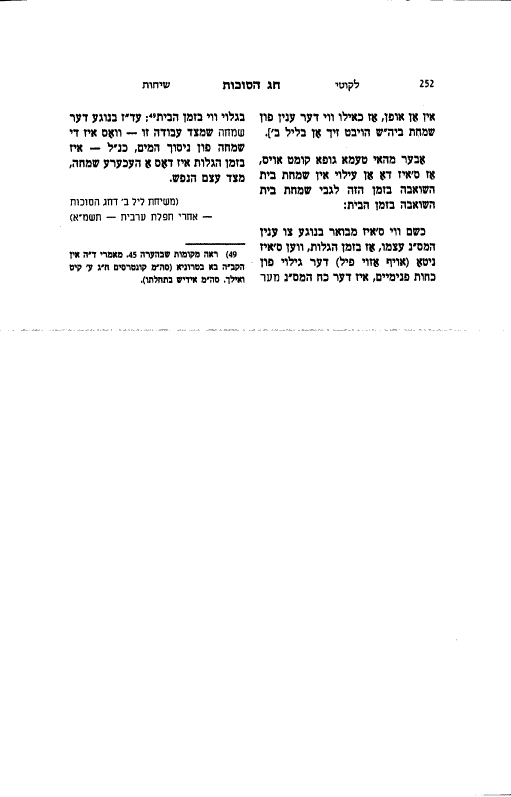
9. With this, we can understand why, nowadays, during the time of exile, the custom among Jews everywhere is to begin the celebration of the Simchas Beis Hashoeivah on the first night of Sukkos:
The primary aspect of drawing the makif internally was during the time of the Temple, when G‑dliness was revealed openly and internally, and the service was mainly through the internal faculties.
However, in the time of exile, when "our signs we have not seen", the beginning and preparation of the service is not so much with the internal faculties; the main service and its beginning is through mesiras nefesh (self-sacrifice) and makif faculties. Simply put — one should not be embarrassed by those who mock, be bold as a leopard, swift as an eagle, fleet as a deer, and strong as a lion (more than the intellect of man) — and therefore, the advantage and superiority of the second night of Sukkos (when there is already the drawing of the makif internally through "And you shall take for yourselves") is not as noticeable now compared to the first night.
[However, since all matters of Torah are eternal, the advantage of the Simchas Beis Hashoeivah of the second night is also expressed in our times — in the very intensity of the joy itself — the joy of the second night is increased, even greater than the joy of the first night; to the extent that it seems as if the matter of the Simchas Beis Hashoeivah begins on the second night.]
But for this very reason, it turns out that there is an advantage in the Simchas Beis Hashoeivah in our times compared to the Simchas Beis Hashoeivah during the time of the Temple:
Just as it is explained regarding the matter of mesiras nefesh itself, that in the time of exile, when there is not so much revelation of the internal faculties, the power of mesiras nefesh is more revealed than during the time of the Temple; similarly, regarding the joy that comes from this service — which is the joy of the water libation, as mentioned above — in the time of exile, this joy is a higher joy, stemming from the essence of the soul.
(From a talk on the second night of the festival of Sukkos — after the Maariv prayer — 5741)
7. This concept can be further understood by examining the nature of the joy associated with the Simchas Beis Hashoeivah. In the time of the Temple, the joy was primarily connected to the physical act of the water libation, which was a tangible expression of the service. However, in our times, when the physical Temple service is absent, the joy is derived from a deeper, more spiritual source. This joy is not limited by the physical constraints of the Temple service and therefore can reach a higher level, emanating from the essence of the soul itself.
In this way, the joy of the Simchas Beis Hashoeivah in our times can be seen as an advantage over the joy experienced during the time of the Temple. Just as the power of mesiras nefesh is more revealed in the time of exile, so too is the joy of the Simchas Beis Hashoeivah more profound and intense, reflecting the inner essence of the soul. This joy, which transcends the limitations of the physical world, is a testament to the eternal nature of Torah and its ability to elevate and transform every aspect of our lives, even in the absence of the physical Temple.