Likkutei Sichos Vol. 24 – Rosh Hashanah
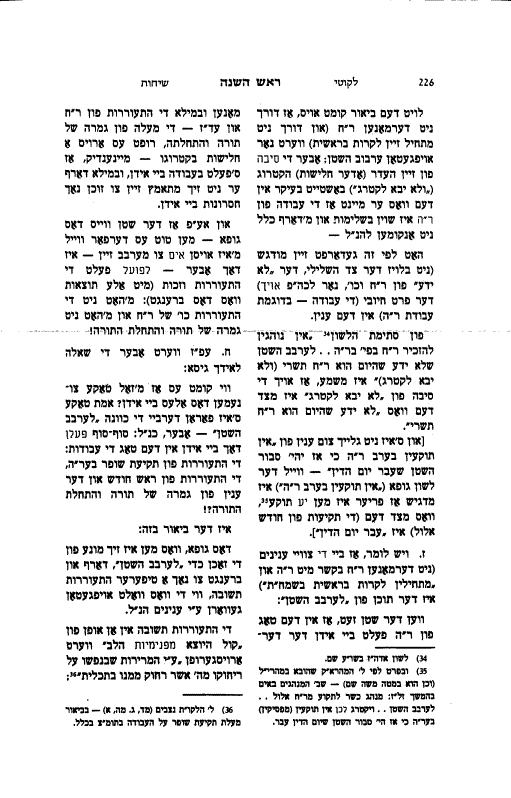
1. One of the reasons why we do not mention Rosh Chodesh in the prayers of Rosh Hashanah is: "to confuse the Satan, so that he does not know that today is Rosh Chodesh Tishrei (and will not come to accuse)." The same concept (of confusing, etc.) is also brought as a reason for the custom of not mentioning (blessing) the month of Tishrei on the Shabbat before it, as we do for every Shabbat before Rosh Chodesh — Shabbat Mevarchim.
This, however, seems not to be understood:
The "Satan" is an angel and comes to the Heavenly Court, as is explicitly stated in the Book of Job (at its beginning), where the Satan came on the Day of Judgment (Rosh Hashanah) — among the sons of G‑d "to present himself before the L‑rd." How can it be said that one can "confuse" him and "mislead" him in such a simple matter, that he should not know (due to the customs) that it is Rosh Hashanah — something so well-known, printed in calendars, etc.?
2. In the Levush, another reason is brought — to confuse the Satan so that he does not know the day that is Rosh Hashanah, but he adds: "since it has not been sanctified." Based on this, it could be explained according to what is known, that the establishment of the months, etc., depends on the decision of the Beis Din: Rosh Chodesh has its establishment only through the sanctification by the Jews; through the Beis Din (Jews) establishing the day as Rosh Chodesh, the day becomes Rosh Hashanah.
To the extent that "when the ministering angels gather before the Holy One, blessed be He, to ask when is Rosh Hashanah and when is Yom Kippur, the Holy One, blessed be He, says to them, 'You ask Me? Let us go to the Beis Din below.'" Therefore, by not mentioning Rosh Chodesh in the prayers of Rosh Hashanah and by the absence of mention on the Shabbat before it, the day is indeed as if it has not been established as Rosh Chodesh Tishrei, and thus the Satan does not know (with certainty?) "the day that is Rosh Hashanah."
However, this explanation is not sufficient, because:
a) On Rosh Hashanah, we perform many actions in which it is evident and emphasized that this is the day of Rosh Hashanah (Rosh Chodesh Tishrei) — so how can it be said that because "it has not been sanctified" (Rosh Chodesh), the Satan will not know that it is Rosh Hashanah?
b) And primarily: the reason of "confusing the Satan" is also brought regarding two other customs, which have no connection to the matter of Rosh Chodesh:
1. "And for this reason, we also do not blow the shofar on the eve of Rosh Hashanah, because then the Satan will think that the Day of Judgment has passed," and "similarly, for this reason, we begin reading Bereishis on Simchas Torah so that he will not understand whether it is the beginning of the year or the end of the year."
This brings the question back to its place: How is it possible to say that by not blowing the shofar on the eve of Rosh Hashanah and by not beginning the reading of Bereishis on Rosh Hashanah, we confuse the Satan so that he thinks "the Day of Judgment has passed," especially since from many aspects it is evident that it is Rosh Hashanah (and the month)?
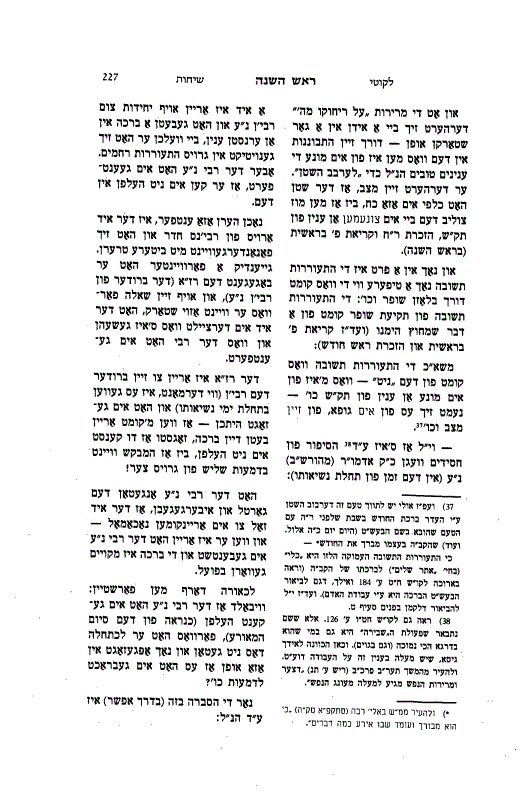
3. We will understand this by first explaining that the concept of confusing the Satan is also brought as a reason for the custom of blowing the shofar throughout the month of Elul — this confuses the Satan "so that he will not understand when Rosh Hashanah will be."
However, this too is not understood, as mentioned above: How can one "deceive" the Satan so that he will not know "when Rosh Hashanah will be"?
We must say the explanation is as follows:
The concept of confusing the Satan is found (in relation to Rosh Hashanah) in the Gemara, regarding the mitzvah of blowing the shofar on Rosh Hashanah in general: Rabbi Yitzchak said... "Why do we blow and sound the shofar while sitting and then blow and sound it again while standing? To confuse the Satan." Rashi explains: "So that he will not accuse; when he hears that the Jews cherish the mitzvos, his words are silenced." This means that since the Jews do not content themselves with blowing and sounding the shofar once, but they blow and sound it again, it shows that they cherish the mitzvos — and this silences the words of the accusing Satan.
Similarly, we can also explain the concept of confusing the Satan regarding the shofar blasts of the month of Elul:
The shofar blasts of the month of Elul are intended (as is known) "to warn the Jews to repent, as it is said, 'Shall a shofar be blown in a city, and the people not tremble?'" Therefore, through the very act of blowing the shofar and being aroused to repentance, the Satan becomes confused, assuming that the Jews have already merited judgment through their repentance in the month of Elul, and thus there is no benefit for him to accuse on Rosh Hashanah — "his words are silenced."
4. Based on this, we can also understand what is said, that the confusion of the Satan (through the shofar blasts of Elul) achieves "so that he will not understand when Rosh Hashanah will be":
5. The explanation of "he will not understand when Rosh Hashanah will be" is not that he does not know (as it is written in the calendar) when the day (time) of Rosh Hashanah is, but rather that he does not know when the distinctiveness, the essence of Rosh Hashanah, the judgment and trial of Rosh Hashanah (which is the time for him to accuse) occurs. As it is explicitly stated in Maharil: "And he does not know when the judgment is to accuse."
When a Jew properly repents before Rosh Hashanah, he is already assured to be inscribed and sealed in the book of the righteous — his "deed."
(And even though the Satan knows that the custom of not blowing the shofar on the eve of Rosh Hashanah is a fixed custom from long ago, and that its reason and rationale is indeed to confuse the Satan — yet this is a custom which (a Jewish custom) is Torah, Torah of truth, and therefore if they merit — this (the absolute merit in judgment) will indeed be so, as the work of Rosh Hashanah has already been accomplished and the Day of Judgment has passed; and therefore his accusation is uncertain, with a weakness, as mentioned above).
6. Similarly, one could seemingly explain regarding the other aforementioned matters that are refrained from on Rosh Hashanah "to confuse the Satan" so that he will not know that it is Rosh Hashanah:
The fact that Rosh Hashanah is simultaneously the day of Rosh Chodesh Tishrei is not only to follow the order of time, but it is also relevant to the essence and content of Rosh Hashanah: the awakening that comes from the fact that it is Rosh Chodesh adds to the awakening and service of the day of Rosh Hashanah, and consequently also to its outcome — to merit in judgment.
Similarly, the idea that "it was fitting to read Parshas Bereishis on Rosh Hashanah," which means that this is not only because Rosh Hashanah is the beginning of the year (in time), but also because the matter of "the completion of the Torah" and "the beginning of the Torah" adds to the merits of the Jews —
And it is clear that both a greater awakening and an addition to the merits of the Jews are of great benefit in the work and effort of Rosh Hashanah, to merit in judgment.
And this is the intention of the reason that Rosh Chodesh is not mentioned on Rosh Hashanah "to confuse the Satan so that he will not know that today is Rosh Chodesh Tishrei" (which means not a lack of knowledge regarding the time of Rosh Chodesh on Rosh Hashanah, but regarding — its essence and service):
Since Jews do not mention Rosh Chodesh on Rosh Hashanah, the Satan will not sense on Rosh Hashanah the awakening and service of Rosh Chodesh — "he will not know that today is Rosh Chodesh";
And still regarding the matter of "beginning to read Bereishis on Simchas Torah so that he will not understand the beginning of the year, etc." — since Jews do not actually begin "to read Bereishis" on Rosh Hashanah, he will assume that in the service of the beginning of the year, the matter and action connected with the completion and beginning of the Torah is lacking — "he will not understand the beginning of the year, etc."
5. This will confuse the Satan "and he will not come to accuse," because if they had merited, as mentioned above, their primary service would be so complete and elevated that they would not need the additional awakening of Rosh Chodesh and the "completion of the Torah" and its beginning; they would have already merited in judgment without it.
6. However, this explanation is not entirely smooth:
According to this explanation, it emerges that by not mentioning Rosh Chodesh, it only achieves the confusion of the Satan; but the reason for his lack (or weakening) of accusation ("and he will not come to accuse") primarily lies in the fact that he thinks the service of Rosh Hashanah is already complete and there is no need to resort to the aforementioned.
According to this, it should have been emphasized (not only the negative aspect, the "he will not know" of Rosh Chodesh, etc., but at least also) the positive aspect (the service — similar to the service of Rosh Hashanah) in this matter.
From the language "it is not customary to explicitly mention Rosh Chodesh on Rosh Hashanah... to confuse the Satan so that he will not know that today is Rosh Chodesh Tishrei (and he will not come to accuse)" it implies that also the reason for "he will not come to accuse" is because "he will not know that today is Rosh Chodesh Tishrei."
[And it is not similar to the matter of "not blowing the shofar on the eve of Rosh Hashanah because then the Satan will think that the Day of Judgment has passed" — because the very language ("not blowing on the eve of Rosh Hashanah") emphasizes that previously one does blow, which because of this (the shofar blasts of the month of Elul) "the Day of Judgment has passed"].
7. We can say that in these two matters, the content of "confusing the Satan" is:
When the Satan sees that on the day of Rosh Hashanah, the Jews lack the mention and consequently the awakening of Rosh Chodesh and the eve of Rosh Hashanah — the advantage of the completion of the Torah and its beginning, it causes a weakening in his accusation — thinking that there is a lack in the service of the Jews, and therefore he does not exert himself to seek out deficiencies among the Jews.
And even though the Satan knows that this itself — they do it because they intend to confuse him — nevertheless, in practice, the awakening and merit are lacking (with all the results that this brings): they do not have the awakening, etc., of Rosh Chodesh, and they do not have the completion of the Torah and the beginning of the Torah!
8. Based on this, however, the question arises on the other hand: How is it that all of this should indeed be taken away from the Jews? It is true that there is the intention "to confuse the Satan" — but, as mentioned above: ultimately, the Jews lack on this day the services: the awakening from the shofar blowing on the eve of Rosh Hashanah, the awakening of Rosh Chodesh, and the matter of the completion of the Torah and the beginning of the Torah?!
9. The explanation is as follows: The very act of refraining from these matters in order "to confuse the Satan" should and does lead to an even deeper awakening of teshuvah than what would have been achieved through the aforementioned matters. This awakening of teshuvah is in a manner of "a voice that comes from the innermost part of the heart," which is aroused "by the bitterness in his soul over his distance from G‑d, which is utterly distant."
This bitterness "over his distance from G‑d" is felt by a Jew in a very strong manner — through his contemplation on the fact that these good matters are withheld from him in order "to confuse the Satan." He perceives his situation, realizing that the Satan has such power over him that it necessitates taking away from him the matter of the shofar blowing, the mention of Rosh Chodesh, and the reading of Parshas Bereishis (on Rosh Hashanah).
Furthermore, in one aspect, this awakening of teshuvah is even deeper than that which comes through the blowing of the shofar, etc.: The awakening of teshuvah from the shofar blowing comes from something external to him; whereas the awakening of teshuvah that comes from the "good" — from which he is withheld the matter of the shofar blowing, etc. — originates from within himself, from his own situation, etc.
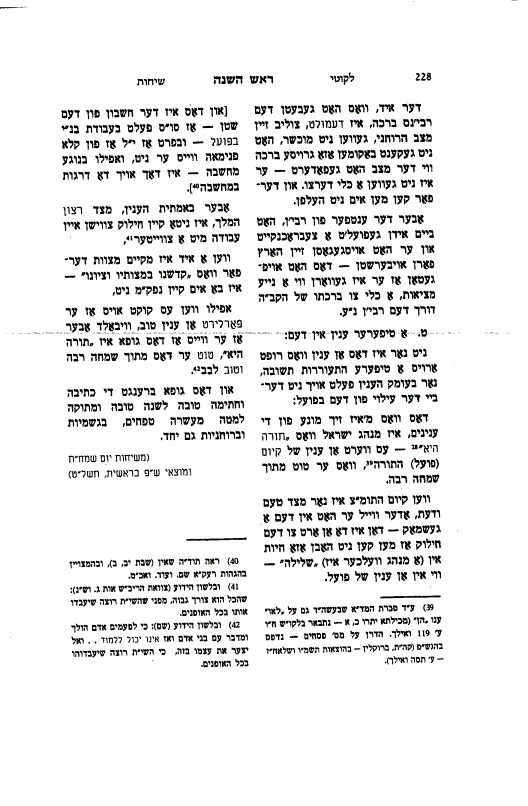
This is similar to the story told by Chassidim about the Rebbe Rashab (Rabbi Sholom Dovber) of blessed memory (at the beginning of his leadership): A Jew came in for a private audience with the Rebbe and requested a blessing for a serious matter, in which he needed a great awakening of mercy. However, the Rebbe replied that he could not help him in this matter.
After hearing such a response, the Jew left the Rebbe's room and burst into tears, crying bitterly. As he walked, crying, he encountered the Rebbe's brother, Raza, and upon being asked why he was crying so intensely, the Jew recounted what had happened and what the Rebbe had answered him.
Raza went in to his brother, the Rebbe (as mentioned, this was at the beginning of his leadership), and said to him, "How is it possible — that when someone comes to request your blessing, you say that you cannot help him, to the point that the petitioner cries with such intense tears from great distress!"
6. The Rebbe, of blessed memory, put on his gartel and instructed that the Jew should come in to see him again. When the Jew entered, the Rebbe blessed him, and the blessing was fulfilled in actuality.
7. At first glance, one might wonder: Since the Rebbe, of blessed memory, was able to help him (as is evident from the conclusion of the event), why did he initially not do so and even refused in such a manner that it brought the petitioner to tears?
The explanation for this (possibly) is similar to the aforementioned concept:
The Jew who requested the Rebbe's blessing was, at that time, due to his spiritual state, not capable of receiving such a great blessing as the situation required — he was not a proper vessel for it. Therefore, he could not be helped.
However, the Rebbe's response caused the Jew to experience a brokenness, and he poured out his heart before G‑d. This brought about a transformation in him, making him like a new entity, a vessel for the blessing of the Holy One, blessed be He, through the Rebbe, of blessed memory.
9. A deeper aspect of this:
Not only does this evoke a deeper awakening of teshuvah, but in the depth of the matter, it also does not lack the revelation of this in actuality:
The fact that one refrains from certain matters is a Jewish custom which is "Torah" — it becomes an aspect of fulfilling (actualizing) the Torah, which he does with great joy.
When the fulfillment of Torah and mitzvos is only due to reason and understanding, or because he enjoys it, there is room for the distinction that one cannot have the same vitality in a custom that is a "negation" as in an actual matter.
However, in the true essence of the matter, from the perspective of the king's will, there is no difference between one service and another.
When a Jew fulfills mitzvos because "He sanctified us with His commandments and commanded us," there is no difference for him, even when it seems that he is losing a good matter. Since he knows that this itself is "Torah," he does it with great joy and a good heart.
And this itself brings the inscription and sealing for a good and sweet year below ten tefachim, in both physical and spiritual matters together.