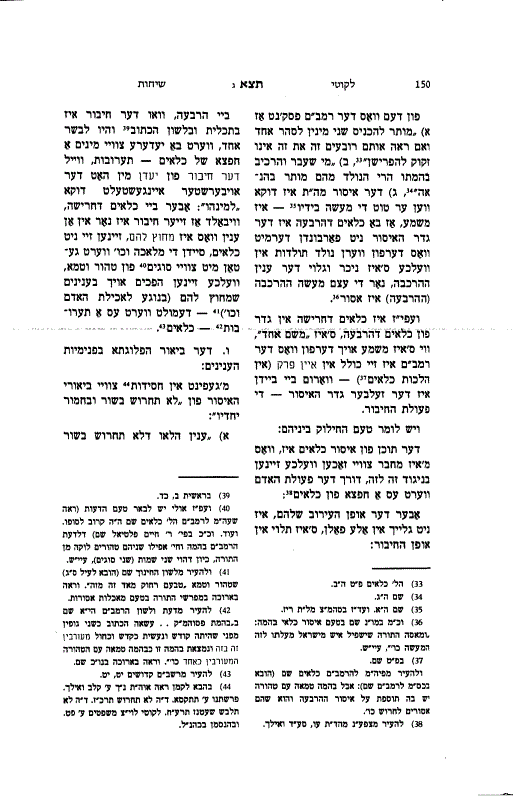
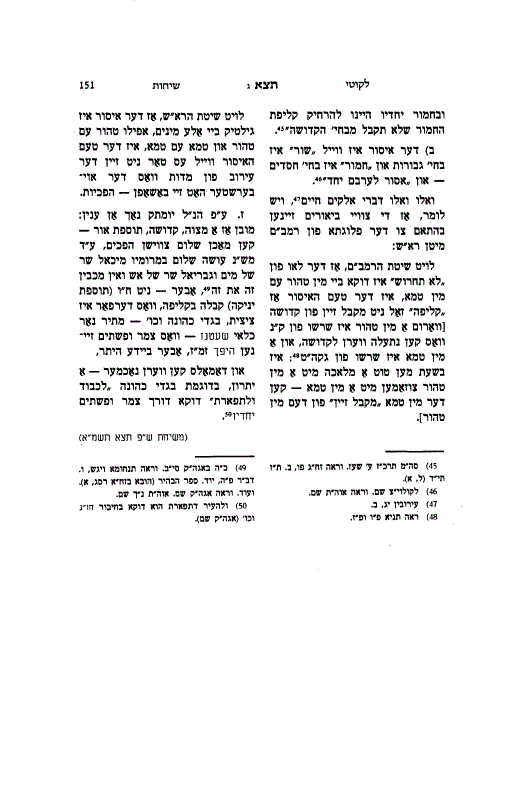
Regarding the commandment, “You shall not plow with an ox and a donkey together,” the Rambam holds that the Torah prohibition applies specifically when a non-kosher animal is together with a kosher animal, whereas the Rosh holds that the Torah prohibition also applies to a non-kosher animal with another non-kosher animal, and a kosher animal with another kosher animal.
It may be said that the reasoning behind their dispute is as follows. Although they disagree in the interpretation of the Mishnah, it can be said that the difference in their underlying reasoning leads to their differing interpretations of the Mishnah.
According to the Rosh, the prohibition of mixed species in plowing is part of the prohibition of mixed species in mating, as the Ramban writes: “It is the way of every farmer to bring his pair of animals into one stable, and they may mate with one another.” Therefore, the prohibition of plowing applies even to one kosher species together with another kosher species, just as the prohibition of mating applies.
The Rambam, by contrast, holds that the prohibition of mixed species in mating is because the joining of two species is a complete union, to the extent that it produces offspring of a new species. Therefore, that prohibition applies in every instance.
In mixed species used for plowing, however, the connection between them is only with regard to something external to the animals themselves. Therefore, the prohibition applies only to two species that are opposites in an external matter connected with them — namely, human consumption: a kosher animal together with a non-kosher animal.
The explanation according to the inner dimension of Torah is as follows:
There are two explanations in Chassidus for the reason behind the commandment, “You shall not plow with an ox and a donkey together.”
One explanation is that it is in order to distance the kelipah represented by the donkey, so that it should not receive nurture from holiness. This accords with the Rambam’s view that the prohibition applies only to a kosher animal together with a non-kosher animal.
The second explanation is that one should not mix the ox — the level of gevurah — with the donkey — the level of chesed. This accords with the Rosh’s view that the prohibition applies even to two kosher species.
Based on this, another point becomes clearer as well. It is understood that an additional revelation of the light of holiness can bring peace between two opposites. Therefore, mixtures of species are permitted in tzitzis and in the garments of the Kohanim.