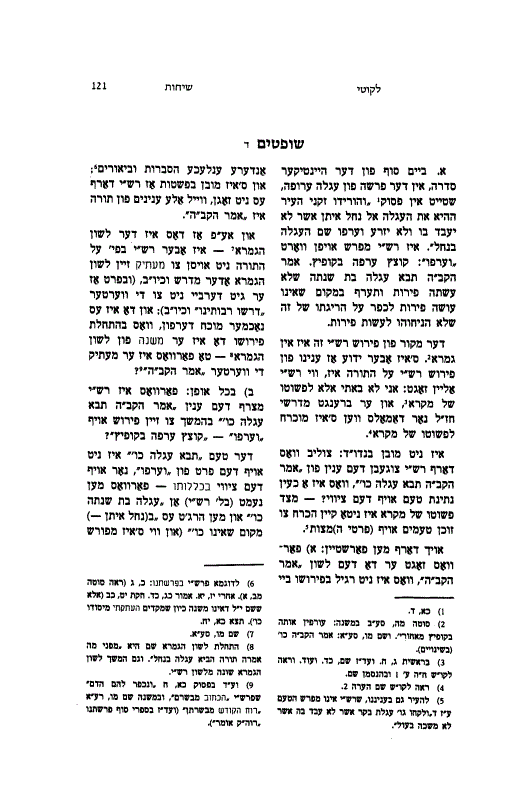
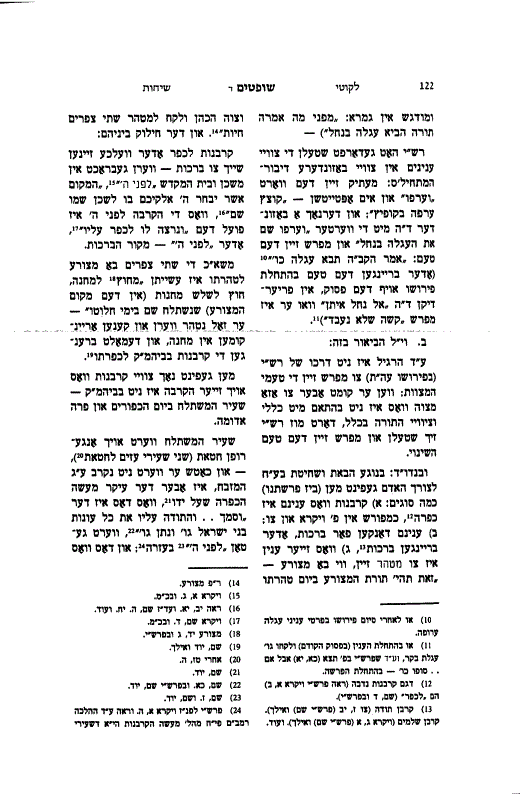
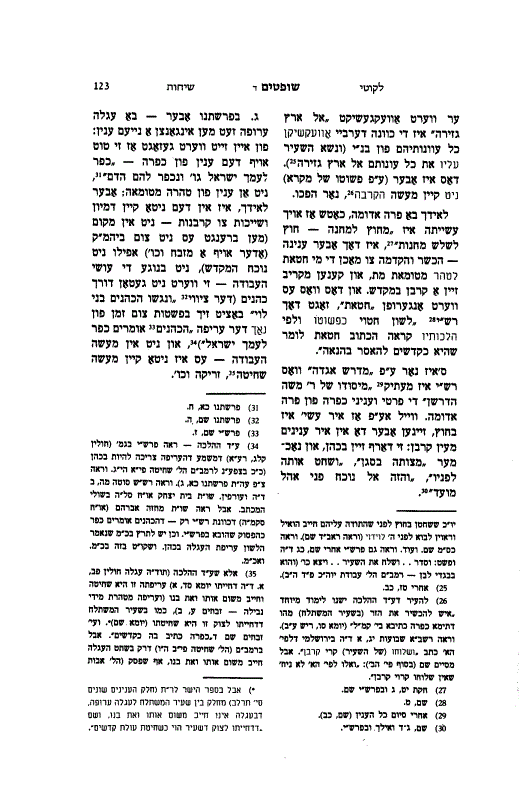
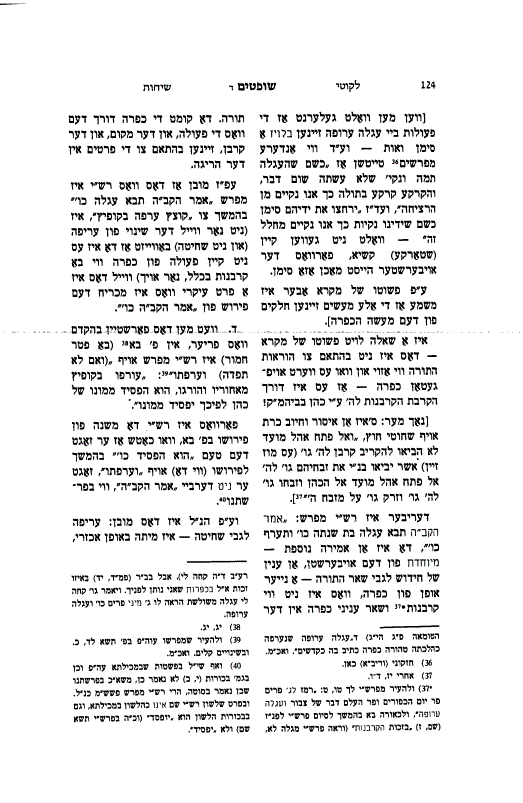
Regarding the law of the eglah arufah, Rashi explains (Devarim 21:4):
“‘And they shall break its neck’: He cuts the back of its neck with a cleaver. The Holy One, blessed be He, said: Let a calf in its first year, which has not produced fruit, come and have its neck broken in a place that does not produce fruit, to atone for the killing of this person, whom they did not allow to produce fruit.”
We must understand why Rashi combines his explanation of the word “va’arfu”—“they shall break its neck”—with his explanation of the reason for the mitzvah, all under a single heading.
We must also understand why Rashi needs to explain the reasons for the individual details of the mitzvah. According to the straightforward meaning of Scripture, there is generally no necessity to search for reasons behind every particular detail of a mitzvah.
And why does Rashi say, “The Holy One, blessed be He, said”? After all, the entire Torah consists of the words of Hashem.
The explanation is as follows:
Rashi explains the reasons for the particular details of eglah arufah because the killing of this calf differs from all other situations in which an animal is brought for the sake of a person.
Generally, sacrifices fall into one of two categories.
First, there are sacrifices brought either for atonement or as an offering to Hashem. These are brought inside the Beis HaMikdash.
Second, there are offerings associated with purification, such as those involved in the purification of a metzora. These are performed outside the camp because their purpose is to purify the metzora so that he can once again enter the camp.
The scapegoat is not an exception to this principle, because the essential act of atonement—the confession—is performed inside, and only afterward is the goat sent away in order to carry off the sins of the Jewish people.
Likewise, the parah adumah, although it is prepared outside, serves as a preparation for purifying a person from impurity caused by contact with the dead.
The eglah arufah, however, is different.
On the one hand, it is clearly an act of atonement, as the verse states, “Atone for Your people.”
On the other hand, it does not possess the usual laws associated with atonement. It is not performed in the Beis HaMikdash, and it is not performed by a Kohen.
Rashi therefore says, “The Holy One, blessed be He, said.” This emphasizes that here there is a special Divine statement, a unique form of atonement that differs from the ordinary pattern of atonement throughout the Torah.
Here, the atonement corresponds specifically to the details of the killing.
This also explains Rashi’s statement that “he cuts the back of its neck with a cleaver.”
Breaking the neck is the opposite of shechitah. It is an act characterized by negation and destruction.
This fits precisely with the specific meaning of the mitzvah: a calf that has not yet produced fruit is killed, in a place that does not produce fruit, in order to atone for the murder of a person whom they prevented from producing fruit.
The common theme of all these details is negation—the denial of the possibility of producing fruit.
There are also several remarkable dimensions in Rashi’s interpretation. We can distinguish three different approaches to understanding the atonement achieved through eglah arufah.
According to the Rambam, the atonement comes through the actions of those involved. By the elders doing everything within their ability to uncover the murderer, “the blood is atoned for them.”
In the Moreh Nevuchim, the Rambam explains that the purpose of eglah arufah is to cause the murderer to be discovered through investigation and inquiry.
Accordingly, he also explains the requirement that the land not be cultivated as a means of motivating the landowner to make every effort to find the murderer.
For this reason, the Rambam understands “nachal eisan” as a strongly flowing stream, rather than as hard, uncultivated ground. On the contrary, if the land is valuable, its owner will have a stronger incentive to find the murderer so that the land will no longer remain unusable.
According to the Ramban—and similarly according to the Rambam in the Mishneh Torah—the atonement lies in the act itself. The Ramban writes that, in his opinion, the matter contains a reason similar to sacrifices that are performed outside the Mikdash.
According to Rashi, however, the emphasis is on the effect upon that which is being atoned for.
The calf atones for the fact that the victim was prevented from producing fruit. Therefore, every detail of the eglah is expressed in a form of negation: a calf that has not produced fruit is beheaded in a place that does not produce fruit.
For this reason, Rashi explains “nachal eisan” as hard ground that is presently uncultivated.
The practical lesson is as follows:
The Torah is eternal. Therefore, when we see a Jew who is, spiritually speaking, a “corpse lying in the field,” we must provide him with sustenance and accompaniment—Torah and mitzvos—to save him.
We must therefore go out into the “field” and awaken every Jew who is there to connect himself with Hashem.
This is especially relevant in the month of Elul, when “the King is in the field,” and He “shows a smiling countenance to everyone” and “receives everyone graciously.”