Likkutei Sichos Vol. 19 – Chag HaSukkos 3
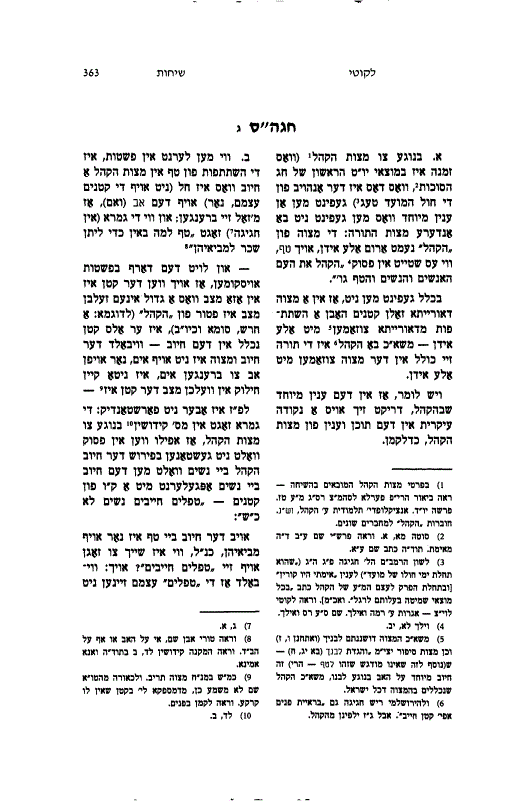
1. Regarding the mitzvah of Hakhel, which takes place on the night following the first day of the festival of Sukkos (which marks the beginning of the intermediate days of the festival), we find a unique aspect not present in other mitzvos of the Torah: the mitzvah of "Hakhel" encompasses all Jews, including children, as it is stated in the verse, "Assemble the people, the men, the women, and the children."
In general, we do not find that in a mitzvah from the Torah, children have participation from a Torah obligation together with all Jews. However, in the case of Hakhel, the Torah includes them in the mitzvah together with all Jews.
It can be said that this unique aspect of Hakhel expresses a fundamental point in the content and essence of the mitzvah of Hakhel, as will be explained.
2. As we learn simply, the participation of children in the mitzvah of Hakhel is an obligation that falls (not on the children themselves, but) on the father (and mother) to bring them. As the Gemara in Chagigah states, "Why do the children come? To give reward to those who bring them."
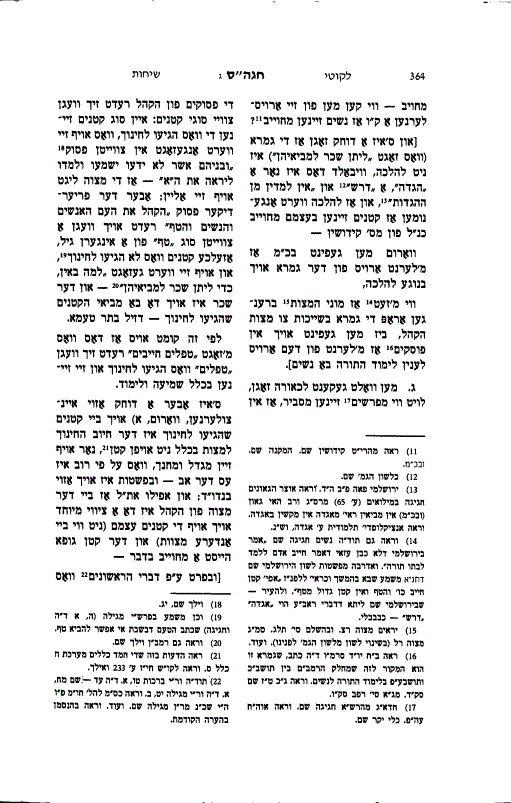
According to this, it should simply follow that even when the child is in a situation where an adult in the same situation would be exempt from "Hakhel" (for example, a deaf person, a blind person, etc.), the child is still included in the obligation—since the obligation and mitzvah is not on him, but on the father to bring him, there is no difference in what state the child is in.
However, according to this, it is not understandable: the Gemara in Kiddushin states regarding those who are obligated—how can we derive from them a rule that women are obligated?
[And it is difficult to say that the Gemara (which states "to give reward to those who bring them") is not according to halacha, since this is merely an "aggadah," a homiletic teaching, and we do not derive halacha from aggados. And according to halacha, it is accepted that children are themselves obligated, as mentioned above from the Gemara in Kiddushin—
For we find in many places that halacha is derived from the Gemara as well,
as we see that those who enumerate the mitzvos bring down the Gemara in connection to the mitzvah of Hakhel, and we also find in the poskim that they derive from this regarding the obligation of Torah study for women.]
3. One might have thought to say, according to the explanations of the commentators, that in
3. The verses concerning "Hakhel" speak about two types of children: one type includes those who have reached the age of education, about whom it is stated in the second verse, "And their children, who do not know, will hear and learn to fear the L‑rd"—indicating that the mitzvah rests upon them themselves. However, the earlier verse, "Assemble the people, the men, the women, and the children," also refers to a second type of "children" of a younger age, those who have not yet reached the age of education. Regarding them, it is said, "Why do they come? To give reward to those who bring them"—and this reward also applies to those who bring the children who have reached the age of education, as the reasoning follows the purpose.
According to this, it emerges that when it is said "children are obligated," it refers to "children" who have reached the age of education and are included in the obligation to hear and learn.
However, it is a stretch to interpret it this way, because: a) Even for children who have reached the age of education, the obligation of education in mitzvos in general is not upon the child, but upon his guardian and educator, who is usually the father—and it is likely the same in this case. Even if we were to say that regarding the mitzvah of "Hakhel," there is a special commandment also upon the children themselves (unlike other mitzvos) and the child himself is considered obligated in the matter—
[Especially according to the words of the early authorities who hold that a child who has reached the age of education, although the obligation of education falls upon the educator, it does not mean that the child is exempt, but rather, due to the mitzvah of education, the child is considered obligated in the mitzvah.]
However, according to this, a novel distinction would emerge between the two types of children—that for very young children, where the obligation and mitzvah is only upon those who bring them, the obligation of "Hakhel" would also include such children who, due to their condition, would be exempt from "Hakhel" when they grow up.
3. Specifically, the older children, those who have reached the age of education (the "young children" mentioned in Tractate Kiddushin), since they themselves are considered obligated in "Hakhel," their obligation only applies when they are in a state where, as adults, they would be obligated in "Hakhel." There is no indication that one should differentiate in this manner between the two types of children.
4. The primary point, from the language of the Gemara in Kiddushin, "young children are obligated"—and not "children are obligated" or similar expressions—implies simply that it refers to the same type of children as in Chagigah ("young children"—"children"). As Rashi emphasizes, "young children are obligated" is derived from the term "and the children" mentioned in the earlier verse (not from the subsequent verse "and their children who do not know, etc.").
From this, it is proven that the child himself has the obligation of the mitzvah.
Regarding "Hakhel": According to the opinions that the obligation also applies to very young children, they too are obligated in the mitzvah of "Hakhel."
And since this is so, the question returns to its place: How does this align with what the Gemara says about "children"—"to give reward to those who bring them," and also with the simple rule (and logical reasoning) that it is not applicable to impose obligations on very young children who are not of understanding age?
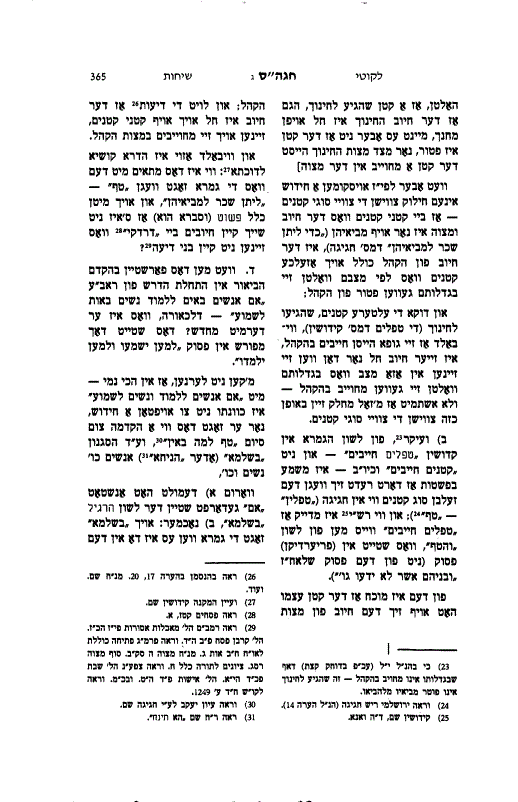
5. This will be understood by first explaining the beginning of the exposition of Rabbi Eliezer: "If men come to learn, women come to listen." At first glance, what is he innovating with this? It is explicitly stated in the verse "so that they may hear and so that they may learn."
We cannot interpret that indeed, with "if men come to learn and women to listen," his intention is not to introduce a novelty, but rather he states this as a preface to the conclusion "why do the children come," similar to the style of "it is understandable" (or "it is acceptable").
Because a) in that case, instead of "if," the usual language "it is understandable" should have been used, b) furthermore: even "it is understandable" is used by the Gemara when there is a novel concept or reasoning that is derived (and not what is explicitly stated), similar to the phrase "it is understandable for the students"—which is not the case here, as he does not add any novelty to what the verse explicitly states.
Moreover, it is more difficult: Rabbi Eliezer's exposition is brought in Rashi's commentary on the Torah, divided according to the specific words of the verse: on "men," Rashi says "to learn," then he quotes from the verse "women" and explains—"to listen," and on "children," he says "why do they come? To give reward to those who bring them." We see that the "to learn" for "men" and the "to listen" for "women" is an explanation in itself (not merely a preface to the question "why do the children come?").
5. It seems that we can explain this based on the words of Tosafos: "It is stated in the Jerusalem Talmud, not like Ben Azzai, who says a person is obligated to teach his daughter Torah"—since the verse states "so that they may hear and so that they may learn" in a general sense, implying it includes women as well. Therefore, Rabbi Eliezer (who holds that one should not teach Torah to the daughters of Israel, unlike Ben Azzai) needed to say and explain that the verse means "to differentiate": "men come to learn and women come (only) to listen."
However, it is a stretch to interpret it this way, because the discussion in the Gemara and Rabbi Eliezer's exposition primarily aim to teach the laws and details of "the mitzvah of Hakhel" and provide the ruling that women are obligated or prohibited in the study of Torah.
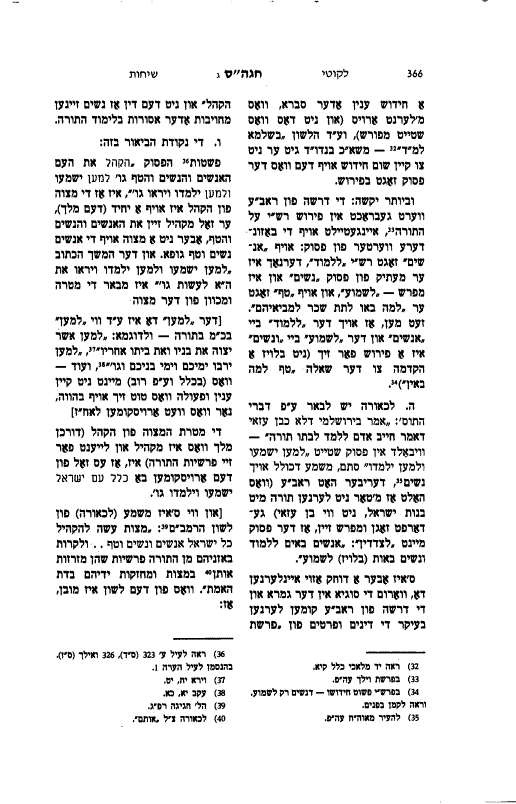
6. The essence of the explanation is as follows:
The simple meaning of the verse "Assemble the people, the men, the women, and the children... so that they may hear and so that they may learn and fear the L‑rd" is that the mitzvah of Hakhel is upon an individual (the king), who should assemble the men, women, and children, but it also places a mitzvah upon the men, women, and children themselves. The continuation of the verse "so that they may hear and so that they may learn and fear the L‑rd" explains the purpose and intent of the mitzvah.
[The "so that" here is similar to "so that" elsewhere in the Torah—for example: "so that he will command his children and his household after him," "so that your days and the days of your children may be prolonged," and others—which generally and usually does not refer to an action occurring in the present, but rather to what will result afterward.]
The purpose of the mitzvah of Hakhel (through the king who assembles and reads the sections of the Torah to them) is that from this, the entire people of Israel will come to hear and learn, etc.
[And as it seems (apparently) from the language of the Rambam: "It is a positive commandment to assemble all of Israel, men, women, and children... and to read to them from the Torah sections that encourage them in the mitzvos and strengthen their hands in the true religion." From this language, it is understood that:
a) The mitzvah of Hakhel is not a commandment on each Jew as an individual, that he must come and participate in the mitzvah of Hakhel, but it is a mitzvah to assemble, and the command is upon the king who has the power to assemble (or upon the court).
b) The mitzvah of Hakhel is the king's mitzvah: to read, etc., to assemble, etc., with the purpose (and more than this—that this is part of the command to the king—that he should assemble and read in such a manner) that they should hear, etc., for which he reads sections "that encourage them in the mitzvos and strengthen their hands in the true religion" (and from a platform).
The men, women, and children are only there so that through their coming, the command upon the assembler, the king, is fulfilled. And through this, the Jews will have the hearing, learning, fearing, and observing to do, etc., in the future.
7. The Ibn Ezra explains the essence of the mitzvah of Hakhel: "If men come, it is to learn; if women come, it is to listen." With this, he introduces two novel ideas:
a) There is a personal obligation (also) upon the men and women themselves to be "coming"—to attend. Although the Torah places the obligation and mitzvah upon the assembler (the king), this results in a personal obligation upon the men and women to fulfill the mitzvah (of the assembler).
[This is similar to the well-known words of the Ran regarding a woman in the mitzvah of procreation, that although a woman does not have the obligation of the mitzvah of procreation, "nevertheless, she has a mitzvah because she assists her husband in fulfilling his mitzvah."
The difference is only: regarding procreation, there is no obligation upon the woman; it is only that "she has a mitzvah," because there her assistance and participation are only due to the reality that the husband cannot fulfill his mitzvah of procreation without her.
However, in our case, the participation of the men and women (and children) is not only due to reality, but also due to the definition of the mitzvah—they are the object of the mitzvah, the entity through which the hearing, learning, etc., must be accomplished. Consequently, there is inherently a personal obligation upon them. Similar to the well-known words of the Chareidim that there is no positive commandment upon Israel that they should be blessed by the Kohanim.
b) The "so that they will hear and so that they will learn, etc." is not only the purpose and result of the mitzvah, but it is the essence of the mitzvah: the obligation upon the men and women to come to Hakhel is not only to be there so that the mitzvah of assembling the people by the king is fulfilled, but the "to learn and to hear" is (also) the essence of the mitzvah of the coming of the men and women.
8. In continuation of this, the Ibn Ezra asks: ("To learn and to hear" is the benefit and mitzvah for the men and women, but) "and why do the children come?" What is the obligation and purpose in the coming of the "children" similar to the coming of the men and women—besides the common aspect of men, women, and children, that through their collective coming, the mitzvah of assembling is fulfilled and the purpose of Hakhel is achieved?
To this, the Ibn Ezra answers that the act of the children coming is "to give reward to those who bring them": since there is no obligation upon the children, the matter and additional benefit is only "to give reward to those who bring them."
10. The explanation of this in the inner dimension of the matters:
— Why specifically in the mitzvah of Hakhel do we find that everyone was obligated—men, women, and children—and on the other hand, the obligation of the mitzvah is upon the one who assembles, upon the king (or the court) —
This will be understood based on the words of the Rambam, that the mitzvah of Hakhel is "to strengthen the true religion," or in the words of the Chinuch, "this mitzvah is a strong pillar and great honor in the religion." We can say the explanation is that the essence of Hakhel is to reveal the point of faith within every Jew, which is the foundation and pillar that strengthens the true religion—"and strengthens their hands in the true religion." The point of faith is strengthened and revealed through the king gathering all the Jews in the Beis Hamikdash and he "reads before them." Since the king is the heart of the entire congregation of Israel and he instills the nullification and acceptance of the yoke of Heaven and fear of G‑d in all Jews, he affects through his gathering of the Jews that within them should be revealed the point of Judaism which expresses itself in faith and fear of G‑d.
[And therefore, they also read the sections of Shema and "And it shall be if you listen"—acceptance of the yoke of Heaven and acceptance of the mitzvos, and the section "You shall appoint a king," all of which arouse and instill within them the]
faith and fear of G‑d throughout all the years—"all the days that you live upon the earth."]
And for this reason, the mitzvah, as it is stated in the verse, in the Written Torah: a) is upon all Jews equally, because the point of Judaism which expresses itself in the awakening of faith in G‑d, etc., exists equally in every Jew, from the greatest of the great to the smallest of the small, even in children, believers the children of believers, because it is not connected with understanding and comprehension, etc., but with the essence of the soul which is present in every Jew.
b) It was not commanded to each individual but to the one who assembles—to the king, because the true strengthening (and awakening) of the point of Judaism, the point of faith, to the extent that it affects "all the days"—is not within one's own power, but through and by means of the king, who is the collective soul of the entire nation.
11. Based on this, we understand a remarkable aspect of the mitzvah of Hakhel: it influences not just for a limited time, as we find with the pilgrimage festivals, but for "all the days that you live upon the earth." This is because this level is connected with the yechidah of the soul, where there are no differences.
Furthermore, it is explained in the Oral Torah — which reveals that which is "wondrous and concealed, hidden and obscured" in the Written Torah — that for the revelation and strengthening of faith through the king, there must also be the revelation of the point, which should affect and awaken the inner faculties. This is accomplished through the (service of the) individual. In this, not everyone is equal; it must be according to each one's manner — "men to learn, etc."
Afterwards, the Gemara continues, stating that by bringing the children and including them in the mitzvah of Hakhel together with the king, a reward (an added elevation) is achieved in the inner faculties of "those who bring them." Perhaps this is even more than what is accomplished through their own service.
12. From this, we derive a practical lesson: Although the mitzvah of Hakhel is not currently applicable in practice, as long as the Beis HaMikdash has not yet been rebuilt, nevertheless, "the Torah is eternal," and in spiritual service, the mitzvah exists even now and everywhere.
We must ensure that during the days of the festival of Sukkos, especially, we gather as many Jews together as possible, regardless of the state of any particular Jew, including the "children." All the more so, those Jews who are obligated in all the mitzvos but are like "children" concerning their knowledge of Torah and observance of mitzvos — they too should be brought into a gathering among Jews.
And although it may be that in knowledge, the aforementioned "children" have not yet reached the age of education — they are not yet even capable of understanding the significance of Torah, mitzvos, and Judaism — nevertheless, by bringing them into a gathering of Jews, where "the Divine Presence rests upon ten," and especially in a gathering whose purpose is to awaken fear of Heaven, this helps to reveal within them the point of Judaism and faith, which is always with them in faith. This will also cause the one who brings them to receive an additional reward and elevation in their service.
And also concerning the children, the point of faith will permeate them entirely, so that their inner faculties will also be transformed, leading to their hearing and learning, until "they will fear the L‑rd and observe to do all the words of this Torah."
And we will merit the fulfillment of "a great congregation shall return here," in the true and complete redemption through our righteous Moshiach, and to celebrate Hakhel with King Moshiach together in the third Beis HaMikdash.
5734, Purim 5727, Simchas Beis HaShoeva 5713)