Regarding the reward for mitzvos, the Gemara states at the conclusion of Maseches Chullin:
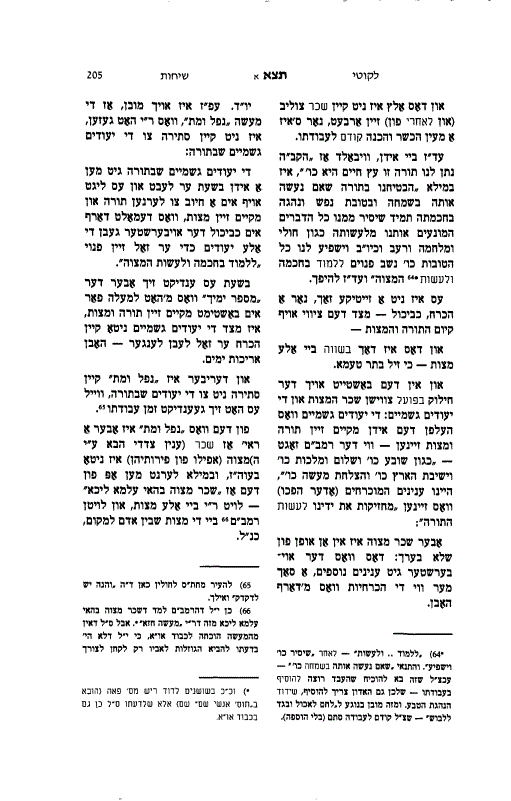
“The school of Rabbi Yaakov taught: Regarding honoring one’s father and mother it is written, ‘So that your days will be prolonged and so that it will be good for you.’ Regarding Shiluach HaKen it is written, ‘So that it will be good for you and you will prolong your days.’ Suppose a person’s father said to him, ‘Go up to the building and bring me young birds,’ and he went up and fell and died. Where is the prolonging of this person’s days? … Rather, ‘so that your days will be prolonged’ refers to a world that is entirely long, and ‘so that it will be good for you’ refers to a world that is entirely good.” And perhaps such an incident never occurred? Rabbi Yaakov actually witnessed such an incident.
On the surface, it appears that Rabbi Yaakov disagrees with the anonymous Mishnah that states, “A person eats their fruits in this world.” If so, why does the Rambam rule, “The giving of the reward for mitzvos … is the life of the World to Come,” in accordance with Rabbi Yaakov rather than with the anonymous Mishnah?
Furthermore, the Rambam explains that the material promises stated in the Torah are not the reward itself, but are intended to remove those things that hinder the fulfillment of Torah and mitzvos. If so, since he explains that there are material promises, why does he not explain that the promise “so that it will be good for you” also refers to material good?
This can be understood by first explaining the final Mishnah in Chullin:
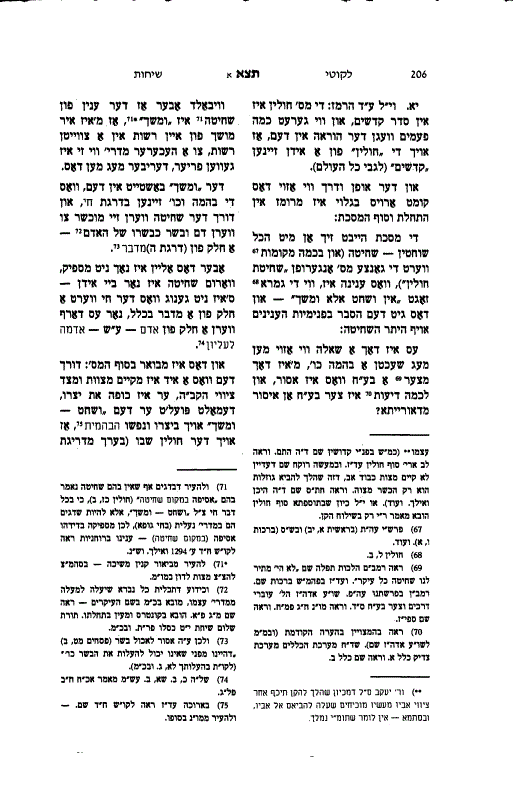
“A person may not take the mother together with the young, even in order to purify a metzora. And if regarding a light mitzvah worth about an issar the Torah says, ‘So that it will be good for you…,’ how much more so regarding the more severe mitzvos of the Torah.”
The connection between the two clauses of the Mishnah is as follows:
From the law that “a person may not take the mother together with the young even in order to purify a metzora,” it is evident that the mitzvah of Shiluach HaKen is not merely in the category of mitzvos between one person and another. For if so, the benefit of showing compassion toward the metzora should override the compassion shown toward the bird.
Rather, Shiluach HaKen also contains an aspect of a mitzvah between man and Hashem — that one must immediately send away the mother in order to subdue his yetzer.
Accordingly, the continuation of the Mishnah concerning the reward for mitzvos — “If regarding a light mitzvah worth about an issar the Torah says, ‘So that it will be good for you…’” — means that there is reward in the World to Come, because reward in this world is only for mitzvos between one person and another.
This is why Rabbi Yaakov emphasizes that the incident also involved honoring one’s father and mother and not only the fulfillment of Shiluach HaKen. The primary proof comes specifically from the mitzvah of honoring one’s father and mother, which is a mitzvah between one person and another, where the benefit produced by the action is of primary importance, even if the son performed the act with an opposite intention and not for the sake of the mitzvah.
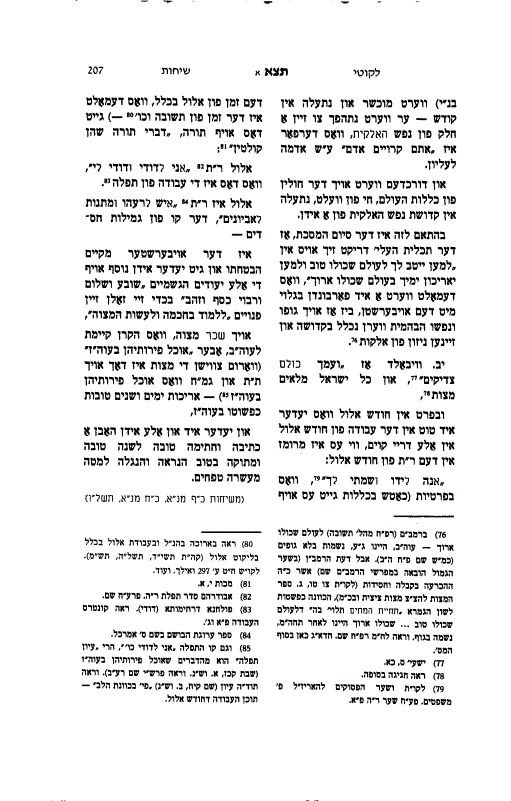
The Rambam rules in accordance with this Mishnah and also in accordance with the Mishnah, “These are the things whose fruits a person eats in this world.” There is a reward — their “fruits” — in this world for mitzvos between one person and another, while the reward for mitzvos between man and Hashem is in the World to Come.
Regarding the incident witnessed by Rabbi Yaakov, the Rambam explains that the son intended to take the young birds for himself and not for his father. In a mitzvah between man and Hashem, if a person performs the act with an intention that is contrary to the mitzvah, it is not considered a mitzvah.
Rabbi Yaakov, however, holds that even the reward for mitzvos between one person and another is in the World to Come.
The promises stated in the Torah are an entirely different matter. They are not reward for the mitzvos, but rather the granting of the possibility — before the fulfillment — to fulfill the mitzvos. In this respect, all mitzvos are equal.
The incident witnessed by Rabbi Yaakov does not contradict the Torah’s material promises, because those promises apply to the period during which a person must fulfill Torah and mitzvos. This does not apply once the allotted span of one’s life has ended, as expressed in the verse, “I will fill the number of your days.”
By Way of Allusion:
Maseches Chullin begins with the subject of shechitah: “The term veshachat means only vemashach — drawing upward,” meaning the elevation of the animal to the level of man.
At the conclusion of the tractate it is explained that when a person subdues his yetzer, he thereby “slaughters” his animal soul, and it becomes elevated and transformed into a part of the G‑dly soul.