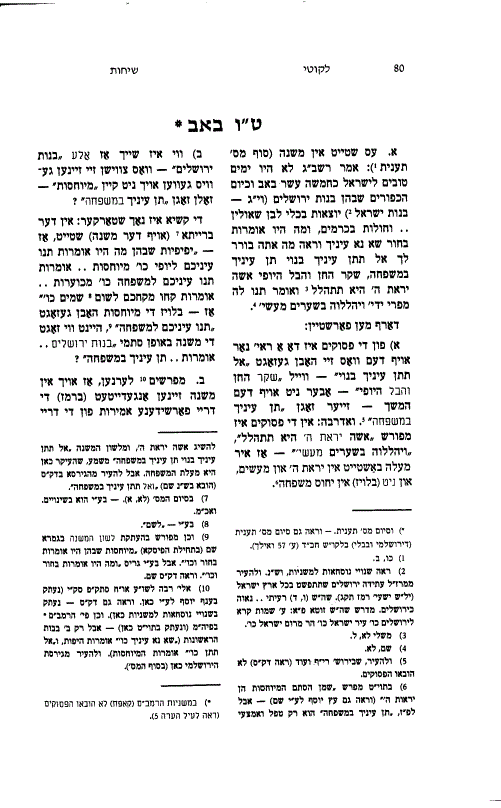
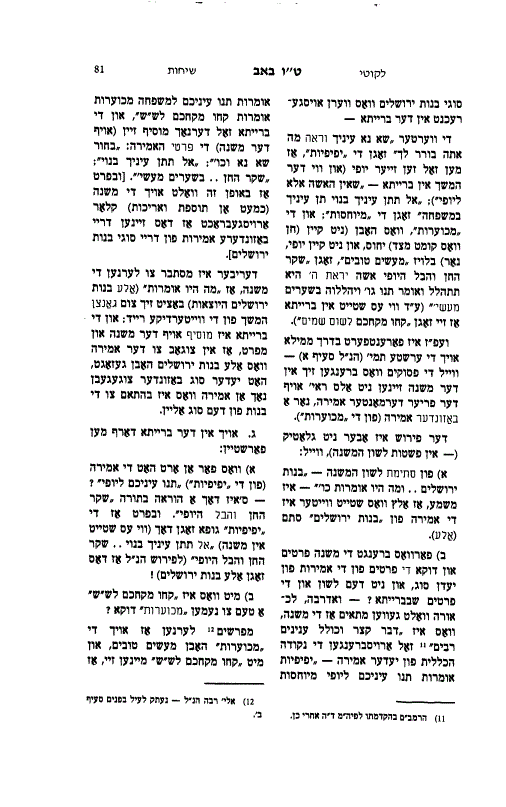
The Mishnah discusses the general quality shared by all the daughters of Jerusalem: they all belong to the family of the Patriarchs and Matriarchs. This is the meaning of the statement, “Set your eyes upon the family.” The Baraisa, by contrast, discusses their individual qualities.
The circle dance of the daughters of Jerusalem expresses the unity among them in two ways: first, through the common essential point shared by them all, as emphasized in the Mishnah; and second, through the unity of their individual qualities, as emphasized in the Baraisa.
The Mishnah at the conclusion of Tractate Taanis states:
“There were no days as festive for the Jewish people as the Fifteenth of Av and Yom Kippur, when the daughters of Jerusalem would go out… What would they say? ‘Young man, please raise your eyes… Do not set your eyes upon beauty; set your eyes upon the family… Grace is false and beauty is vain… Give her the fruits of her hands…’”
The Baraisa states:
“The beautiful ones among them would say, ‘Set your eyes upon beauty…’ Those of distinguished lineage would say, ‘Set your eyes upon the family…’ The unattractive ones would say, ‘Make your selection for the sake of Heaven.’”
It must be understood: How can the Mishnah say that all the daughters of Jerusalem declared, “Set your eyes upon the family,” when not all of them possessed distinguished lineage?
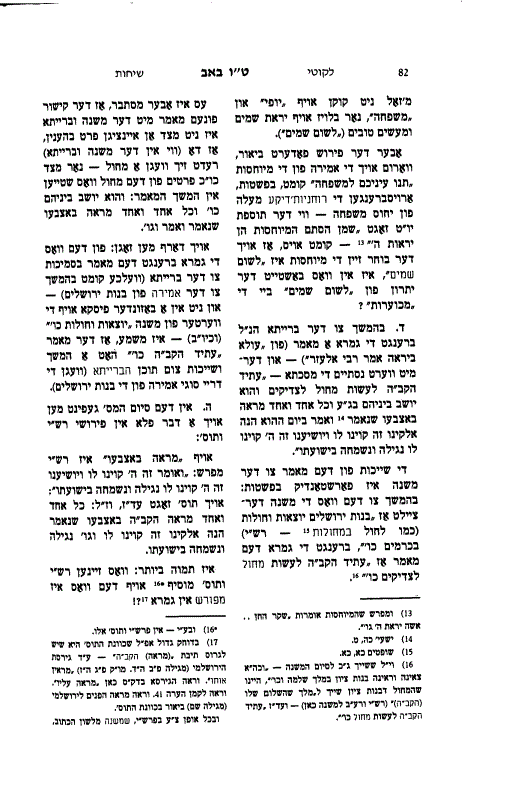
Following this discussion, the Gemara states:
“In the future, the Holy One, blessed be He, will make a circle dance for the righteous… and each one will point with his finger, as it is stated: ‘On that day they will say: Behold, this is our G‑d…’”
Regarding the words, “Each one will point with his finger,” Rashi explains: “And he will say, ‘This is Hashem…’”
Rashi’s addition to the words of the Gemara indicates that, in his view, the righteous will say, “This is Hashem for Whom we hoped.” This differs from Tosafos, which omits the word “and he will say,” because Tosafos maintains that the righteous will merely point with their fingers.
The explanation of all this is as follows:
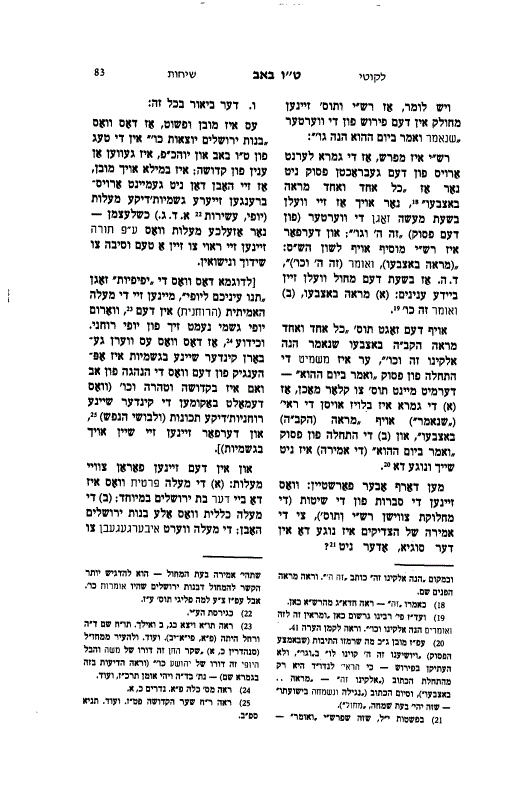
The Mishnah discusses the general quality shared by all the daughters of Jerusalem. They all belong to the family of the Patriarchs and Matriarchs, and therefore they can all say, “Set your eyes upon the family.” Each one is, in her essence, “a woman who fears Hashem.”
This is the meaning of the words, “Raise your eyes and see.” One must look upward toward the source and root—“raise your eyes”—and then one sees that every one of them is, in her essence, “a woman who fears Hashem.”
The Baraisa, by contrast, discusses their individual qualities. These include physical and spiritual beauty, distinguished lineage, and those described as unattractive.
“Unattractive” means that they do not possess a revealed quality. This very lack, however, arouses within them bitterness and teshuvah, to the extent that they specifically declare and understand that one must “make one’s selection for the sake of Heaven.”
The circle dance of the daughters of Jerusalem expresses the unity among them. This is evident from the fact that “they would go out wearing borrowed white garments, so as not to embarrass anyone who did not possess her own.”
Unity contains two dimensions.
The first is the unity that comes from the common essential point shared by everyone, as explained in the Mishnah.
The second is the unity of their distinct qualities, in which all the individual elements join together as one, as explained in the Baraisa.
Following the Baraisa, the Gemara therefore introduces the future “circle dance of the righteous,” in which each one “points with his finger” according to his own individual perception.
Within this itself, however, there is a difference between Rashi and Tosafos.
According to Rashi, each righteous person will also speak. He will communicate and transmit his own particular quality and perception to all the other righteous people.
According to Tosafos, however, when the Holy One, blessed be He, is in the center, there can be no “and he will say.” Each righteous person cannot transmit his own individual level to the others.
A circle has no beginning and no end. This signifies that the essential point of every level is revealed. Consequently, the unity of the circle dance can exist only in the first manner—through the common element shared by everyone.
Unity through the inclusion of the distinct individual qualities cannot exist within the circle dance. On the contrary, regarding their individual spiritual levels, “each person is burned by the canopy of his fellow.”