Likkutei Sichos Vol. 14 – Nitzavim 1
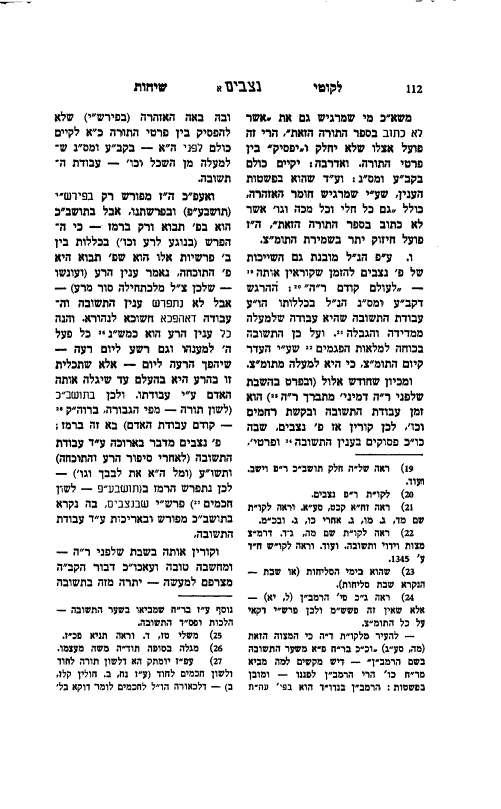
1. On the verse "And the L‑rd shall separate him for evil... according to all the curses of the covenant that are written in this book of the Torah," Rashi quotes the words "that are written in this book of the Torah" and explains: "Above, it says 'in this book of the Torah,' and also 'every sickness and every plague, etc.' The word 'this' in the feminine form refers to the Torah, while 'this' in the masculine form refers to the book. Through the division of the cantillation marks, they are divided into two expressions. In the section of the curses, the cantillation mark 'tipcha' is placed under 'in the book,' and 'the Torah' is connected to it, therefore it says 'this' in the feminine form. Here, the 'tipcha' is placed under 'the Torah,' so 'the book of the Torah' is connected, and therefore the masculine form follows, as the expression refers to the book."
We need to understand:
a) Why does Rashi quote from the verse here also the word "that are written," when his difficulty (and explanation) is only with the words "in this book of the Torah"?
b) Similarly, in the second verse: since Rashi points out "above it says" and quotes the words "in this book of the Torah," it is already known to which verse he is referring — why does he need to quote also the beginning of the verse "also every sickness, etc."? And even if we say there is a reason to include the beginning — why is it not enough with these words [and to conclude with "etc."], but he also quotes "and every plague, etc."?
c) In quoting this verse, he first writes the end of the verse "in this book of the Torah" and then (marks it at the beginning of the verse) "also every sickness and every plague, etc."?
d) What is Rashi's intention in writing "in the section of the curses the 'tipcha', etc." — and either way: if for some reason it is necessary to mark the verse within the content of the section, he should have said this at the beginning of his explanation instead of the word "above (it says)"; and if the first time it suffices to simply say "above" — how much more so there is no need for an additional sign when he mentions it the second time? — He should have said: above, or that the 'tipcha', etc. (as he says later) "and here, etc."?
The explanation itself also requires clarification:
e) Even after Rashi explains that there is no contradiction in the expressions of the verses, because the masculine "this" here refers to the book, and the feminine "this" there refers to the Torah — this very change itself requires a reason: why did the verse change — here emphasizing "the book" and there "the Torah," when in both it says the same expression: "in the book of the Torah"?
2. All this will be understood by first examining another precision in Rashi's commentary: Seemingly, there is no need to question our verse due to a contradiction from another verse, because in this very verse, the word "this" (in the masculine form) is difficult, since the word "the Torah" next to it is in the feminine form? (And the verse above in Parshas Tavo "the Torah this" is precise — and it is not in the category of an undecided expression that has no resolution) — and it should have been explained that the intention of the verse here is not as it appears at first glance, but that "this" refers to the "book," which is in the masculine form (because the expression in Parshas Tavo does not need resolution as it is precise, as mentioned above).
3. However, from the continuation of the verse itself, it is understood that there is no place for this question: since the verse states "written in this book of the Torah," meaning that the discussion is about the writing, it is understood that this refers and is related to the "book" in which the "covenant" is written ("book" is the object in which things are written); whereas "Torah" is a name for the content of the matters written in the book. Therefore, it is straightforward that the verse uses the masculine form "this," since it refers to the "book," but the verse interrupts with the word "Torah" to explain the content of the book. However, it is difficult because "above" (where it also says "written" and yet) it says "in this book of the Torah" in the feminine form?
4. Rashi answers this: (since it is stated there) "also every illness and every plague, etc. (therefore it must say) 'this' in the feminine form refers to the Torah, (whereas here) 'this' in the masculine form refers to the book." This means that above, the main focus of the verse is the "Torah," and the necessity for this is due to the beginning of the verse "also every illness and every plague, etc."
The matter of the curses and the rebuke, in simple terms, is to warn the Jewish people so that they will hear and fear and turn away from the path of the commandments. It is understood that the more the warning is increased and intensified, the greater the fear will be to transgress the commandments.
Therefore, when it says "also every illness and every plague that is not written in this book of the Torah, G‑d will bring upon you, etc.," the intention is to frighten them even more: in addition to everything written in great detail before, there is an addition of "also" "that is not written" — but G‑d will bring it upon you; and not just a part of it, but "every illness and every plague," everything — meaning that it includes everything possible to include.
And behold, in the "book," whose matter is that it is written,
10. There are matters that are explicitly written, and there are matters that are derived from what is explicitly written because they are included in it. The writer intends for them to be taught (from the language of the Torah) through this book, which is called the "Book of the Torah." This is evident from Rashi's explanation of "which I have written to instruct them," meaning all 613 mitzvos are included in the Ten Commandments, even though only they are explicitly stated as "I have written." Similarly, in Parshas Tavo, when it says that there will be an addition to what is "written in the Book of the Torah," the intention is that there will be an addition to what is included in the written text, and the written text is meant to instruct it from what is written. Here, on the contrary, the instruction included in the "written" is primary — since the content of this verse is to increase the fear as much as possible, as mentioned above, therefore the word "Torah" is primary, and it is understood why it concludes with the term "this."
11. This is the distinction between the two verses: In the verse before us, since the content of the matter does not necessitate that the word "Torah" is the primary focus, it can be understood simply as "written in the book — (whose content is) this Torah"; whereas in the text "above," its content necessitates that "the Torah" is primary.
12. However, this is still not sufficient: Although from the content of the verses in Parshas Tavo it is evident that "the Torah" is the primary focus and therefore it is written "this," and in our Parsha the primary focus is "in the book" and therefore it is written "this" — nevertheless, to avoid any misunderstanding or question, it would have been more appropriate to write in our Parsha "in this book" and omit the word "Torah," and it would be self-evident to which book it refers; and similarly in Parshas Tavo — "this Torah" (omitting "in the book"). [And even though this is not a question in itself (why these words are added) because this is the way of the scriptures, however, in this case, there is room for this question due to the difference between the two texts].
For this, Rashi adds "and according to the division of the cantillation marks, they are divided into two expressions" — meaning there is no room for misunderstanding or question at all, because the cantillation marks clearly separate and divide into two expressions.
With this, Rashi's emphasis on "in the section of the curses" is understood (this is not for the purpose of citation, as mentioned above) because the fact that the section's content (to frighten with a multitude of) curses — necessitates that "the Torah" is primary, and therefore the division of the cantillation marks must be in this manner.
13. From the "wine of the Torah" in our Parsha:
The entire Torah is "one Torah," even though it is said in detail "My ten Torahs — to include the Oral Torah, the law given to Moses at Sinai" — and in each of them there are light and severe [commandments], etc. Our sages said, "Do not sit and weigh the commandments of the Torah," "Be as careful with a light mitzvah as with a severe one," and more.
And even though this is a light mitzvah and that is a severe one, they are all the will of the Holy One, blessed be He. Even what a diligent student is destined to innovate was given to Moses at Sinai, and by fulfilling it, one fulfills the will of G‑d. This must be the true reason for fulfilling the Torah and mitzvos, and not because of the reward or its opposite, etc., and certainly not because it is a rational mitzvah.
14. Therefore, all of them are statutes and the will of G‑d, for He and His will are one. They are fulfilled because of the "simple will" within a person, as is also evident from the well-known words of Maimonides — with acceptance of the yoke and self-sacrifice.
And since we have been promised, "If you walk in My statutes... I will give your rains in their season," it is understood that this conduct, which is a commandment of the Torah, is dependent on the influence of all good, both physical and spiritual.
However, if one comes to divide and separate, saying this teaching is pleasant and this teaching is not, and a sin leads to another sin — to separate between the Written Torah and the Oral Torah, accepting the Written Torah as primary and the Oral Torah as secondary, G‑d forbid, etc., this is contrary to the Torah and causes the withholding of blessings, etc.
This is what Rashi wrote, that "in the section of the curses, the tipcha (which indicates a pause and separation) is placed under 'in the book,' and 'this Torah' are connected to each other" — the opposite of blessing comes through separating between "in the book" — the Written Torah, and "the Torah" — the Oral Torah, as mentioned above.
The reason for this separation is that one does not feel the aspect of "which is not written in this book of the Torah" — the aspect of self-sacrifice and acceptance of the yoke, which are above (not written) the service that is explicitly explained with reasons in the Written Torah (in the book) and the Oral Torah (the Torah).
However, one who feels also "which is not written in this book of the Torah," this influences him not to divide ("pause") between the details of the Torah. On the contrary, he will fulfill them all with acceptance of the yoke and self-sacrifice: as it is in the simple sense, by feeling the severity of the warning, including "also every sickness and every plague, etc., which is not written in this book of the Torah," this causes a greater strengthening in the observance of the Torah and mitzvos.
15. Based on the above, the connection of Parshas Nitzavim to the time it is read is also understood — "always before Rosh Hashanah": the feeling of acceptance of the yoke and self-sacrifice mentioned above in general is the concept of the service of teshuvah, which is a service beyond measure and limitation. Therefore, teshuvah has the power to rectify the deficiencies caused by the lack of observance of Torah and mitzvos, for it is above Torah and mitzvos.
And since the month of Elul (especially on the Shabbos before Rosh Hashanah, from which Rosh Hashanah is blessed) is a time for the service of teshuvah and requesting mercy, etc., therefore, we read Parshas Nitzavim then, which contains many verses concerning the matter of teshuvah and its details.
And in it comes the warning not to separate between the details of the Torah, but to fulfill them all before G‑d — with acceptance of the yoke and self-sacrifice that is above intellect, etc. — the service of teshuvah.
16. Nevertheless, this is explicitly stated only in Rashi's commentary (the Oral Torah) and in our parsha, but in the Written Torah, it is in Parshas Tavo and only hinted at. The distinction (regarding evil, etc.) in general between these two parshas is that Parshas Tavo is the parsha of rebuke, where the matter of evil is stated, but the concept of teshuvah and the service of transforming darkness into light is not explicitly mentioned. The entire matter of evil, as explained, is that "G‑d has made everything for His purpose, even the wicked for the day of evil" — that the evil should be transformed into a day. However, this purpose in evil is concealed until a person reveals it through his service. Therefore, in the Written Torah (the language of Torah — from the mouth of the Almighty, with Divine inspiration — before man's service), this is hinted at.
Parshas Nitzavim speaks at length about the service of teshuvah (after the recounting of evil and rebuke) and repentance (and "the L‑rd your G‑d will circumcise your heart, etc."). Therefore, the hint is explained in (the Oral Torah — the language of the Sages) Rashi's commentary in Nitzavim, where it is explicitly and at length about the service of teshuvah.
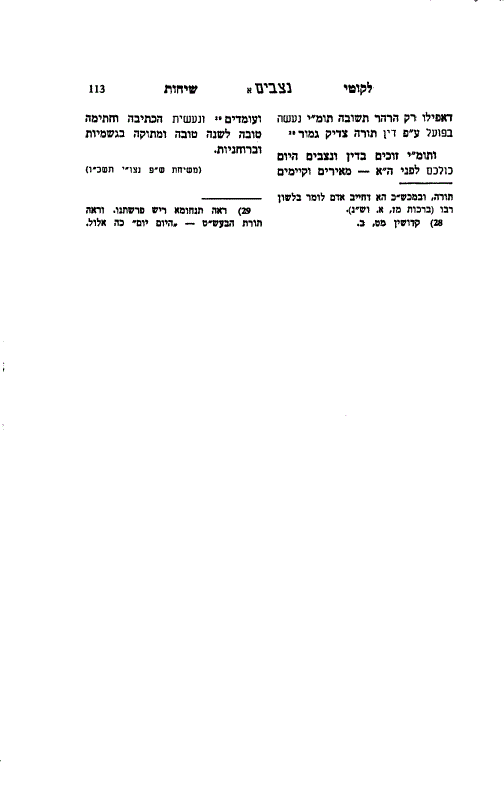
And we read it on the Shabbos before Rosh Hashanah — and a good thought, and certainly the speech of the Holy One, blessed be He, joins them to action — even more so with teshuvah.
Even just the thought of teshuvah immediately becomes an action according to Torah law, making one a complete tzaddik.
And immediately they merit in judgment and "you stand today all of you before the L‑rd your G‑d" — illuminated, established, and standing, and it becomes a good and sweet inscription and sealing for a good and sweet year in both material and spiritual matters.
1. Rashi, in his commentary on the verse: "Your little ones, your wives, and your stranger that is in the midst of your camp, from the hewer of your wood unto the drawer of your water," quotes the words "from the hewer of your wood" and explains: "This teaches that the Canaanites came to convert in the days of Moses, just as the Gibeonites came in the days of Joshua, and this is what is said about the Gibeonites: 'And they also acted with cunning,' and Moses made them woodcutters and water drawers."
The commentators have written that Rashi's intention is as stated in the Tanchuma: "This teaches that the Gibeonites came to Moses, and he did not accept them, as it says, 'And they also acted with cunning, etc.' What does 'also' mean? To teach you that they came to Moses, and he did not accept them," meaning that in practice, Moses did not make a covenant with them, but rather "Moses immediately made them woodcutters and water drawers"; that is, they remained servants to the children of Israel.
However, from the fact that Rashi adds (to the Tanchuma) "(that the Canaanites came) to convert," and omits (what is written in the Tanchuma) that Moses did not accept them, it is proven that according to Rashi's view (in the simple meaning of the text), Moses accepted them, and they converted in practice.
6. However, according to this, it is necessary to understand:
(a) From where does Rashi derive, in the simple meaning of the text, that they converted? On the contrary, it would seem that just as Rashi's necessity to say that the "hewers of wood, etc." are not from the children of Israel, since the verse separates them into a distinct category and does not include them in "all the men of Israel," it would similarly seem that they are not converts. This is because converts were already mentioned earlier as "the stranger that is in your camp," as Rashi himself explains in the Gemara: "Since the verse refers to the woodcutters by name, it proves they are not part of Israel and not part of the converts, etc."
(b) What is Rashi's intention in writing "this teaches (that the Canaanites came, etc.)" instead of stating: "the Canaanites came to convert, etc."?
(c) Why does he quote the word "with cunning" — for even without it, his proof is understood and clear?
7. The explanation of all this:
In the simple meaning of the text, it is proven that the "hewer of wood..."