Likkutei Sichos Vol. 9 – Ki Savo 1
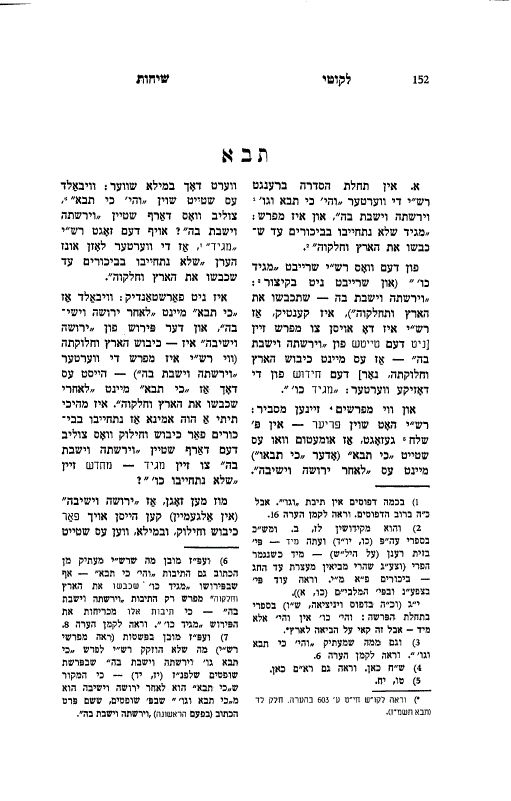
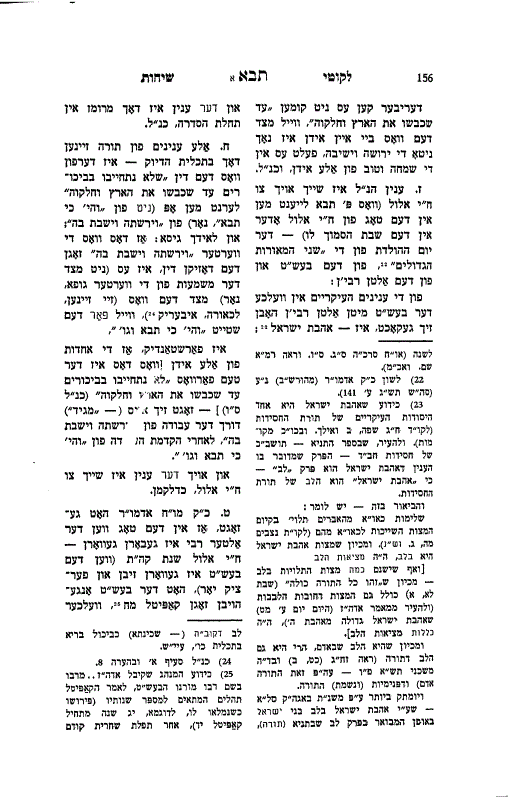
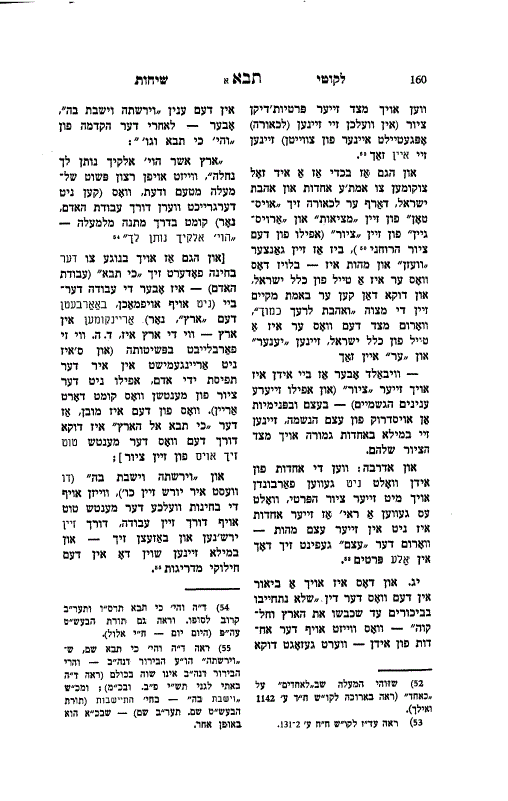
1. At the beginning of the parsha, Rashi brings the words "And it will be when you come... and you inherit it and dwell in it," and explains: "This teaches that they were not obligated in the mitzvah of bikkurim until they conquered the land and divided it."
From the fact that Rashi writes "This teaches, etc." (and does not write succinctly: "And you inherit it and dwell in it — that you conquer the land and divide it"), it is evident that Rashi intends to explain not the meaning of "and you inherit it and dwell in it" — that it refers to the conquest and division of the land — but rather the novelty of these words: "This teaches, etc."
As the commentators explain, Rashi has already stated earlier in Parshas Shelach that wherever it says "when you come" (or "when you will come"), it means "after inheritance and settlement."
This raises a difficulty: Since it already states "And it will be when you come," why is it necessary to state "and you inherit it and dwell in it"? Rashi answers with "This teaches," indicating that these words inform us "that they were not obligated in bikkurim until they conquered the land and divided it."
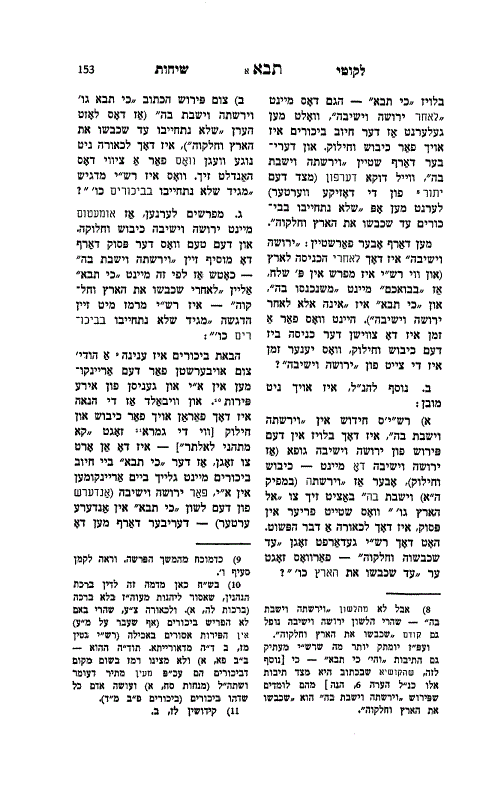
It is not understood: Since "when you come" means "after inheritance and settlement," and the interpretation of "inheritance and settlement" is the conquest and division of the land, it follows that "when you come" means "after they conquered and divided the land." So why would there be an assumption that they were obligated in bikkurim before the conquest and division, necessitating the phrase "and you inherit it and dwell in it" to teach — to innovate — "that they were not obligated, etc."?
We must say that "inheritance and settlement" (in general) can also mean before conquest and division. Therefore, when it states only "when you come" — although this means "after inheritance and settlement," which we learn that the obligation of bikkurim is also before conquest and division — it is necessary to state "and you inherit it and dwell in it," because only from this (due to the redundancy of these words) do we learn "that they were not obligated in bikkurim until they conquered the land and divided it."
1. We must understand: "Inheritance and settlement" is after entering the land. What time is there between entering the land and the conquest and division, during which this period is considered "inheritance and settlement"?
2. In addition to the above, it is also not understood:
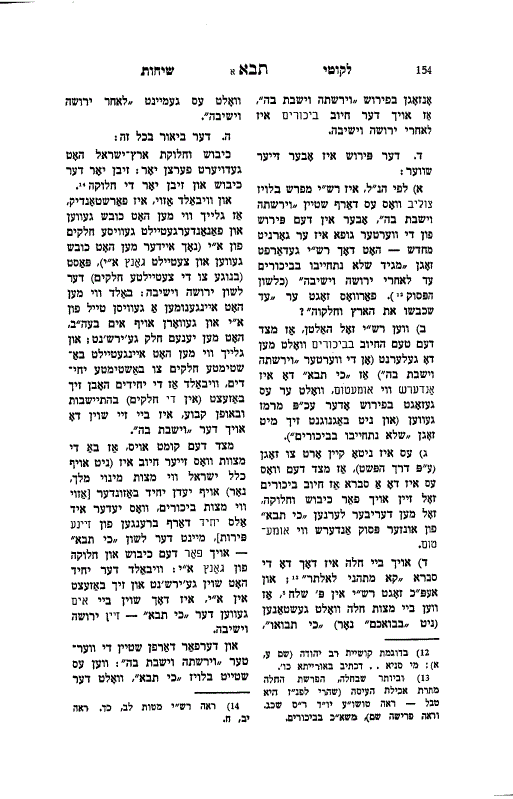
a) Rashi's innovation in "and you inherit it and dwell in it" is only in the interpretation of inheritance and settlement itself (that inheritance and settlement here means conquest and division). However, if "and you inherit it (with the final 'hei') and dwell in it" refers to "the land, etc." mentioned earlier in the verse, it seems to be a simple matter. Rashi should have said "until they conquered and divided it" — why does he say "until they conquered the land, etc."?
b) Regarding the interpretation of the verse "when you come, etc., and you inherit it and dwell in it" (which implies "that they were not obligated until they conquered the land and divided it"), it seems irrelevant what commandment it pertains to. Why does Rashi emphasize "it informs that they were not obligated in bikkurim, etc."?
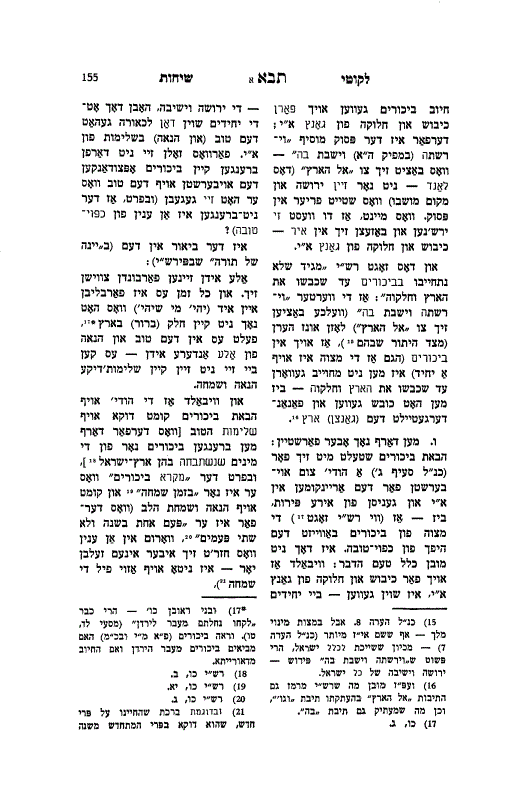
3. Commentators explain that everywhere "inheritance and settlement" means conquest and division, and the reason the verse needs to add "and you inherit it and dwell in it" — even though according to this, "when you come" alone means "after they conquered the land and divided it" — is hinted at by Rashi with his emphasis "it informs that they were not obligated in bikkurim, etc.":
The bringing of bikkurim is essentially a thanksgiving to the Almighty for entering the Land of Israel and enjoying its fruits. And since this enjoyment exists even before conquest and division [as the Gemara states, "they benefit immediately"], there is room to say that the "when you come" regarding the obligation of bikkurim means immediately upon entering the Land of Israel, before inheritance and settlement (unlike the expression "when you come" in other places) — therefore, it is necessary here to explicitly state "and you inherit it and dwell in it," that the obligation of bikkurim is also after inheritance and settlement.
4. However, this explanation is very difficult:
a) According to the above, Rashi is explaining only why it needs to state "and you inherit it and dwell in it," but in the explanation of these words themselves, he is not introducing anything new. Rashi should have said, "it informs that they were not obligated in bikkurim until after inheritance and settlement" (using the language of the verse). Why does he say "until they conquered the land and divided it"?
b) If Rashi held that due to the reason for the obligation of bikkurim, one would have learned here (without the words "and you inherit it and dwell in it") that "when you come" here is different than elsewhere, he would have stated it explicitly or at least hinted at it (and not sufficed with saying "they were not obligated in bikkurim").
c) There is no place to say (according to the simple meaning) that because there is a reasoning that the obligation of bikkurim should also be before conquest and division, one should therefore interpret "when you come" from our verse differently than elsewhere.
d) Also regarding challah, there is the reasoning "they benefit immediately"; and nevertheless, Rashi says in Parshas Shelach that if regarding the mitzvah of challah it would have stated (not "when you come" but) "when you enter," it would mean "after inheritance and settlement."
5. The explanation of all this:
The conquest and division of the Land of Israel took fourteen years: seven years for the conquest and seven years for the division.
And since this is so, it is understandable that as soon as they conquered and divided certain parts of the Land of Israel (even before they had conquered and divided the entire Land of Israel), the expression "inheritance and settlement" applies (regarding the divided parts): As soon as they took possession of a certain part of the Land of Israel and became its owners, they inherited that part; and as soon as they allocated specific parts to specific individuals, since these individuals settled (in these parts) in a permanent manner, they already had the "and dwell in it."
Therefore, it follows that for those mitzvos whose obligation is (not on the entire Jewish people like the mitzvah of appointing a king, but) on each individual separately [such as the mitzvah of bikkurim, where each Jew as an individual must bring from his fruits], the expression "when you come" means also before the conquest and division of the entire Land of Israel: Since the individual has already inherited and settled in the Land of Israel, he has already experienced the "when you come" — his inheritance and settlement.
And therefore, the words "and you inherit it and dwell in it" need to be stated: If it only stated "when you come," the obligation of bikkurim would have been also before the conquest and division of the entire Land of Israel; therefore, the verse adds "and you inherit it (with a definitive 'hei') and dwell in it," which refers to "to the land" (the land — not just its inheritance and place of residence) mentioned earlier in the verse, meaning that you will inherit it and settle in it — the conquest and division of the entire Land of Israel.
5. And this is what Rashi states: "It teaches us that they were not obligated in bikkurim until they conquered the land and divided it." The words "and you inherit it and dwell in it" (which refer to "to the land") inform us (due to their redundancy) that even regarding bikkurim (even though the mitzvah is upon the individual), one is not obligated until they have conquered and divided the entire land.
6. However, we must further understand: The bringing of bikkurim represents (as mentioned in section 3) a thanksgiving to the Almighty for entering the Land of Israel and enjoying its fruits, to the extent that the mitzvah of bikkurim demonstrates the opposite of ingratitude. Therefore, the reason is not understood at all: Since even before the conquest and division of the entire Land of Israel, there was already — for individuals — the inheritance and settlement, these individuals seemingly already had the complete good (and enjoyment) of the Land of Israel. Why should they not be required to bring bikkurim to thank the Almighty for the good He has given them (especially since not bringing them is an aspect of ingratitude)?
The explanation in this is: All Jews are interconnected, and as long as there remains even one Jew (whoever he may be) who does not yet have a clear portion in the land, it detracts from the good and enjoyment of all other Jews — they cannot have complete enjoyment and happiness.
And since the Torah's commandment regarding the bringing of bikkurim is specifically for the completeness of good [which is why bikkurim must be brought only from the species with which the Land of Israel is praised], and especially the "recitation of bikkurim," which is only "at a time of joy" and pertains to enjoyment and joy of the heart (which is why it is "once a year and not twice," because in a matter that repeats within the same year — there is not as much joy),
therefore, it cannot occur "until they have conquered the land and divided it," because as long as there is one Jew who does not yet have the inheritance and settlement, it detracts from the joy and good of all Jews, as mentioned above.
7. This concept is also related to the 18th of Elul (as Parshas Ki Tavo is read on the day of the 18th of Elul or on the Shabbos close to it) — the birthday of the "two great luminaries," the Baal Shem Tov and the Alter Rebbe:
One of the main themes in which the Baal Shem Tov and the Alter Rebbe were deeply involved is — Ahavas Yisrael (love of fellow Jews).
8. All matters of Torah are precise. This is evident from the fact that the law "they were not obligated in bikkurim until they conquered the land and divided it" is derived not from "And it will be when you come," but from "And you shall possess it and dwell in it." Conversely, the reason the words "And you shall possess it and dwell in it" convey this law is not due to the meaning of the words themselves, but because they appear to be superfluous, since "And it will be when you come, etc." already states it.
It is understood that the unity of all Jews [which is the reason why "they were not obligated in bikkurim until they conquered the land and divided it" (as explained above in section 6)] is expressed ("it tells") through the service of "And you shall possess it and dwell in it," following the preface of the service of "And it will be when you come, etc."
This concept is also connected to the 18th of Elul, as will be explained.
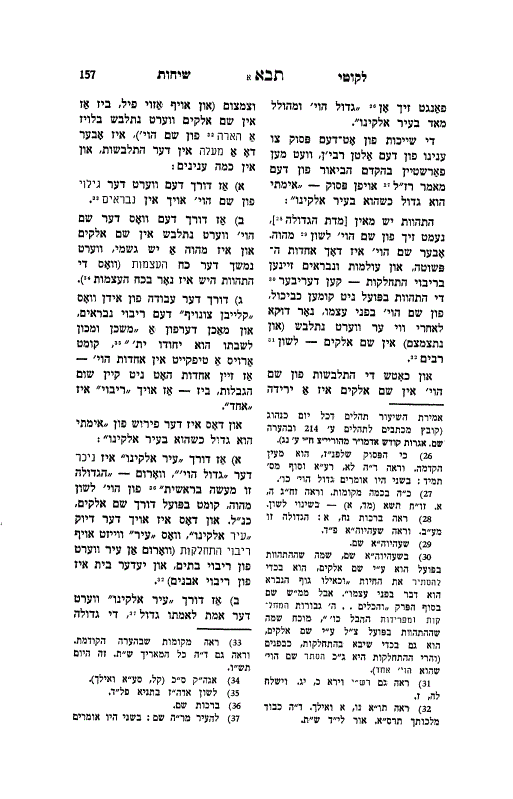
9. The Previous Rebbe said that on the day the Alter Rebbe was born — the 18th of Elul in the year 5505 (when the Baal Shem Tov was forty-seven years old), the Baal Shem Tov began reciting Psalm 48, which begins with "Great is the L‑rd and greatly to be praised in the city of our G‑d."
The connection of this verse to the essence of the Alter Rebbe will be understood by first explaining the saying of our Sages on the verse — "When is He great? When He is in the city of our G‑d":
The creation of something from nothing [the attribute of greatness] derives from the name Havayah, which means "to bring into being." However, the name Havayah represents the simple unity of G‑d, while the worlds and creations exist in a multitude of divisions. Therefore, the actual creation cannot come, so to speak, from the name Havayah alone, but specifically after it becomes clothed (and contracted) in the name Elokim — which is a term of plurality.
And although the enclothing of the name Havayah in the name Elokim is a descent,
9. However, there is an advantage in this enclothing and contraction (to the extent that in the name Elokim, only a ray of the name Havayah is clothed), and this is evident in several aspects:
a) Through this, the revelation of the name Havayah also occurs within creations.
b) Through the fact that the name Havayah becomes clothed in the name Elokim and brings into being a physical entity, the power of the essence is drawn down (since the creation of something from nothing is only through the power of the essence).
c) Through the service of Jews who "gather together" the multitude of creations and make from them a "dwelling and resting place for His unity," a depth in the unity of Havayah is revealed — that His unity has no limitations, to the extent that even "multiplicity" is "one."
And this is the explanation of "When is He great? When He is in the city of our G‑d":
a) Through "the city of our G‑d," the "Great is the L‑rd" is recognized, for "greatness is the act of creation" from Havayah, meaning "to bring into being," which comes into actuality through the name Elokim, as mentioned above. This is also the precision of "the city of our G‑d," as "city" indicates a multitude of divisions (for a city is made up of many houses, and each house is made up of many stones).
b) Through "the city of our G‑d," the true greatness is revealed, the essential greatness (which is even beyond "and His greatness is unsearchable" — the greatness of the name Havayah as it is in its essence).
c) Through the service of "the city of our G‑d," where Jews make from the multitude of creations (which are brought into being by "our G‑d") a dwelling for His unity (just as a city is made from a multitude of stones and houses), where in this the unity without limit is expressed as mentioned above — through this, the true greatness is revealed, because the term "great" truly indicates without limit.
10. And this is also the connection of the verse "Great is the L‑rd, etc., in the city of our G‑d" to the Alter Rebbe — the founder of Chabad Chassidus:
a) Through the fact that the Alter Rebbe brought down Chassidus into wisdom, understanding, and knowledge, to the extent that everyone could understand it, the teachings of the Baal Shem Tov were also revealed in an intellectual manner accessible to all.
2. Through this, there was also an enhancement in the teachings of the Baal Shem Tov. As is known, through the integration of Chassidus into intellectual comprehension, the essence of the inner dimension of the Torah was drawn down.
3. By explaining the unity of Havayah even within human intellect, the true unity of "there is none else besides Him" was revealed — that even human intellect is not separate, etc.
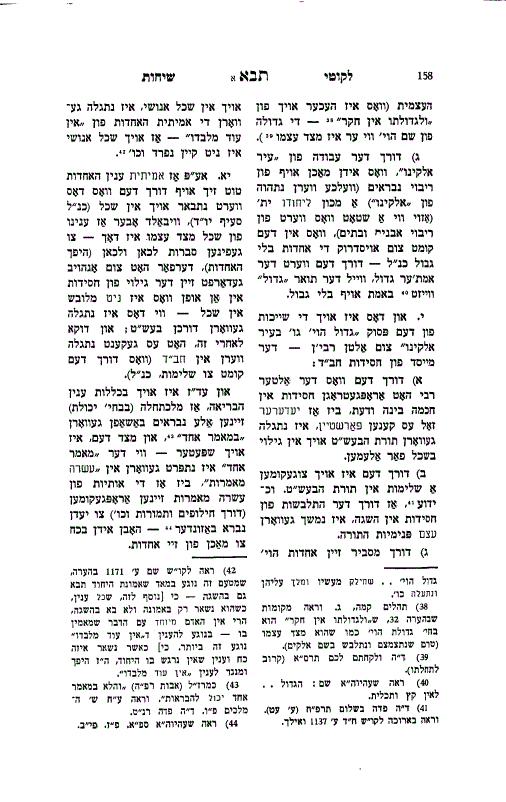
11. Although the true concept of unity is revealed through its explanation within intellect (as mentioned above in section 10), since the nature of intellect itself is to find arguments for and against (the opposite of unity), initially, the revelation of Chassidus had to be in a manner not clothed in intellect — as it was revealed by the Baal Shem Tov. Only after this could it be revealed in Chabad (through which it reaches completion, as mentioned above).
Similarly, this is also true regarding the general concept of creation. Initially (in the aspect of potential), all creations were made "with one utterance," and because of this, even later — when the "one utterance" was detailed into "ten utterances," until the letters of the ten utterances descended (through exchanges and transformations, etc.) to each individual creation — Jews have the power to make from them unity.
This is the inner reason why, at the very beginning of Shaar HaYichud VehaEmunah, the Alter Rebbe brings the Baal Shem Tov's interpretation on the verse "Forever, O L‑rd, Your word stands firm in the heavens":
In order to draw down "there is none else," "in the heavens above and on the earth below" (within creation, and as it is detailed into many particulars: from "the heavens above" to "on the earth below"), and in a manner of "and you shall know" (Chabad) — one must first bring the Baal Shem Tov's interpretation (the concept of the unity of Havayah as it was revealed by the Baal Shem Tov in a manner of revelation of light from above, beyond being clothed in intellect) on the verse "Forever, O L‑rd, Your word stands firm in the heavens" — "Your word" in the singular form (the aspect of one utterance).
And this concept is later brought down into the creations as they exist in a state of multiplicity, so that they should understand it with their intellect (until it also reaches the intellect of those who previously, before hearing about the concept of "the great distinction between the work of man and his schemes and the work of the heavens and the earth," were "deniers of Divine Providence and the signs and wonders of the Torah"), so that also from the perspective of creation itself (not only from the perspective of the revelation of light from above), it becomes "and you shall know" that "there is none else."
And through this, the truth of "there is none else" is revealed, that also "the heavens above and on the earth below" themselves are "there is none else."
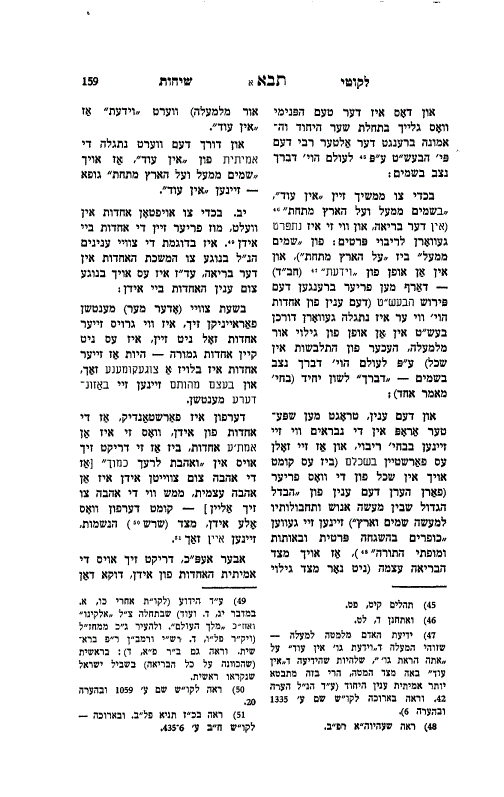
12. In order to effect unity in the world, there must first be unity among Jews. Just as with the two aforementioned matters regarding drawing down unity in creation, so too is it concerning the matter of unity among Jews:
When two (or more) people unite, no matter how great their unity may be, it is not a complete unity, because their unity is merely an added aspect, and in their essential nature, they are separate individuals.
From this, it is understood that the unity of Jews, which is a true unity, to the extent that it expresses itself in "Love your fellow as yourself" [where the love for another Jew is an intrinsic love, just like the love for oneself], comes from the fact that all Jews, from the perspective of the (root of the) souls, are one entity.
However, nevertheless, the true unity of Jews is expressed specifically when also from the perspective of their individual characteristics (in which they are seemingly separated from one another), they are one entity.
And although, for a Jew to reach true unity and love for fellow Jews, he seemingly needs to "remove" himself from his "existence" and "go out" from his "form" (even from the spiritual form), until his entire "being" and essence is — only that he is a part of the collective of Israel, and only then can he truly fulfill the commandment "Love your fellow as yourself," because from the fact that he is a part of the collective of Israel, "your fellow" and "he" are one entity.
— However, since for Jews, even their "form" (and even their physical matters) is essentially and internally an expression of the essence of the soul, they are therefore in complete unity also from the perspective of their form.
And on the contrary: if the unity of Jews were not connected also with their individual form, it would be proof that their unity is not in their essential nature — because the "essence" is found in all details.
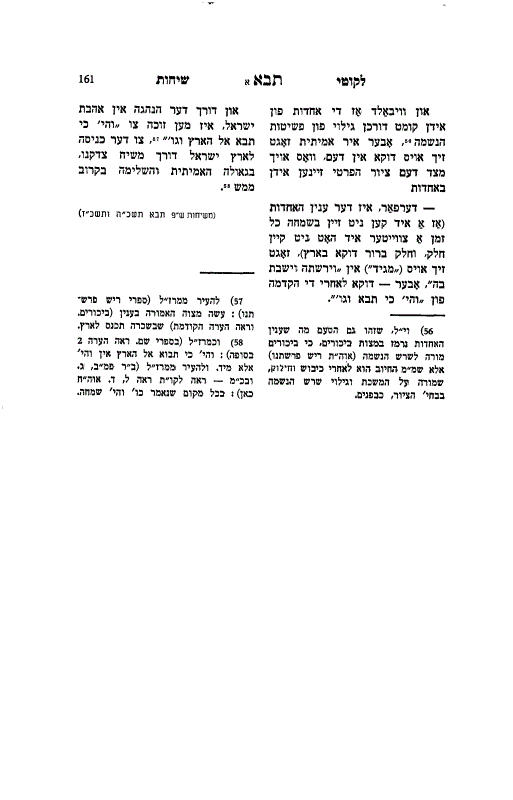
13. This also explains why the law that "they were not obligated in the mitzvah of Bikkurim until they conquered and divided the land" — which indicates the unity of Jews — is specifically stated in the context of "and you shall inherit it and dwell in it," but only after the introduction of "And it shall be when you come...":
"A land that the L‑rd your G‑d gives you as an inheritance," indicates a simple will from Above, beyond reason and understanding, which (cannot be achieved through human effort, but) comes as a gift from Above — "the L‑rd your G‑d gives you."
[And although concerning this level, "when you come" (human effort) is also required — the effort here is not to develop or work the "land," but to enter the land as it is, meaning, as it remains in its simplicity (without any human intervention, not even the form of the people entering it), from which it is understood that "when you come to the land" is specifically through the person divesting himself of his form];
And "you shall inherit it and dwell in it" (you will inherit it, etc.) indicates the levels that a person achieves through his effort, through his inheriting and settling — and consequently, there are already distinctions in levels.
And since the unity of Jews comes through the revelation of the simplicity of the soul, but its true expression is specifically in that, also from the perspective of their individual form, Jews are in unity —
Therefore, the matter of unity (that a Jew cannot be truly joyful as long as another Jew does not have a portion, and specifically a clear portion in the land) is expressed ("told") in "you shall inherit it and dwell in it," but only after the introduction of "And it shall be when you come..."
And through conducting oneself with love for fellow Jews, one merits "And it shall be when you come to the land," to the entry into the Land of Israel through our righteous Moshiach, in the true and complete redemption, speedily in our days.
(From the talks of Shabbat Parshat Ki Tavo, 5725 and 5727)