
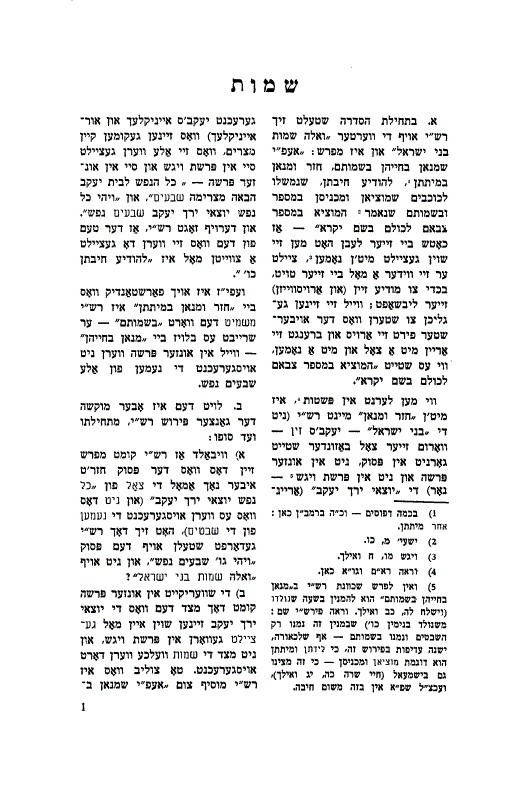
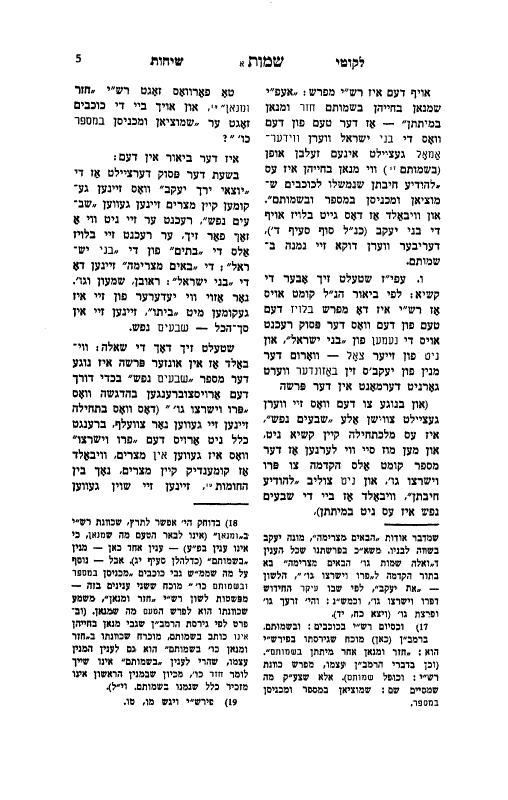
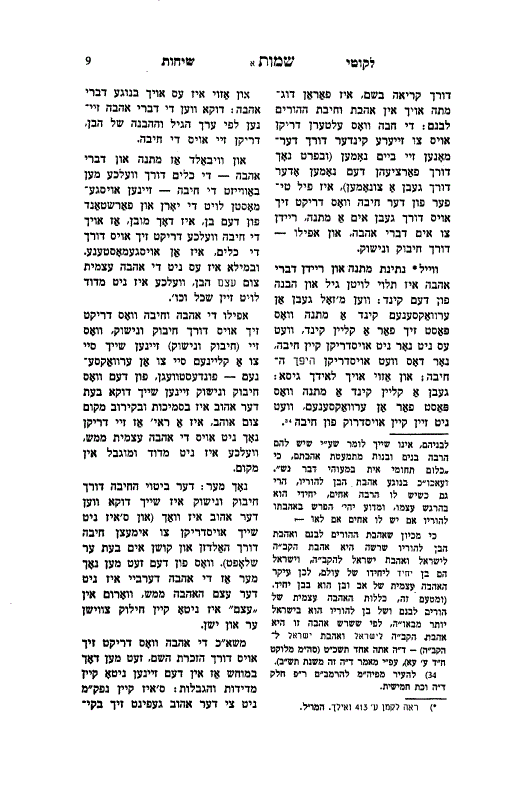
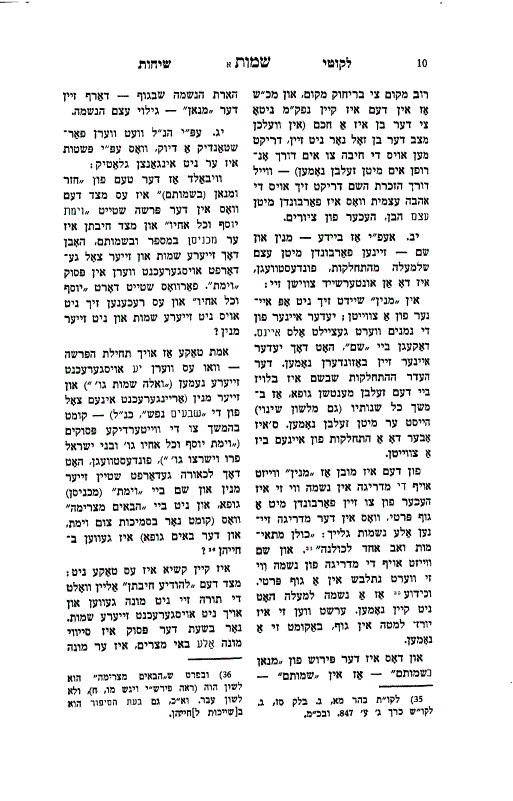
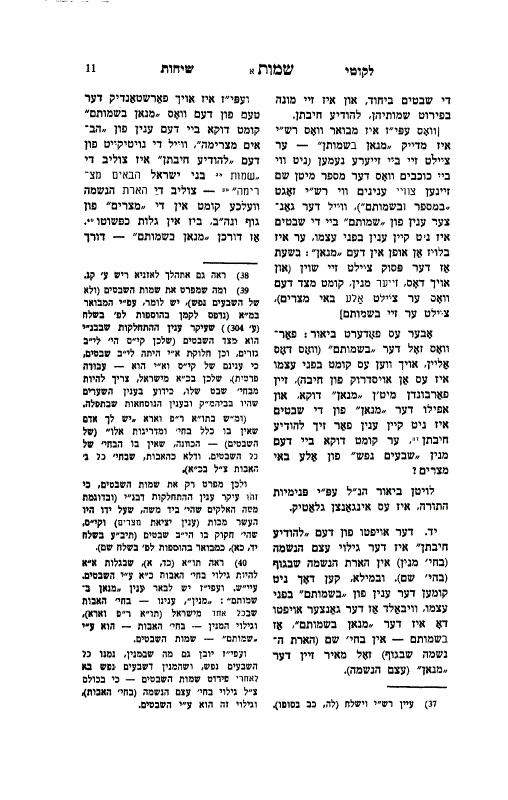
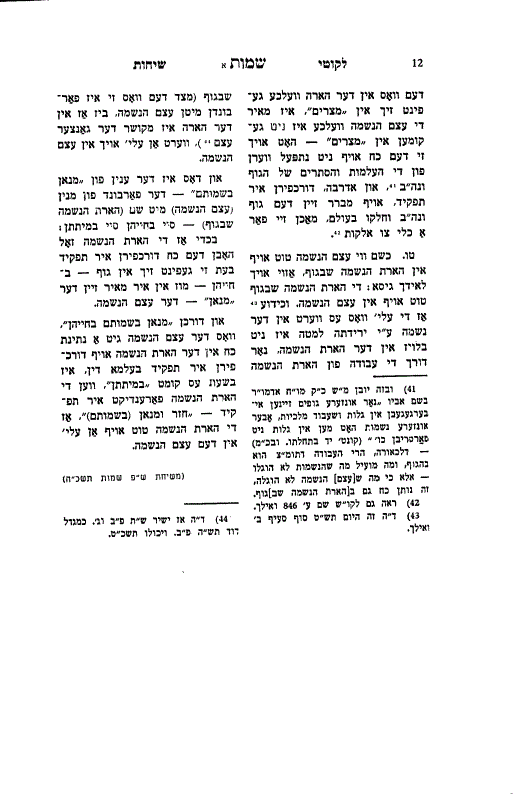
1. At the beginning of the parsha, Rashi comments on the words "And these are the names of the children of Israel" and explains: "Even though He counted them in their lifetime by their names, He counts them again after their death, to make known their dearness, for they are compared to stars, which He brings out and brings in by number and by their names, as it is said, 'He brings out their host by number; He calls them all by name.'" Although during their lifetime they were already counted by name, He counts them again after their death to show their dearness, because they are compared to stars, which the Almighty brings out and brings in with a number and a name, as it is stated, "He brings out their host by number; He calls them all by name."
As we learn in the simple meaning, with "He counts them again," Rashi means not the "children of Israel"—Jacob's sons—because their specific number is not mentioned in the verse, but rather Jacob's grandchildren and great-grandchildren who came to Egypt. They are all counted both in Parshas Vayigash and in our parsha—"All the souls of the house of Jacob who came to Egypt were seventy" and "All the souls that came out of Jacob's loins were seventy souls." Rashi explains that the reason they are counted here a second time is "to make known their dearness."
Accordingly, it is also understood why with "He counts them after their death," Rashi omits the word "by their names"—he writes it only with "He counted them in their lifetime"—because in our parsha, the names of all seventy souls are enumerated.
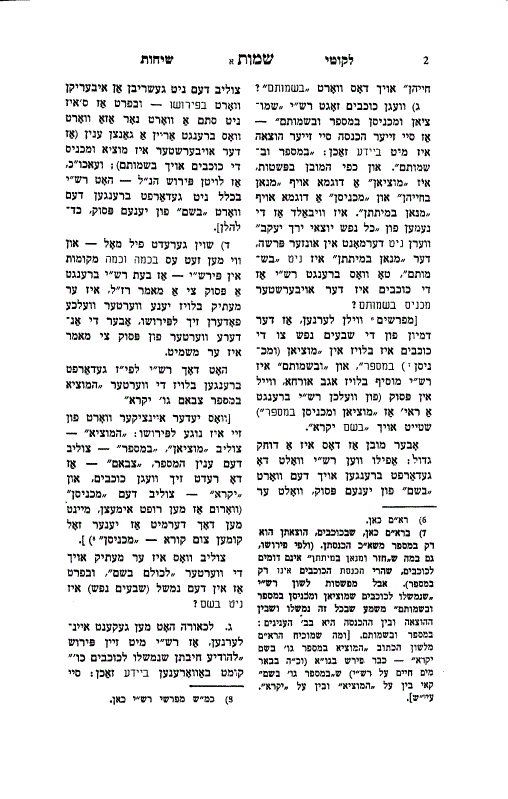
2. According to this, however, the entire explanation of Rashi is difficult from beginning to end. Since Rashi comes to explain what the verse repeats "in their lifetime," why does he also include the word "by their names"?
Regarding the stars, Rashi says, "He brings them out and brings them in by number and by their names." Both their bringing out and bringing in are with these aspects: by number and by their names. And as understood simply, "He brings out" is an example of "He counted them in their lifetime," and "He brings in" is an example of "He counts them after their death." Since the names of "all the souls that came out of Jacob's loins" are not mentioned in our parsha, the "He counts them after their death" is not "by their names." So why does Rashi bring that with the stars, the Almighty brings them in by their names?
(Some commentators want to explain that the comparison of the seventy souls to the stars is only in "He brings them out and brings them in by number," and "by their names" Rashi adds only incidentally, because in the verse (from which Rashi brings a proof) "He brings them out and brings them in by number" it also states "He calls them all by name.")
However, it is understood that this is a forced explanation: even if Rashi would...
...even if Rashi would have written an additional word in detail—and especially since it is not just any word, but a word that introduces an entire concept (that the Almighty brings out and brings in the stars also by their names)—all the more so, according to the aforementioned explanation, Rashi should have included the word "by their names" from that verse to clarify.
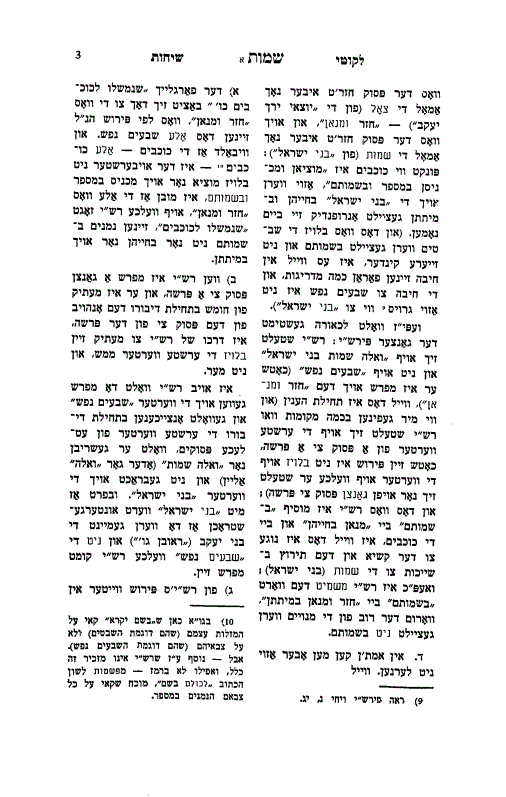
4. It has been discussed many times, as seen in various places in Rashi's commentary, that when Rashi cites a verse or a statement of our Sages, he only quotes the words necessary for his explanation, but omits the other words of the verse or statement.
According to this, Rashi should have only brought the words "He brings out by number their host, etc. He calls"—since each word is relevant to his explanation: "He brings out" because of "He brings them out," "by number" due to the concept of counting, "their host"—as the verse repeats the count (of those who came out of Jacob's loins)—"He counted them again," and also because the verse repeats the names (of the Children of Israel) just as with the stars, "He brings them out and brings them in by number and by their names," so too, the Children of Israel are counted in their lifetime and after their death, grouping them by name. (And the fact that only the tribes are counted by their names and not their children is because in affection there are several levels, and the affection for the seventy souls is not as great as for the Children of Israel.)
According to this, the entire Rashi commentary would seemingly fit: Rashi focuses on "And these are the names of the Children of Israel" and not on "the seventy souls" (although he also explains "He counted them again"), because this is the beginning of the matter (and as we find in several places where Rashi focuses on the first words of a verse or a parsha, even though his explanation is not only on those words).
5. The comparison "they are compared to stars, etc." relates to those who "He counted them again," which according to the simple explanation refers to all seventy souls. And since the stars—all stars—are brought out and also brought in by number and by their names, it is understood that all those who "He counted them again," about whom Rashi says "they are compared to stars," are counted by their names, not only in their lifetime but also after their death.
6. When Rashi explains an entire verse or a parsha, and he does not quote from the Chumash at the beginning of his commentary the beginning of the verse or parsha, it is Rashi's way to only quote the very first words. Therefore, if Rashi were explaining here also the words "seventy souls" and wanted to indicate at the beginning of his commentary the first words of certain verses, he would have written only "And these are the names" (or even just "And these").
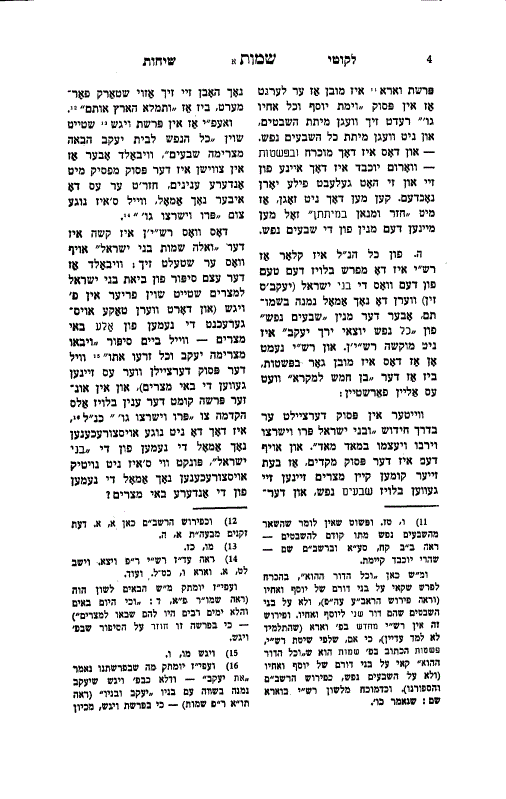
It is understood that Rashi elaborates on the verse "And Joseph died, and all his brothers, and all that generation" which speaks about the death of the tribes and gives the account of the death of all seventy souls. This is necessary and obvious, for Yocheved was one of them, and she lived many years afterward. Therefore, it cannot be said that "He counted them in their death" should refer to the count of the seventy souls, since not all of them died at that time.
Rashi explains only the reason why the children of Israel (Jacob's sons) are counted again by their names after they had multiplied so greatly, to the extent that "the land was filled with them." Even though in Parshas Vayigash it already states "All the souls of the house of Jacob who came to Egypt were seventy," since there is a verse in between that interrupts with other matters, it repeats it here again, as it is relevant to the "fruitful and multiplied" aspect of becoming a great nation.
Rashi's difficulty with "And these are the names of the children of Israel" is because the very story of the coming of the children of Israel to Egypt is already mentioned earlier in Parshas Vayigash (where indeed the names of all those who came to Egypt are listed — as the verse recounts "Jacob and all his seed with him came to Egypt"), and here in our parsha, this matter comes only as a preface to "they were fruitful and multiplied greatly." Therefore, there is no need to enumerate again the names of the "children of Israel," just as it is not necessary to recount the number.
On this, Rashi explains: "Even though they were counted in their lifetime by their names, He counted them again in their death" — that the reason why the children of Israel are counted again in the same manner (by their names) as they were in their lifetime is to make known their dearness, as they are compared to stars that He brings out and brings in by number and by their names. And since this applies only to the children of Jacob (as mentioned at the end of section 4), therefore, specifically they are counted by their names.
However, the question arises: According to the above explanation, it seems that Rashi is explaining only the reason why the verse enumerates the names of the "children of Israel," and not their number — because the count of Jacob's sons is not mentioned at all in this parsha. And regarding the fact that they are counted among all "seventy souls," this is not a question from the outset, as the number comes as a preface to "they were fruitful and multiplied."
Why then does Rashi say "He brings them out and brings them in by number and by their names" also regarding the stars? The explanation is as follows: When the verse recounts that the "descendants of Jacob" who came to Egypt were "seventy souls," it counts them as a separate matter. It counts them as the "houses" of the children of Israel; the "ones who came to Egypt" are the "children of Israel": Reuven, Shimon, etc. Since each of them came with his household, they total seventy souls.
Thus, the question arises: Why is the number "seventy souls" relevant in our parsha to bring out the feeling of "they were fruitful and multiplied" (since at the beginning they were only twelve, it does not bring out the "they were fruitful and multiplied" that occurred in Egypt, as they were coming to Egypt with only seventy souls)?
The verse should have simply stated briefly that those who came were seventy souls, or not mentioned the tribes at all (even without detailing their names). From the fact that the verse speaks of "all the souls that came from the loins of Jacob" as the houses of the tribes, it counts them (not the seventy souls themselves) as the twelve tribes, "each man and his household." This is proof that here it is relevant to count them individually. Therefore, Rashi says both their number and their names. This is "to make known their dearness," just as with the stars, which are brought in by number and by their names.
Rashi does not explain the reason for "He counts them in their death." If this is "to make known their dearness," he adds: "They are compared to stars, which He brings in and brings out by number and by their names," etc. When one learns Rashi at first glance, it seems that Rashi wants to bring a proof from the stars, or from natural things, where one brings in and takes out by—
5. Regarding Jews, the time of "they were afflicted"—they are compared to stars and also to dust. One must say that with "they are compared to stars," Rashi means (not just as a proof but also) a reason: because Jews are compared to stars, they have the same qualities as stars. Therefore, the expression of dearness to them through number and name is like stars, which "He brings in and brings out by number and by their names." And as mentioned above, that in their death it refers only to the children of Israel, this was before "a new king arose," and "as they were afflicted," they were then compared to stars.
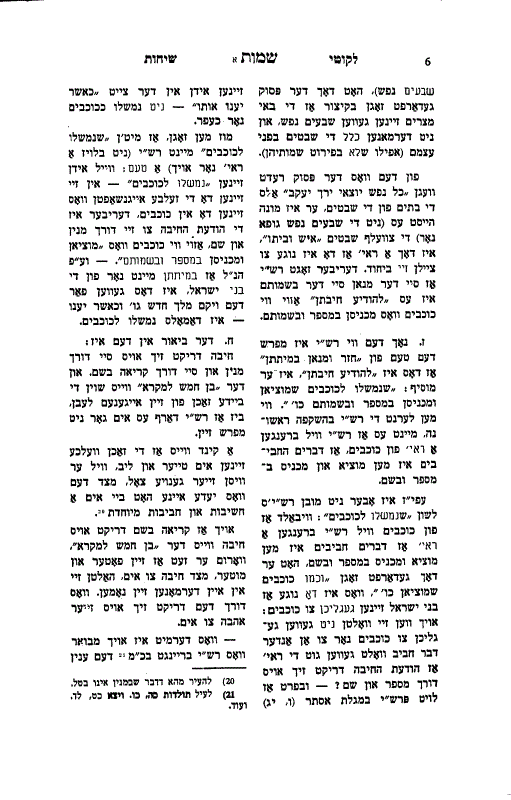
6. The explanation is: Dearness is expressed both through counting and through calling by name. A "five-year-old for Scripture" already knows these things from his own life, to the extent that Rashi needs to explain it to him very well.
A child knows that the things which are dear and beloved to him, he wants to call them by name and does not need to explain what is the importance in this. Furthermore, Rashi does not dwell on "and He said to him, 'I will be with you'" to explain what G‑d meant.
Since each matter—counting alone and name alone—expresses dearness, why is there the need to "make known their dearness" both through their number and through their names? The answer is that indeed, each additional action expresses more dearness. Therefore, Rashi adds an explanation: "They are compared to stars." Through this comparison, it is clear (as explained above—this is not a question), and each of the two matters—number and name—expresses a distinct aspect of dearness.
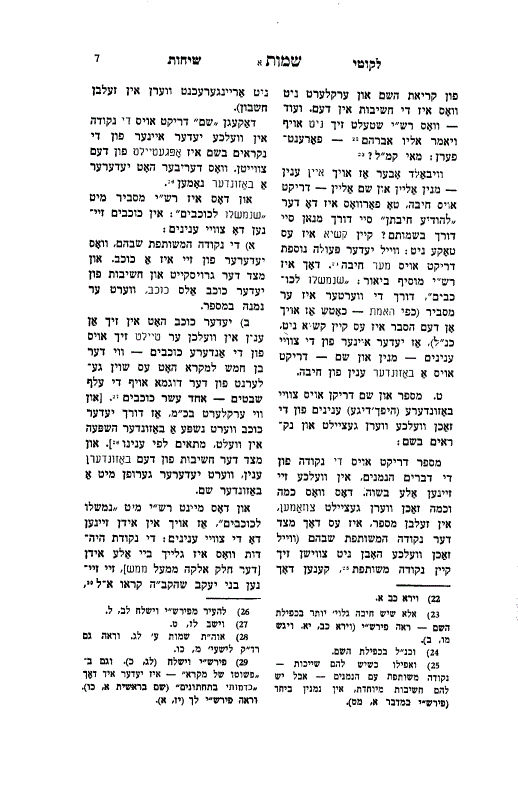
Number and name express two distinct (opposite) aspects of the things that are counted and called by name. Number expresses the point of the things being counted, it is their essence.
Number expresses the essence of the things being counted, and this is distinct from the aspect expressed by calling by name. Each one of those called by name is distinguished from the others. Therefore, each one has a unique "name," and this is what Rashi explains with "they are compared to stars": in stars, there are two aspects:
1) The common point among them, that each one is a star, and this expresses the greatness and importance of each star as a star, which is why they are counted. 2) Each star has within it a unique aspect, which distinguishes it from the other stars. The "five-year-old for Scripture" has already learned this from the example of the eleven tribes—"eleven stars" (as explained elsewhere, that through each star a unique influence is drawn into the world, according to its nature). And from the importance of the individual star:
Or the unique quality that exists in each Jew individually, and therefore the expression of dearness to Jews must be through both aspects: through "counting" the dearness to each Jew is shown from the point of their Jewishness, and through "their names," the dearness to each Jew is shown from their unique quality.
As in Rashi's commentary, there is also the "wine of Torah"—in this, that the "to make known their dearness" is expressed through "counting them by their names," there is a delightful aspect of the inner dimension of the Torah (and according to this explanation, many details which in simple terms are not so clear will become understandable).
Both "number and name" indicate the revealed aspects, which is why a person is called by the same name throughout their life, despite the various developments that occur in their revealed powers over the years of their life.
However, since the service of a Jew must be with their revealed powers, and the empowerment of these revealed powers to perform their service comes specifically through the illumination of their essence (as will be explained later, section 14), therefore, the "to make known their dearness," that the dearness from the essence, which is higher than revelation, should become known—should stand in revelation. And the revelation of the dearness from the essence comes through "counting them by their names"; through counting them and calling them by name in revelation, the essence (which is connected with number and name as mentioned above) is expressed in a revealed manner.
It is known that the essential love of parents for their children...
There is a parallel to this in the love and affection of parents for their children: the affection that parents express to their children by calling them by name (and especially through drawing a name out affectionately or giving them a nickname) is much deeper than the affection expressed by giving them a gift, speaking words of love, or even through hugging and kissing.
This is because giving a gift and speaking words of love depend on the age and understanding of the child: if one gives an adult a gift that is suitable for a small child, it will not express affection at all, but rather the opposite; and similarly, on the other hand, giving a small child a gift that is appropriate for an adult will not be an expression of affection.
And so it is also regarding words of love: only when the words of love are appropriate to the age and understanding of the child do they express affection.
And since a gift and words of love—the means through which affection is demonstrated—are measured according to the years and understanding of the child, it is understood that the affection expressed through these means is also measured. Consequently, it is not the essential love for the essence of the child, which is not measured according to their age, etc.
Even the love and affection expressed through hugging and kissing, which are applicable both to a small child and to an adult—nevertheless, since hugging and kissing are only applicable when the beloved is in proximity and close to the lover, it is a proof that they do not express the essential love itself, which is not limited or confined by place.
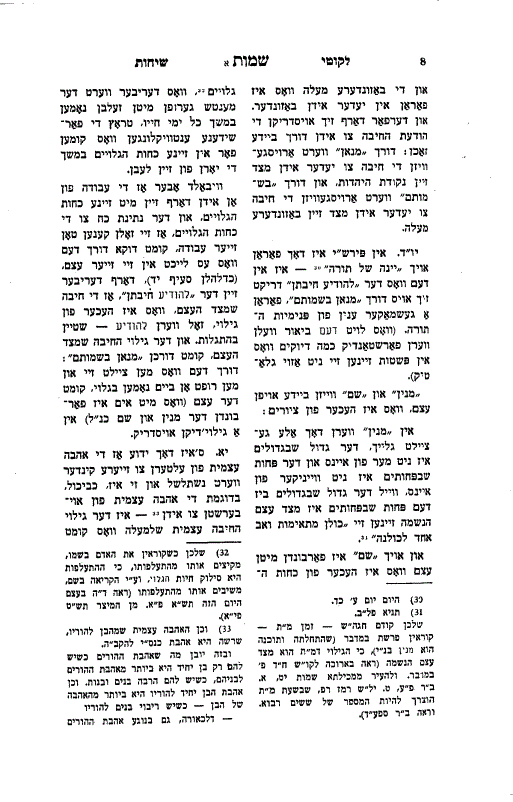
8. The majority of the time, when there is a distance from the beloved, without the illumination of the soul within the body, the essential connection to the essence of the soul is not apparent. Therefore, when one gives a gift or expresses affection according to the age and understanding of the recipient, it is a demonstration of love that is not intrinsic. However, when one mentions the names of the tribes in the Torah, it is an expression of essential love, which is not dependent on the recipient's age or understanding. This is because the mention of their names in the Torah is an expression of their intrinsic connection to G‑d, which transcends any external characteristics.
Even though both the counting and the mention of names are connected to the essence of the soul, there is a distinction between them. The counting is a separate matter, while the mention of names is an expression of their essential connection. This is why the Torah mentions the names of the tribes specifically in the context of their descent into Egypt, as it highlights their intrinsic connection to G‑d, which remains intact even in exile.
9. Based on this, we can understand why the mention of "their names" is specifically in the context of "coming to Egypt." The necessity of "to make known their dearness" is due to the challenges faced by the Jewish people when they descended into Egypt. This descent represents the soul's entry into the "Egypt" of the body and the animal soul, and even into literal exile. Through the counting "by their names," their intrinsic connection to G‑d is revealed, which transcends the limitations of exile.
The fact that within the illumination found in "Egypt," the essence of the soul, which did not descend into "Egypt," also possesses the power not to be affected by the concealments and obscurities of the body and the animal soul. On the contrary, it fulfills its role by refining the body, the animal soul, and its portion in the world, making them a vessel for G‑dliness.
10. Just as the essence of the soul influences the illumination of the soul within the body, so too, conversely, the illumination of the soul within the body influences the essence of the soul. It is known that the elevation that occurs in the soul through its descent below is only in the illumination of the soul, achieved through the service of the illumination of the soul within the body. Although our bodies are in exile and subject to challenges, our souls are not exiled. The work and perfection are in the body, and it benefits from the fact that the souls are not exiled.
This is because the illumination of the soul within the body is connected with the essence of the soul, to the extent that within the illumination, the entire essence is connected. Thus, there is an elevation also in the essence of the soul.
This is the concept of "counting by their names" — the connection of the essence of the soul with the illumination of the soul within the body — both in their lifetime and after their passing. In order for the illumination of the soul to have the power to fulfill its role while it is in the body — during their lifetime — the "counting" must illuminate within it — the essence of the soul.
And through the "counting by their names in their lifetime," where the essence of the soul gives strength to the illumination of the soul to fulfill its role in this world, it is understood that when it comes to "after their passing," when the illumination of the soul completes its role, "He counts them again (by their names)." The illumination of the soul causes an elevation in the essence of the soul.