
Likkutei Sichos Vol. 5 - Bereishis 2
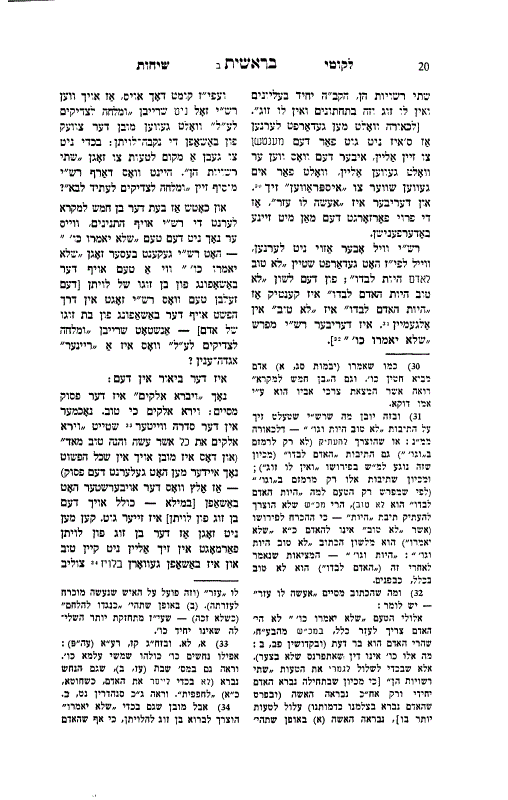
1. In the verse "And G‑d created the great sea creatures," Rashi comments on the word "sea creatures" without bringing the word "great" and explains: "large fish of the sea." This means that from the word "sea creatures" alone, we already know that they are large fish. However, this is not understood: from the fact that the verse adds the adjective "great" to "sea creatures," it seemingly indicates that there are different types of fish among the sea creatures, both large and small. So why does Rashi say that "sea creatures" are large fish?
2. After the explanation "large fish of the sea," which Rashi provides from the simple meaning of the text, he adds: "And in the words of Aggadah, it is the Leviathan." Why does Rashi bring the words of Aggadah here?
According to the "words of Aggadah" that Rashi adds, the question on the wording of the verse "the great sea creatures" in relation to his explanation "large fish" becomes even stronger:
If Rashi had not brought the "words of Aggadah," one could have learned (with difficulty, at least) that with the explanation "large fish," Rashi only intends to provide a sign for the fish called "sea creatures," indicating that they are large.
And then the question of "the great sea creatures" would not have been so strong, because we find similarly in other places where the verse adds an adjective to a certain word only to emphasize the matter that the adjective brings out.
However, if "sea creatures" means large fish, it is difficult: if "sea creatures" alone means large, then there is no place to add "great" after the word "sea creatures."
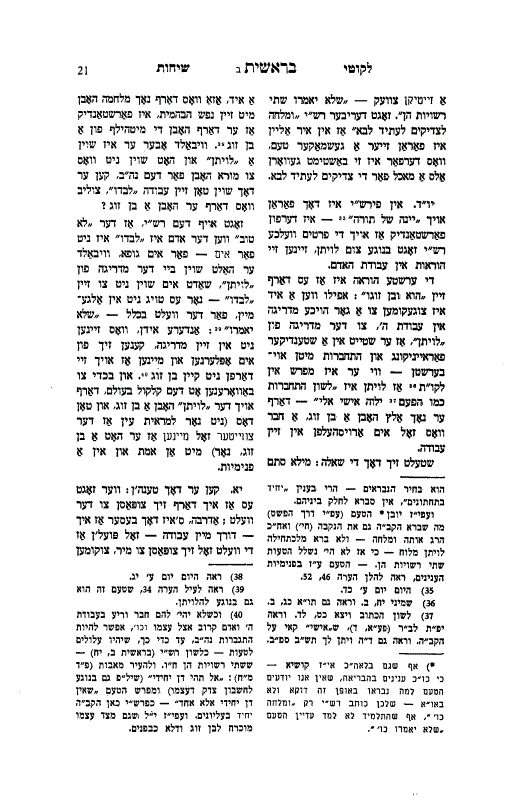
3. After Rashi brings the explanation from Aggadah that "sea creatures" refers to the Leviathan, he adds "and its mate" — meaning that "sea creatures" refers not only to the male Leviathan but also to its mate. He then quotes further words from Aggadah: "He created them male and female, and He killed the female and salted it for the righteous in the future, for if they were to be fruitful and multiply, the world could not endure before them." Rashi concludes: "It is written 'sea creature' in the singular," which explains why it is written "sea creature" without a yud, in the singular form, because after G‑d killed the female Leviathan, only one sea creature remained. It is not understood: to explain what type of fish is meant by "sea creatures," it is enough to say "it is the Leviathan." Why does Rashi also quote the further words of Aggadah?
4. The difficulty with the word "sea creatures" is as follows: From the reading "sea creatures" (with a yud) in the plural form, and also from the phrase "the great sea creatures," it is clear that it refers to more than one creature. So why is it written "sea creatures" (without a yud) in the singular form?
To answer this question, Rashi brings the words of the Aggadah, explaining that "sea creatures" indeed means plural — two: "the Leviathan and its mate." Nevertheless, it is written "sea creatures" in the singular because "He killed the female," leaving only one creature.
However, in truth, one cannot learn it this way. When Rashi explains why a certain word is "deficient" (missing a letter), his usual approach is to answer a question that a child would naturally ask; Rashi does not need to point out the question to him.
But since in "sea creatures" there is also the difficulty of it being deficient, only after Rashi brings the words of the Aggadah and answers the obvious question does he add "it is written 'sea creatures'" — that through the words of the Aggadah, the question of why "sea creatures" is written without a yud is also answered.
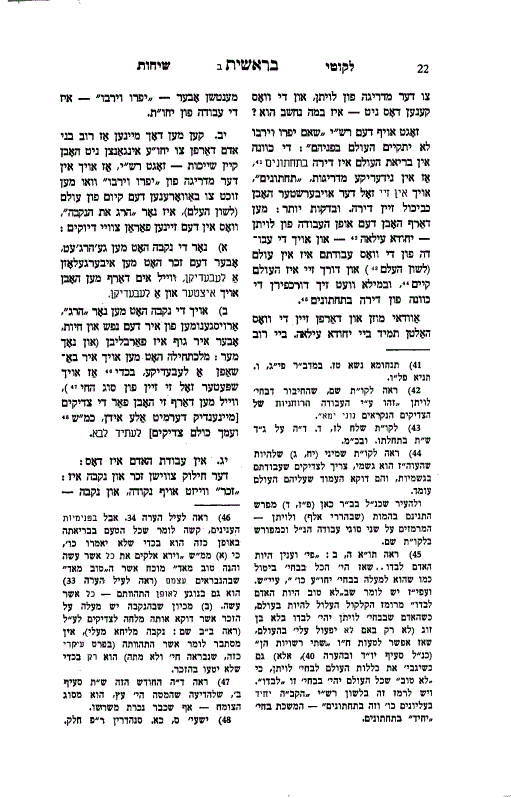
5. The explanation in this: After the words "And G‑d created the great sea creatures," it states "and every living creature that moves, which the waters brought forth." It becomes difficult: In "every living creature," sea creatures are also included [as is evident from the fact that in the previous verse it states only "let the waters bring forth abundantly the moving creature that has life," which includes all species, including sea creatures, without mentioning them separately]. Therefore, it would have been sufficient to state "And G‑d created every living creature." Why are "the sea creatures" singled out?
On this, Rashi explains "sea creatures — large fish" — that the reason sea creatures are counted separately is because they are "large fish."
The child, however, argues: Among the other fish, there are also various types: smaller and larger, and yet they are all included in "every living creature." So why, because the sea creatures are even larger, should they be counted separately?
To this, Rashi brings that by "sea creatures" is meant the Leviathan fish, which is known (even among children) for its extraordinary size. Since the magnitude of the Leviathan is entirely of a different kind, which is not at all similar to the size of all other types of fish, therefore it is counted separately.
6. When Rashi writes "and in the words of Aggadah it is the Leviathan," he must immediately add "and its mate." This is because in the Aggadah at this location, it states that the Leviathan does not have a mate; therefore, it says "the sea creatures" in the singular form.
However, it immediately becomes difficult: From the phrase "the great sea creatures" (read as plural), it is clear that it refers to more than one creature. So how can one interpret according to the straightforward meaning that "the sea creatures" refers to a single Leviathan?
Therefore, Rashi adds "and its mate," indicating that he refers to the Aggadah from another place, which states that "the sea creatures" are two — "the Leviathan and its mate."
7. All species that the Almighty created must also exist now, unless there is a special reason — as explained here in Rashi. Therefore, when the five-year-old studying scripture learns that the Almighty created the Leviathan and its mate, he might make an error in the straightforward understanding of the verses, thinking that (the female Leviathan also exists now and) the verse that follows, "He blessed them," refers also to the Leviathan — as the straightforward meaning of the text suggests.
8. Therefore, Rashi warns, "He created them male and female and killed the female" — meaning that with "And G‑d created the great sea creatures," it indeed refers to two creatures: "male and female." However, subsequently, "He killed the female," and thus only one Leviathan remained.
9. When Rashi brings "and killed the female," he must also add [not only the reason for "and killed" — "so that they should not multiply and the world could not endure them," but also] "and salted it for the righteous in the future." This is because it is entirely unclear why there was a need to create its mate if it was destined to be killed.
10. At first glance, one might ask: In the verse "It is not good for man to be alone," Rashi explains: "So that they should not say...
A second purpose — "so that they should not say there are two authorities." Therefore, Rashi says, "and salted it for the righteous in the future," indicating that within it lies a very delightful reason, which is why it was designated as food for the righteous in the future.
11. In Rashi's commentary, there is also "the wine of Torah" — from this, it is understood that even the details Rashi mentions regarding the Leviathan are lessons in the service of man.
The first lesson is that there must be "him and his mate": Even when a Jew reaches a very high level in the service of G‑d, to the level of "Leviathan," where he stands in constant union and connection with the Almighty — as explained in Likutei Torah that Leviathan is "a term of connection, as in 'this time my husband will be joined to me'" — he still needs a mate, a companion to assist him in his service.
This raises the question: Granted, in general...
12. A Jew who still needs to battle with his animal soul understands the necessity of having the assistance of a partner. However, once he has reached the level of a "Leviathan" and no longer fears his animal soul, he might think he can perform his service "alone." Why, then, does he need a partner?
Rashi explains that the "not good" when man is "alone" is not for his own sake — since he has already reached the level of "Leviathan," being "alone" does not harm him. Rather, it is not suitable in general, for the world at large — "so that they should not say": Other Jews, who are not on his level, might learn from him and think that they too do not need a partner. To prevent this potential harm in the world, even the "Leviathan" must have a partner and do so genuinely and internally, not merely for appearances so that others think he has a partner.
13. He might argue: Who says I need to conform to the world? On the contrary, it is better that through my service, I should influence the world to conform to me, to reach the level of "Leviathan." However, it is "not good" for the entire world to be in this state of "alone." There is an allusion to this in Rashi's wording: "The Holy One, blessed be He, is unique in the upper realms, and this is in the lower realms" — drawing down the aspect of "unique" into the lower realms.
14. However, in the inner dimensions of the matter, it is difficult to say that the entire reason for its creation in such a manner is merely so that "they should not say," because (a) the verse "And G‑d saw all that He had made, and behold, it was very good" proves that the "very good" within the creations themselves is also regarding the manner of their existence.
Regarding expansion: (Just as in the matter of birth, where from the father comes only a drop — a point, and through the fact that the drop remains for nine months in the mother's womb, it becomes detailed — expanded). This is also understood concerning the Leviathan, that the male represents the point of the higher unity (Yichuda Ila'ah), and the female — the expansion of the higher unity.
And these are the two lessons — for the majority of people — from the aforementioned two nuances:
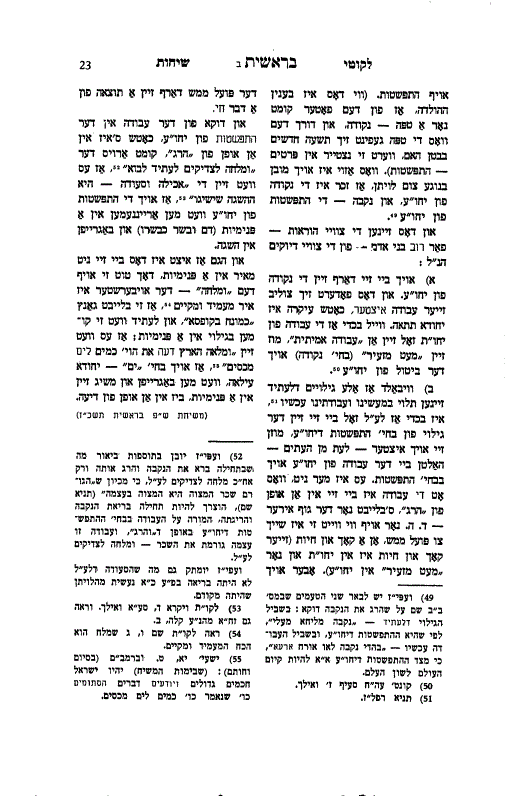
(a) They too must have the point of the higher unity. This is required for their service now, even though its primary focus is the lower unity (Yichuda Tata'ah). Because in order for the service of the lower unity to be a "true service," there must be "a little bit" (a point) of the nullification of the higher unity.
(b) Since the actual effect must be a result of a living thing. And specifically from the service in the expansion of the higher unity, even though it is in a manner of "slaughter," comes the "and salted for the righteous in the future," that there will be the "eating and feast — which is the comprehension they will attain," that even the expansion of the higher unity will be internalized (blood and flesh as one's own flesh) and comprehended in understanding.
And although now it does not illuminate within them internally, it still accomplishes the "and salted" — the Holy One, blessed be He, sustains and maintains it, so that it remains whole "as if placed in a box," and in the future, it will be revealed internally; that "the earth will be filled with the knowledge of the L‑rd as the waters cover the sea," that even the aspect of "sea" — the higher unity, will be comprehended and grasped internally, to the extent of knowledge.