


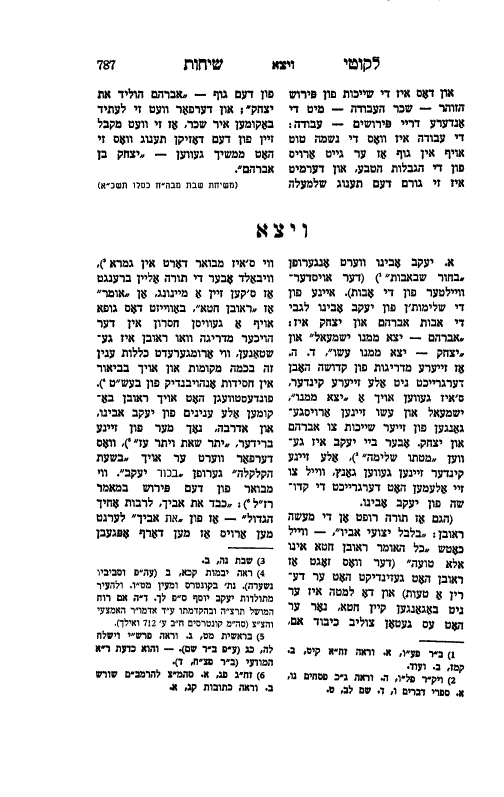


Parshas Toldos
1. On the verse "ואלה תולדות יצחק בן אברהם אברהם הוליד את יצחק" ("These are the generations of Yitzchak the son of Avraham; Avraham begot Yitzchak"), the commentators on the Torah ask: after it says "These are the generations of Yitzchak the son of Avraham," why does it need to repeat "Avraham begot Yitzchak"? It is a redundancy!
Various answers are given to this. Some of them:
(a) The Gemara (and Midrash) says1 that because "היו כל אומות העולם מרננים ואומרים" ("all the nations of the world were murmuring and saying") — all the nations of the world murmured and said that Yitzchak was not Avraham's son — G‑d therefore made the appearance of Yitzchak's face exactly like the face of Avraham, and everyone saw that Yitzchak was Avraham's child. And this is what the verse means: "Yitzchak the son of Avraham," because there is proof of this, and everyone bore witness that "Avraham begot Yitzchak."
(b) The Midrash says2 on this: "יצחק נתעטר באברהם ואברהם נתעטר ביצחק" ("Yitzchak was crowned through Avraham, and Avraham was crowned through Yitzchak") — both "Yitzchak the son of Avraham," that Yitzchak was crowned, took pride, in his father Avraham; and "Avraham begot Yitzchak," that Avraham was crowned and took pride in his son Yitzchak.
(c) In Chassidus it is explained3 that the avodah of Avraham was in the line of Chesed and love, and the avodah of Yitzchak was in the line of Gevurah and fear. Each line of avodah — both the avodah of love and the avodah of fear — divides into two general levels. There are two levels in fear: yirah tata'ah (lower fear) and yirah ila'ah (higher fear). Lower fear, the lower level of fear, means being afraid to act against G‑d's will because of the punishment for the sin, or even for a loftier reason — but always because he fears the harm that the sin will bring upon him. Higher fear, the higher level of fear, means yiras haromemus (awe of G‑d's exaltedness): he is afraid and ashamed before the exaltedness and greatness of G‑d to commit any sin; that is, he fears the sin itself, because it is against G‑d's will. Likewise there are two levels in love — ahavah rabbah (great love) and ahavah zuta (lesser love). Lesser love, the smaller level of love, means that he loves G‑d and fulfills His will because it is good for him — good materially, or something more refined than that, up to the ultimate in spirituality. Great love, the lofty level of love, is that he loves G‑d and does His will "שלא על מנת לקבל פרס" ("not for the sake of receiving a reward"), not because of the good that will come to him from it.
And since "מעשה אבות סימן לבנים" ("the deeds of the fathers are a sign for the children")4 — in the avodah of every Jew — the Torah indicates: twice Avraham — two levels in love; twice Yitzchak — two levels in fear. The order of avodah in both lines is that first come the lower levels, lesser love and lower fear, and afterwards great love and higher fear (as the Gemara says5: "לעולם יעסוק אדם בתורה ובמצות אפילו שלא לשמן" ("A person should always occupy himself with Torah and mitzvos, even not for their own sake") — a person should always study Torah and fulfill mitzvos even not for their own sake, which means for his own benefit — lesser love and lower fear; "שמתוך שלא לשמן בא לשמן" ("for out of [doing them] not for their own sake, he comes to [do them] for their own sake"), because from this he will come to higher levels — great love and higher fear). And the order of the verse also indicates this order in avodah: fear (lower), love (lesser), love (great), fear (higher) — as is explained at length in several places6.
And this is a directive to every Jew in the service of G‑d: he must serve G‑d in both lines, love and fear7 — Avraham and Yitzchak — as is known the explanation of the saying of our Sages, "אין קורין אבות אלא לשלשה" ("Only three are called 'Fathers'")8: Avraham, Yitzchak and Yaakov are the fathers of all Jews, and their lines of avodah must be present in every Jew.
The avodah of each of the twelve tribes need not be present in every Jew; a Jew has his own avodah, suited to the tribe from which he descends. But the avodah of all the Avos must be present in every Jew. If a Jew acts only in one line, love or fear, it may be that this is not because of avodah, but because by his nature9 he is inclined to kindness or to severity. The directive is that there must be avodah10, and that is by acting in both lines and on all levels.
(d) In the Midrash HaNe'lam, in the Zohar11, it says that Avraham alludes to the soul (just as it explains there in the Zohar12 the section about Sarah's passing as an allusion to the body: "ותמת שרה" ("And Sarah died") — the body died. And the death of the body is that the "קרית ארבע" ("Kiryas Arba"), the four elements of which the body is composed, become separated from one another, whereas while being "בארץ כנען" ("in the land of Canaan"), in this world, they were "היא חברון" ("that is Chevron") — joined together (mechubar). "ויקם אברהם מעל פני מתו" ("And Avraham rose up from before his dead") — this is the soul, which is above death and separation), and Yitzchak, from the term tzechok (laughter) and delight, refers to the delight that the soul will have in the Time to Come. And the Zohar explains the meaning of the verse "Yitzchak the son of Avraham": in the future, the soul, "Avraham," will merit the revelation of delight, "Yitzchak." How will it merit this? Through the fact that "Avraham begot Yitzchak" — the soul, through its avodah in this world, has begotten (brought about) the delight, and this very delight will be revealed to it in the Time to Come.
2. It has already been discussed that when there are various explanations by our Sages on one and the same verse, they all have a connection with one another; they are not entirely separate matters.
Among the proofs of this: our Sages expound13 that the word "שעטנז" (shatnez) means "שוע" (smoothed, combed), "טווי" (spun) and "ונוז" (and woven). And the Gemara says14 that since the Torah included these three things, "shua, tavui, venuz," in the one word "shatnez," this proves that they are all bound up with one another; therefore one is not liable (by Torah law) for shatnez (wool and linen together) when only one or two of the three conditions are present, but only when all three are together. We see from this that three matters, even when they are derived from separate letters, since they stand in one word, have a bond between them. All the more so in our case, where all four explanations are alluded to in the very same letters — they surely have a connection with one another. We must therefore understand how the four above-mentioned explanations are connected with one another.
All the stories of the Torah are, after all, a directive for us in our avodah15. According to the explanation of Chassidus, the directive for us is understandable, as said above: every Jew must have both lines of avodah, love and fear, and [we are taught] how they must be. According to the explanation of the Zohar, too, it is understandable why the Torah tells us "Yitzchak the son of Avraham, Avraham begot Yitzchak": because it is relevant for us to know that the soul, through its avodah, draws down delight, and that the delight that is drawn down now will be revealed in the future — and this knowledge of the reward for a mitzvah increases and adds extra vitality to our avodah.
We must, however, understand: what is the directive for us from "Avraham begot Yitzchak" according to the explanations of the Gemara and the Midrash? What concern is it of ours that in Avraham's generation the nations of the world claimed that Yitzchak was not Avraham's son (for which reason G‑d ensured that Yitzchak's "קלסתר פנים" ("facial features") would resemble Avraham's)? And also, what do we learn from the fact that Yitzchak took pride in Avraham and Avraham took pride in Yitzchak?
3. According to both explanations, of the Gemara and of the Midrash, the verse is speaking of matters that are above nature. According to nature Avraham could not have a child, and the limitation of nature was not only that, because of his physical body, he was sterile16; the heavenly constellations, too, showed that it was impossible for him to beget a child. That is why it says17: "ויוצא אותו החוצה" ("And He took him outside"), and as our Sages explain18: "צא מאיצטגנינות שלך" ("Go out of your astrology") — in order for Avraham to be able to have children, G‑d took him out above the limitations that come from the constellations. Likewise, the fact that Avraham could take pride in the greatness of Yitzchak was a supernatural matter, because according to nature the generations become ever lower, as our Sages say19: "אם ראשונים בני מלאכים, אנו בני אנשים וכו'" ("If the early generations were like angels, we are like men, etc."). That Avraham took pride in Yitzchak — who was a generation later, and yet had such qualities that brought completeness to the level of Avraham (which is the meaning of "Avraham was crowned through Yitzchak," just as a crown makes the one who wears it more beautiful) — is something above nature.
And this is also the directive for us: every Jew must know that Jews are not subject to the limitations of nature — not only in spiritual matters, but also in material matters.
Spiritual offspring Avraham had even before Yitzchak was born, as our Sages say20: "תולדותיהם של צדיקים מעשים טובים" ("The offspring of the righteous are their good deeds") — and especially according to what is explained in Kabbalah21, that from every union conducted in a holy manner, according to Torah, holy spiritual offspring are born. The birth of Yitzchak accomplished that even with regard to physical offspring, Avraham is not bound by the laws of nature.
And here come the "ליצני הדור" ("scoffers of the generation")22 (the opponents of holiness23 found in every generation) and argue to a Jew: Granted, in spiritual matters you can accomplish things, because they are not subject to the laws of nature; but when it comes to material matters, physical offspring, you cannot have them unless you subject yourself to Avimelech, the king and ruler of the land — "מאבימלך נתעברה שרה" ("Sarah conceived from Avimelech") — through whom all material influences pass. — True, they only pass through him, but nevertheless they pass through him24.
"מה עשה הקב"ה" ("What did the Holy One, blessed be He, do?") — "צר קלסתר פניו של יצחק דומה לאברהם" ("He formed Yitzchak's facial features to resemble Avraham's"), and everyone saw and bore witness that "Avraham begot Yitzchak": that even offspring and influences in material matters a Jew receives not, G‑d forbid, from Avimelech, but from Avraham — from the soul (as in the explanation of the Zohar). If a Jew awakens the powers of the soul and takes no account of any obstacles from the body and the animal soul, then even his bodily and material matters are not subject to the laws of nature.
4. This also explains what my father-in-law, the Rebbe [the Previous Rebbe], said25: "...All the nations on the face of the earth must know that only our bodies have been handed over to exile and to the subjugation of the kingdoms, but our souls were not driven into exile and were not handed over to the subjugation of the kingdoms. We must declare openly, before all eyes, that in all that concerns our religion — Torah, mitzvos and the customs of Israel — we Jews have no one who dictates to us, and no coercive force whatsoever may be used against it."
At first glance these words of the Rebbe need to be understood: the soul is, after all, enclothed in a body, and it must fulfill Torah and mitzvos with the body and through the body, in the physical world. So how does it help us that the souls were not driven into exile, when the bodies are indeed in exile? But as said above, the arousal of the soul brings about that even the matters of the body are not driven into exile and are not handed over to the subjugation of the kingdoms. And this must be in a manner that is "גלוי לעין כל" ("open before all eyes") — as the Rebbe says in his words: "All the nations on the face of the earth must know" — to the point that even the scoffers of the generation admit that Avimelech has no mastery whatsoever over a Jew's influences, not even in material matters.
5. In light of the above, we will also understand the connection between all four explanations — of the Gemara, the Midrash, the Zohar and Chassidus.
Gemara is the revealed part of the Torah; therefore the Gemara explains the verse with regard to the open, physical matters as they are in this world. Since here there can be room for the claim of the opposing side — of the "scoffers of the generation" — the Torah informs us that a Jew is not bound by the limitations of nature even in his material matters.
Midrash (Aggadah)26 is an intermediary between the revealed part of the Torah and the inner part of the Torah; the Midrash therefore speaks of the same matter, but also in a higher way: how a Jew is not limited by nature in the spiritual levels of the order of Hishtalshelus (the chain of descending worlds). In the order of the generations, each successive generation's spiritual level is diminished — as is also the case in the general order of Hishtalshelus, where the further down one goes, each level is lower than the one before it. But among Jews the order is "עטרת זקנים בני בנים וגו'" ("The crown of the elders is their grandchildren, etc.")27 (the crown of the elders is their children's children); and a crown, after all, is above the head. This means that among Jews the children add elevation to the fathers — and that is above the measure and limitation of the order of Hishtalshelus.
(And therefore the Midrash, according to the second explanation, does not address the claim of the opposing side, because the Midrash here speaks of the levels in spirituality, where from the outset there is no room for the claims of the opposing side; consequently there is no need to refute it.)
Chassidus, whose purpose is to explain the paths of avodah, here too explains the order of avodah by which one can reach and stand above nature and above the order of Hishtalshelus: when a Jew serves G‑d with both attributes, love and fear together — through which he changes the established nature of the attributes, for only in the service of G‑d can this be28, whereas by nature the attributes of love and fear cannot exist together — then, if one conducts himself according to the directive of the explanation of Chassidus to go out of the nature of one's attributes, he is also granted influence from Above in a manner above nature in all matters: both in the spiritual levels (as in the explanation of the Midrash) and in material things (as in the explanation of the Gemara).
The Zohar, which is the hidden part of the Torah, explains matters as they will be in the future, and it says that (through the avodah of "Yitzchak the son of Avraham, Avraham begot Yitzchak," according to all three explanations mentioned above) a Jew merits the Supernal delight.
6. The explanation29 of "שכר מצוה מצוה" ("the reward of a mitzvah is the mitzvah") is well known: the reward of a mitzvah is the mitzvah itself; that is, the reward for mitzvos is not some other thing that will come as a payment for the mitzvos, but the reward will be the mitzvos themselves, as they will be revealed in the future. In light of this, the connection between the explanation of the Zohar, which speaks of the reward for avodah, and the three preceding explanations, which speak of the avodah itself, is even more understandable — because "the reward of a mitzvah is the mitzvah."
7. In Chassidus is explained the reason why, when Yitzchak was born, it says30 "צחוק עשה לי אלקים" ("G‑d has made laughter for me"): the Name Elokim indicates concealment, as it says31 "כי שמש ומגן הוי' אלקים" ("For the L‑rd G‑d is a sun and a shield") — the two Names Havayah and Elokim are compared to a sun and a shield: Havayah is the sun, and Elokim is like the shield that covers over the sun, because "Elokim" has the numerical value of "הטבע" (nature)32, and nature conceals G‑dliness. And this is the meaning of "G‑d (Elokim) has made laughter for me": through refining the things that are concealed in nature (numerically equal to Elokim), laughter and delight come about Above, because thereby the Supernal intention of a dwelling place in the lower realms is fulfilled.
Man is created in the Supernal image and likeness; so too in man below there is a soul with a body, which are a reflection of Havayah and Elokim33. The soul corresponds to Havayah, and the body, which conceals the soul, corresponds to Elokim. And the laughter and delight Above come specifically from the refinement of the body, because it is in the body that the [Divine] intention is fulfilled.
And because the main intention is to refine the body, therefore in the future the body will be higher than the soul, and the soul will receive from the body34 — not like today, when the body receives from the soul. But because the soul refines the body, it too will therefore receive its reward: it will receive from the Supernal delight that it brought about through its avodah in the body35.
And this is the connection between the explanation of the Zohar — the reward for avodah — and the other three explanations — avodah: the avodah is what the soul accomplishes in the body, in that it goes out of the limitations of nature, and thereby it brings about the Supernal delight from the body — "Avraham begot Yitzchak." And therefore in the future it will receive its reward: it will receive from this very delight that it drew down — "Yitzchak the son of Avraham."
(From the sichos of Shabbos Mevarchim Kislev, 5721)
Notes
1) Bava Metzia 87a. Tanchuma, Toldos 1; cited in Rashi at the beginning of Parshas Toldos. Explained in Ohr HaTorah, beginning of Parshas Toldos.
2) Tanchuma, Toldos 4. Similarly in [Bereishis] Rabbah, beginning of Toldos.
3) Ohr HaTorah, ibid. (In a different manner: in Torah Ohr, Toldos; and [the maamar of] 5608, ibid.)
4) See above, Parshas Lech Lecha, and the sources noted there.
5) Nazir 23b, and the sources cited there. Rambam, Laws of Torah Study 3:5; Laws of Teshuvah 10:5. The Alter Rebbe's Laws of Torah Study 4:3. Tanya, end of ch. 39.
6) See Tanya ch. 43, and elsewhere.
7) Tanya ch. 41.
8) Berachos 16b. See also Torah Ohr, beginning of Parshas Va'eira. And see also Likkutei Sichos vol. 4, Parshas Balak, p. 1068, note 12.
9) See Torah Ohr, Toldos 19c.
10) See Tanya ch. 15.
11) Vol. I, 135a.
12) [Zohar I,] 122b. See also Responsa of the Rashba, §418. The maamar beginning "Rabbi Bena'ah" (printed in Ohr HaTorah, Chayei Sarah (119b ff.; 442b ff.)), in Kuntres Maamarei HaTzemach Tzedek (no. 22).
13) Kilayim 9:8.
14) Niddah 61b. Explained in the Responsa of the Tzemach Tzedek, Shaar HaMiluim, §38. And see the Tzemach Tzedek's "S.S.D." [abbreviation as printed] (Likkutei Dinim, §300).
15) Zohar III, 53b.
16) Yevamos 64a.
17) Bereishis 15:5.
18) Shabbos 156a.
19) Shabbos 112b.
20) Rashi, beginning of Parshas Noach. Bereishis Rabbah 30:6.
21) See Ohr HaChamah on Zohar III, 90a. Shaar HaMitzvos, Parshas Bereishis.
22) Rashi, beginning of Parshas Toldos.
23) Yoma 35b, end.
24) See Iggeres HaKodesh, ch. 25.
25) 3 Tammuz 5687; printed in Likkutei Dibburim vol. 4, 692a; Sefer HaSichos 5687, p. 169; and elsewhere.
26) See Iggeres HaKodesh, end of ch. 23. Likkutei Torah, Vayikra (5d). Ohr HaTorah, Bo, on the verse "Ulekachtem" (p. 302).
27) Mishlei 17:6. Cited in Tanchuma, ibid.
28) Sifri, Devarim 6:5.
29) Avos 4:2. See Tanya ch. 39. Hayom Yom, 25 Iyar and 5 Cheshvan.
30) Bereishis 21:6. Torah Ohr, Toldos, the second maamar beginning "Mayim Rabbim."
31) Tehillim 84:12.
32) Pardes, Shaar 12, ch. 2. And in the Shelah, Shaar HaOsiyos, the letter Kuf (Kedushah), in the gloss beginning "Vehinei mosif al harishonos" (140a), it is somewhat implied that this is found in the Zohar.
33) See Shaar HaYichud VehaEmunah, ch. 6.
34) See the maamar beginning "Lechol Tichlah," 5659. Toras Shmuel, p. 127. "Mayim Rabbim" 5717 (in Sefer HaMaamarim Meluket, vol. 1).
35) Like the avodah of joy now (which is a reflection of, and brings about, the delight of the Time to Come): although it must be felt in the physical body, it nevertheless comes specifically from the side of the soul [OCR unclear: the source reads "הגשמה"] (for his body is despicable and loathsome in his eyes, and his joy is the joy of the soul alone (Tanya ch. 32)), and it draws the joy into the body.
Key Lesson
A Jew is not bound by the limitations of nature — not in spiritual matters, and not in material ones either. When a Jew serves G‑d with both love and fear, rising above his natural temperament, G‑d grants him blessing beyond nature in every area, and his work in refining the body brings about the Supernal delight that will be fully revealed in the Time to Come.